One morning your baby grins and there it is: a tiny white edge in the lower gum. Or perhaps your 11-month-old is still all gums while somebody else's younger baby already has four teeth.
Both can fit normal development.
Most babies start teething at around 6 months, but some begin before 4 months and some after 12 months. Teeth tend to follow a recognisable order, with front teeth followed by molars and canines, but the calendar varies widely.
> The usual order is: central incisors, lateral incisors, first molars, canines, then second molars. Lower front teeth commonly appear before their upper partners. Most children have all 20 milk teeth by about 2 to 3 years old.
Baby teeth order at a glance
| Tooth group | Typical eruption window | What you may notice | |---|---:|---| | Lower central incisors | 6–10 months | The two bottom front teeth are often first | | Upper central incisors | 8–12 months | The two top front teeth create the familiar four-tooth smile | | Upper lateral incisors | 9–13 months | Teeth appear beside the upper central pair | | Lower lateral incisors | 10–16 months | The lower front row widens | | First molars | 13–19 months | Broad back teeth arrive before the canines in many children | | Canines | 16–22 months | Pointed teeth fill the spaces between incisors and molars | | Second molars | 23–33 months | The final four milk teeth usually complete the set |
These are the broader orientation windows used in OBubba, not NHS deadlines. The NHS teething guide gives a simpler rough sequence: central incisors around 6 months, lateral incisors around 8 months, first molars around 12 months, canines around 18 months and second molars around 24 months.
Neither chart is an appointment. A tooth may arrive earlier, later or in a slightly different order without meaning anything is wrong.
The complete journey from first tooth to 20
Babies eventually develop 20 milk teeth: 10 in the upper jaw and 10 in the lower jaw.
Stage 1: lower central incisors
The lower middle pair often breaks through first, commonly between 6 and 10 months. Sometimes one leads and its partner follows days or weeks later.
These small cutting teeth help with biting soft foods, but a baby does not need teeth before beginning suitable solids. Gums can mash many soft textures surprisingly well.
Stage 2: upper central incisors
The upper front pair commonly arrives between 8 and 12 months. This is often when the new-tooth smile becomes obvious in photographs.
The order can reverse: some babies get an upper tooth first. That is a variation, not a failed milestone.
Stage 3: lateral incisors
Lateral incisors sit beside the central teeth. The upper pair often appears around 9 to 13 months, while the lower pair commonly follows around 10 to 16 months.
By the end of this stage, a child may have eight front teeth. They may also have a gap between the upper central teeth. Spacing in milk teeth is common and leaves room for larger adult teeth later.
Stage 4: first molars
First molars usually appear around 13 to 19 months. They sit farther back, leaving a temporary gap where the canines will eventually emerge.
Molars have a broader surface and can feel like a bigger teething event for some children. Others show almost no sign until the tooth is visible.
Stage 5: canines
Canines, the pointed teeth between lateral incisors and molars, sit in OBubba's broad 16-to-22-month orientation window. The NHS rough guide places them at around 18 months.
They often fill the noticeable spaces in the upper and lower rows. The eruption order may overlap with molars; bodies do not wait for one neat stage to finish before beginning the next.
Stage 6: second molars
Second molars are commonly the final milk teeth, arriving around 23 to 33 months. They sit at the very back of each side.
By 2 to 3 years, most children have the full set of 20. Continue adult-assisted brushing; having “all the teeth” does not mean a toddler can clean them independently.
Why your baby's timeline may look different
There is no prize for an early tooth and no developmental failure in a later one. Timing can be influenced by normal family variation and individual development.
A baby may:
- be born with a tooth already present
- show chewing and drooling for months before a tooth appears
- erupt several teeth close together
- get one side weeks before the matching tooth
- get upper teeth before lower teeth
- pause for months between groups
- start after their first birthday
The NHS says some babies begin before 4 months and others after 12 months. Use the chart to name what you see, not to score your child.
If your baby's tooth development worries you, ask a dentist, health visitor or GP. A clinician can consider prematurity, family pattern, nutrition, growth and the mouth itself rather than judging from age alone.
Is it really teething?
Teething symptoms are usually mild and local. The NHS lists:
- a sore, red gum where a tooth is emerging
- a slightly raised temperature below 38°C
- one flushed cheek
- a facial dribble rash
- rubbing an ear
- more dribbling
- gnawing and chewing
- increased fretfulness
- disturbed sleep
Some teeth emerge with no visible discomfort. A baby chewing everything at 3 months may be exploring with their mouth, not necessarily cutting a tooth.
Teething does not explain every symptom
The NHS says there is no evidence that teething causes diarrhoea. A true fever is 38°C or more and should not be dismissed as “just teeth”. Vomiting, marked lethargy, breathing difficulty, a spreading rash, persistent diarrhoea or a child who seems seriously unwell needs medical assessment according to the symptoms.
Two things can happen at once: a tooth may be emerging while the baby also has an infection. If the story does not fit mild, local gum discomfort, look beyond teething.
Use the current NHS fever guidance for age thresholds and emergency signs.
Safe ways to soothe teething discomfort
The NHS teething-comfort guidance recommends beginning with simple measures.
Offer a chilled teething ring
Cool the ring in the fridge according to its instructions. Do not freeze it: a frozen ring can become too hard and damage the gums.
Never tie a teething ring around a baby's neck. Anything worn around the neck can create a strangulation or choking hazard.
Massage the gum
Wash your hands, then gently rub the sore area with a clean finger. Firm, slow pressure may be more soothing than repeated light touching.
Use cool food when developmentally appropriate
For a baby aged 6 months or older who is already eating solids, cool soft foods such as melon may soothe. Sit the baby upright, prepare food safely and supervise every bite because choking safety still applies.
Avoid rusks as a default teether; many contain sugar. A food does not become tooth-friendly because the packet says “baby”.
Protect dribbly skin
Gently dab the chin and cheeks rather than rubbing. Change wet bibs or tops and use a suitable simple barrier product if needed.
Comfort and distract
Extra cuddles, a change of scene or calm play may help. Comfort during a sore night does not create a permanent sleep problem.
Pain relief and teething gels
If your baby is clearly in pain, NHS guidance says sugar-free children's paracetamol may be suitable from 2 months and ibuprofen from 3 months. The product must be appropriate for the child's age and circumstances.
Read the label, use the supplied syringe and ask a pharmacist or GP if unsure. Do not use aspirin in anyone under 16. Ibuprofen is not suitable for every child, including some who are dehydrated, have chickenpox or have certain asthma advice.
There is limited evidence that teething gels work. If you choose one:
- use only a teething gel designed for young children
- check the stated minimum age
- ask a pharmacist
- never substitute a general adult oral-pain gel
Homeopathic teething products are not recommended by the NHS. Unlicensed products bought online have been associated with serious side effects.
Avoid amber necklaces, bracelets and anklets. They have no proven teething benefit and create choking or strangulation risks.
Teething, milk and solids
A sore mouth can temporarily change how a baby feeds. They may prefer a cooler spoon, a different bottle temperature, shorter feeds or softer foods.
Keep milk central during the first year and respond to feeding cues. Helpful adjustments may include:
- offering breast or bottle feeds more often if each feed is shorter
- trying cool soft food for a weaning baby
- avoiding pressure to finish a bowl or bottle
- watching wet nappies and overall alertness
- returning to normal texture progression once discomfort settles
Do not assume every feeding drop is teething. A marked or persistent reduction, fewer wet nappies, repeated vomiting, swallowing difficulty or a child who seems unwell deserves advice.
Teething and sleep
Teething can coincide with more waking, shorter naps and extra settling needs. It also overlaps with developmental changes, new mobility, separation anxiety and illness, so a difficult night cannot be diagnosed from age alone.
During obvious gum discomfort:
- keep the usual wind-down cues
- add comfort without making independence the goal
- use safe pain relief only when appropriate
- continue the normal safe sleep setup
- avoid necklaces or loose teethers in the cot
- postpone a major sleep change if the child is actively uncomfortable
Once the discomfort passes, return gently to the familiar pattern. Our teething-and-sleep guide gives a night-by-night plan.
Start brushing with the first tooth
The first visible edge changes oral care immediately. Start brushing as soon as the first milk tooth breaks through.
For babies and toddlers under 3, the NHS recommends:
- brushing twice daily, last thing at night and on one other occasion
- using only a tiny smear of toothpaste
- choosing toothpaste with at least 1,000 ppm fluoride
- having a grown-up do the brushing
- registering with a dentist as teeth begin to appear
Milk teeth help with eating and speech and hold space for adult teeth. They can decay, so their temporary nature does not make care optional.
See our first-tooth brushing guide for positioning, toothpaste amounts and ways to manage resistance.
How the actual OBubba app follows the tooth journey
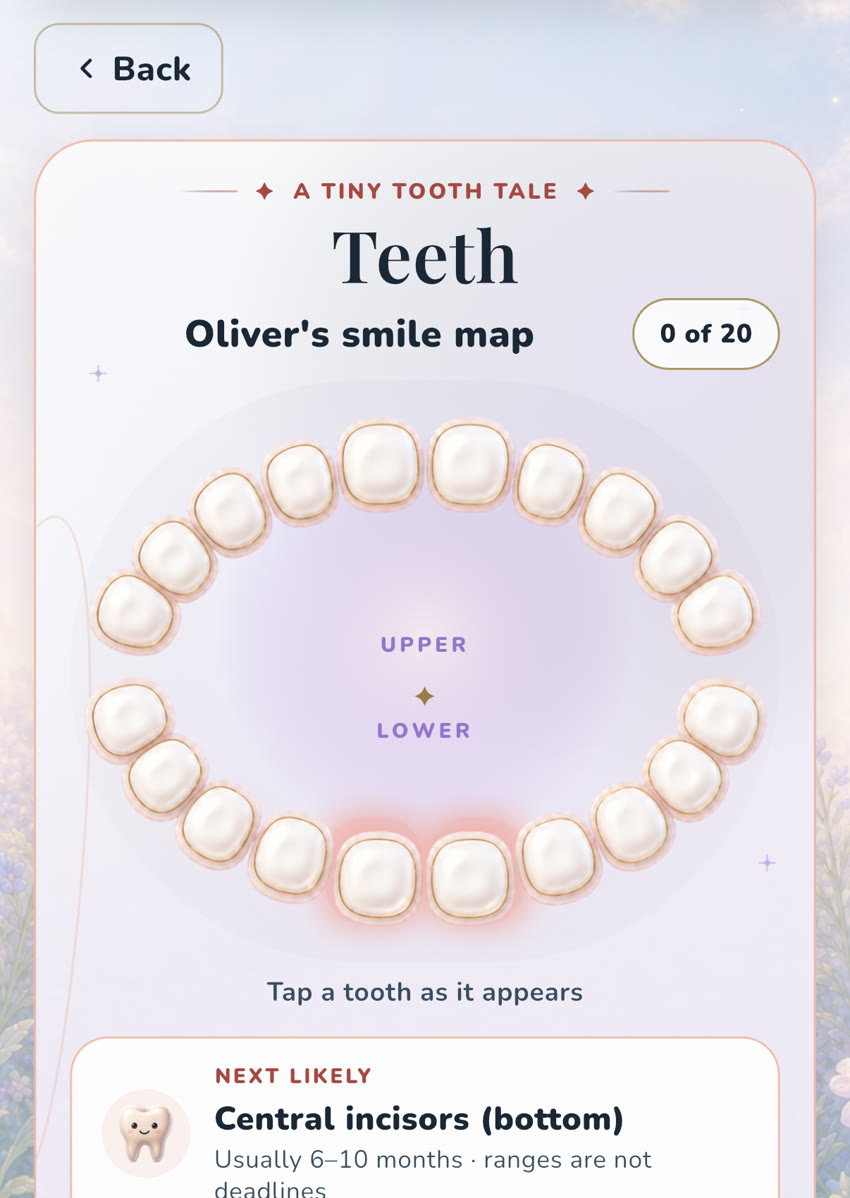
OBubba's Grow → Teeth screen turns a generic chart into the child's own 20-tooth map.
The live feature:
- displays all 10 upper and 10 lower tooth positions
- highlights the next likely group using the child's age
- labels every window as a range rather than a deadline
- uses corrected age when it is available for a baby born early
- lets a parent tap the exact tooth that appeared
- records the date, selected symptoms and a short note
- supports logging several teeth that arrived together
- preserves the first tooth in the child's Memory Book
- gives age-specific brushing and fluoride guidance
- synchronises the record for shared family care
The app's interpretation is intentionally more careful than “baby drooled, therefore teething”. Its comfort insight requires a recent logged tooth plus stronger discomfort context such as swollen gums, fussiness or disturbed sleep. Drooling, chewing or a temperature marker alone do not trigger the conclusion.
When feeding changes near an eruption, OBubba also respects the units:
- a bottle trend uses actual measured millilitres
- breastfeeding duration is labelled as a time proxy, not milk volume
- mixed feeding remains uncombined rather than averaging minutes and millilitres
- solids are not counted as milk
- sparse data produces silence rather than a confident claim
A recent tooth can also tell the sleep coach to hold off on interpreting disrupted nights as a new behavioural habit. That is the product philosophy in one small example: context first, intervention second.
OBubba cannot see a tooth under the gum, diagnose pain, rule out infection or decide whether delayed eruption needs investigation. The “next likely” highlight is orientation, not prediction.
Map baby's first teeth in OBubba →. Try OBubba free and keep first teeth beside feeds, sleep, medicines, growth and milestones, then turn the moments you log into a first-year story the family can share.
What is worth recording?
You do not need to inspect the mouth every day. When something changes, a concise entry is enough:
| Record | Why it may help | |---|---| | Exact tooth or approximate position | Distinguishes a real eruption from a general teething note | | Date first spotted | Connects the tooth with a short-lived feeding or sleep change | | Sore or swollen gum | More specific than chewing alone | | Feeding changes | Helps show whether milk or food intake actually shifted | | Temperature measured with a thermometer | Prevents “felt warm” becoming an invented fever | | Comfort method tried | Makes care handover easier between adults |
Do not prolong an examination if the child resists. A photo of a natural smile or the date you first noticed the edge is enough for the memory.
When to ask for professional advice
Speak to a dentist, health visitor, pharmacist, GP or NHS 111 as appropriate if:
- pain is severe, persistent or not helped by suitable comfort measures
- the gum or face is markedly swollen
- there is pus, a bad smell, bleeding that does not settle or an injury
- feeding remains significantly reduced
- you are unsure whether a medicine or gel is suitable
- tooth development or the appearance of the mouth worries you
- symptoms do not fit mild teething
Follow the NHS fever and serious-illness guidance for a temperature of 38°C or more, breathing difficulty, dehydration, unusual drowsiness, a non-fading rash or a child who is not responding normally. Do not wait for a tooth to appear to prove the symptoms were teething.
Frequently asked questions
Which baby teeth usually come first?
The lower central incisors, the two bottom front teeth, are most often first, commonly around 6 months. Upper front teeth may lead in some babies, and that can still be normal.
Can a 3-month-old be teething?
Yes. The NHS says some babies begin before 4 months. Chewing and drooling alone are not proof, because young babies also explore with their mouths and naturally produce more saliva.
Is it normal to have no teeth at 12 months?
Some babies start after 12 months. If you are concerned, mention it to a dentist or health visitor rather than comparing with another child.
Do molars come before canines?
Often, yes. OBubba uses broad orientation windows of 13 to 19 months for first molars and 16 to 22 months for canines. The NHS rough guide places first molars at around 12 months and canines at around 18 months. Individual order varies.
How long does each tooth hurt?
There is no fixed number of days. NHS guidance says mild symptoms may last a few days, and some teeth emerge without obvious discomfort. Persistent or severe pain deserves a check rather than being labelled teething indefinitely.
Does teething cause fever or diarrhoea?
Teething may accompany a slight temperature below 38°C. A true fever is 38°C or more. The NHS says there is no evidence that teething causes diarrhoea, so assess those symptoms separately.
When should I start brushing?
As soon as the first milk tooth begins to break through. Brush twice daily with a tiny smear of fluoride toothpaste containing at least 1,000 ppm for children under 3.
Can teeth come through in the wrong order?
A different sequence is often just normal variation. A dentist can assess an unusual appearance, persistent asymmetry or any concern about the jaw and gums.
This article provides general UK information, not a diagnosis or individual dental plan. Seek professional advice when symptoms are severe, persistent, unusual or worrying.
Ready to try OBubba?
Use OBubba to track feeds, sleep, naps, nappies, growth, milestones and family handovers in one calm baby tracker app.