The first tooth is barely more than a white edge in the gum. Surely it is too small to need a toothbrush — and what are you meant to do when your baby wants to chew the brush instead?
Start brushing as soon as the first milk tooth begins to come through. For babies and toddlers under 3, use a small, soft toothbrush and a tiny smear of toothpaste containing at least 1,000 ppm fluoride. Brush last thing at night and on one other occasion each day. A parent or carer should do the brushing.
You may clean one tiny tooth for only a few seconds at first. That is still the beginning of a useful routine.
Why brush a tooth that will eventually fall out?
Milk teeth matter now. They help a child bite and chew, support speech and hold space for the adult teeth developing underneath. They can also develop tooth decay.
The first tooth is exposed to the same basic process as every later tooth: bacteria in the mouth use sugars from food and drink to make acids, which can damage the tooth surface. How often teeth meet sugar matters as well as the total amount.
Beginning early has two jobs:
- Fluoride toothpaste helps protect the new tooth.
- The brush becomes a familiar part of morning and bedtime before a full set of teeth makes the task longer.
Do not wait for several teeth, a particular birthday or the end of teething discomfort.
What toothbrush and toothpaste does a baby need?
Choose a child-sized toothbrush with a small head and soft bristles. A long enough handle for the adult to control is usually easier than expecting a baby to manoeuvre a finger brush accurately.
Check the toothpaste packaging for fluoride concentration. NHS guidance for babies and children under 3 is:
- toothpaste containing at least 1,000 ppm fluoride
- a tiny smear, roughly the size of a grain of rice
- brushing twice daily, including last thing at night
“Children's toothpaste” on the front of a tube does not tell you the fluoride strength. Read the number on the back.
Use the small amount rather than avoiding fluoride because a baby cannot spit reliably. Keep the tube out of reach and do not let a child lick or eat toothpaste from it. If a dentist recommends a different fluoride strength because of individual decay risk, follow that advice.
How to brush a baby’s first teeth
Set up before you begin: toothbrush ready, tiny smear applied and enough light to see. You do not need a sink or rinsing cup.
One NHS-suggested position is to sit your baby on your knee with the back of their head resting against your chest. You can also sit or stand behind an older baby while supporting their head. The important points are stability, a clear view and gentle adult control of the brush.
Then:
- Lift the lip gently so you can see the tooth and gum line.
- Use small circular movements rather than hard scrubbing.
- Clean the front, back and biting surface of every tooth that is present.
- Brush the gum line gently.
- Encourage spitting as your child becomes able, but do not rinse with water after brushing because that washes fluoride away.
NHS guidance describes brushing for about 2 minutes. With one newly erupted tooth, the actual cleaning may be brief; build towards a thorough two-minute routine as more teeth arrive. Coverage and consistency matter more than holding a protesting baby to an exact stopwatch.
Never let a baby or toddler walk or run with a toothbrush in their mouth. Stay with them throughout.
What if my baby clamps their mouth shut?
A new taste, bristles on a tender gum and losing control of an interesting object can all cause resistance. It does not mean the routine has failed.
Try making the task smaller and more predictable:
- let your baby see you brush first
- give them a second dry toothbrush to hold while you use the cleaning brush
- use the same short song each time
- say what is happening: “top tooth, little circles, all done”
- choose a stable lap position rather than chasing their mouth around the room
- praise cooperation without making sweets the reward
If the gum is especially tender, be gentle but continue the daily routine. Do not freeze a teething ring or use a toothbrush as a teether. A chilled teether used separately while awake may be more comfortable.
If brushing repeatedly causes bleeding, significant pain or you can see a damaged or discoloured tooth, ask a dentist for advice rather than escalating force.
Where does brushing fit in the bedtime routine?
Make brushing the last regular tooth-care step before sleep, ideally after the final planned feed when practical. Then move into the familiar closing cues: sleepwear, book, cuddle, song and the safe sleep space.
A baby may still need responsive milk feeds overnight. Do not withhold a necessary feed to protect a routine. At bedtime or during the night, NHS advice is to offer only breast milk, formula milk or cooled boiled water rather than juice, squash or sweetened drinks.
Do not put juice, sweetened milk or sugary drinks in a bedtime bottle. Prolonged contact repeatedly exposes the teeth to sugar. Never dip a dummy in honey, sugar or jam; honey is also unsafe for babies under 12 months because of the risk of infant botulism.
The useful sequence is simple: ordinary milk feed, brush when you reasonably can, no sweet drink as a sleep prop.
Tooth-friendly habits when weaning
Starting solids creates many new tastes and textures, but “made for babies” does not automatically mean tooth-friendly.
- offer water or the baby's usual milk rather than sugary drinks
- from around 6 months, introduce drinks from a non-valved free-flow cup
- keep juice, if offered at all, diluted and with a meal rather than sipped across the day
- avoid frequent biscuits, rusks, sweets and sticky dried fruit between meals
- check labels on baby snacks, pouches and drinks for added or concentrated sugars
- ask a pharmacist or GP whether a sugar-free version is available when a child needs medicine
Fruit, milk and balanced meals still belong in a healthy diet. The aim is not to fear every naturally occurring sugar; it is to avoid bathing teeth in sweet food or drink repeatedly.
Brushing cannot cancel out unlimited sugar exposure, and a sugar-free diet does not replace fluoride brushing. The two protections work together.
When should a baby first see a dentist?
Take your child to the dentist when the first milk teeth appear, or before their first birthday. An early visit may be very short. The dentist can look at the mouth, discuss fluoride and feeding habits, and help the child become familiar with the setting before there is a problem.
NHS dental care for children is free. Taking your baby along to your own check-up can also make the environment feel ordinary, although you should still arrange whatever child appointment the practice recommends.
Do not wait for the routine visit if you suspect decay, a tooth is injured, your baby has ongoing mouth pain or there is swelling. Facial or mouth swelling, breathing or swallowing difficulty, uncontrolled bleeding or serious injury needs urgent assessment.
A first-tooth routine you can repeat
Keep the equipment and steps boringly consistent:
- Put the baby toothbrush and fluoride toothpaste where the adult can reach them but the child cannot.
- Use one tiny smear — not a ribbon along the bristles.
- Support your baby securely on your lap.
- Brush every visible surface gently.
- Do not rinse away the fluoride.
- Repeat last thing at night and once more during the day.
- Replace the brush around every 3 months, or sooner if the bristles are damaged.
If one attempt is chaotic, reset at the next planned brush. There is no benefit in turning a missed morning into three stressful cleaning sessions that evening.
How the current OBubba app supports first-tooth care
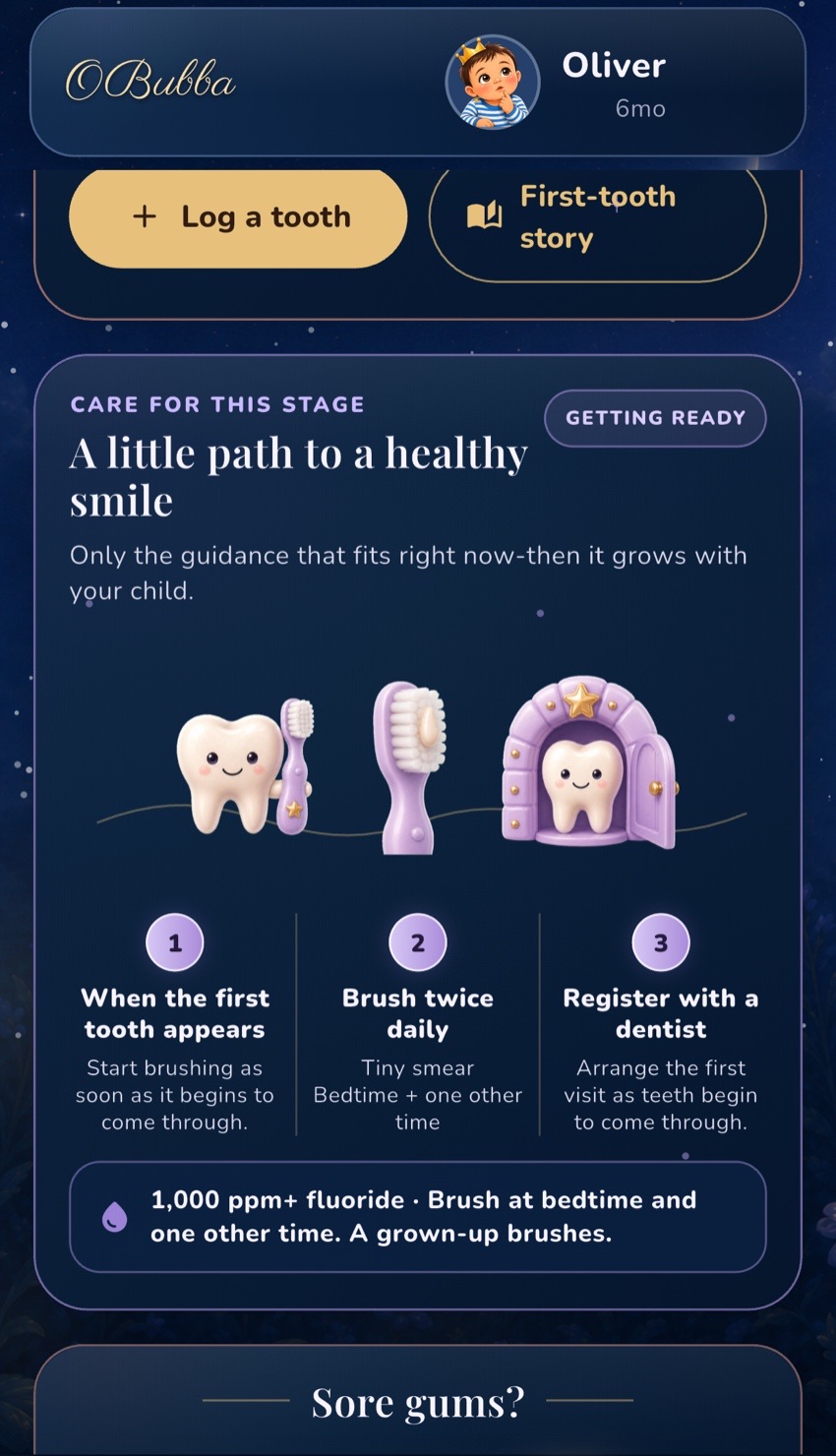
Open Grow → Teeth and OBubba presents a smile map, tooth logger and a care path matched to the stage recorded in the app. Before a tooth is logged, the oral-care card says Getting ready and keeps the plan to three memorable steps: start when the first tooth appears, brush twice daily and register with a dentist.
For a baby, the card specifies a tiny smear, toothpaste with 1,000 ppm or more fluoride, brushing at bedtime and one other time, and an adult doing the brushing.
When the first tooth is logged, the guidance changes from preparation to care for the tooth that is actually present. The screen also provides Log a tooth and First-tooth story actions. Logging can include the tooth position, date spotted, selected observations and a note; the dated first can then become part of the child's Memory Book.
This is intentionally different from a twice-daily brushing compliance tracker. OBubba reminds you what good first-tooth care looks like without awarding a streak, claiming a mouth is clean or asking you to turn every bedtime into data entry.
The broader Teeth screen also includes sore-gum comfort and typical eruption ranges. Those ranges are context, not deadlines. The oral-care instruction begins when a tooth appears, whether that is earlier or later than the average month shown.
Try OBubba free → — keep first teeth, sleep, feeds, nappies, growth and family memories in one calm place, with practical guidance that changes as your child grows.
Quick answers
Do I brush a baby’s gums before teeth appear?
You can gently wipe the gums as part of care if you wish, but fluoride toothbrushing should begin as soon as the first tooth comes through. Do not delay once you see that first edge.
Can a baby use adult toothpaste?
The essential check is fluoride concentration and the amount used. NHS guidance says under-3s need at least 1,000 ppm fluoride and only a tiny smear, unless a dentist advises differently. Choose a flavour your child can tolerate and keep the tube out of reach.
What if my baby swallows the toothpaste?
Babies cannot spit reliably, which is why the recommended amount is only a smear. Do not encourage swallowing or let them eat from the tube. If a child consumes a large amount or you are worried, contact NHS 111 or seek professional advice with the packaging to hand.
Should I rinse the toothbrush around the mouth with water?
No mouth rinse is needed. Encourage spitting when your child can, but do not rinse the mouth after brushing because that reduces the fluoride left on the teeth.
Sources and further reading
- NHS Best Start in Life: Baby and toddler tooth care
- NHS: Children's teeth
- NHS: Looking after your baby's teeth
- GOV.UK: Delivering Better Oral Health — oral hygiene
- GOV.UK: Delivering Better Oral Health — fluoride
OBubba supports routines, records and parent education. It cannot inspect teeth, confirm effective brushing, diagnose decay, assess fluoride needs or replace advice from a dentist, pharmacist, health visitor, GP, NHS 111 or emergency services.
Ready to try OBubba?
Use OBubba to track feeds, sleep, naps, nappies, growth, milestones and family handovers in one calm baby tracker app.