Your baby is finally heavy in your arms. You slow the rocking, hold your breath and attempt the cot transfer. Their eyes open before your hands leave the mattress.
After the third attempt, it is easy to wonder whether rocking created the problem—and whether you now have to stop.
No: you do not need to stop rocking your baby to sleep simply because it is familiar. Rocking is normal, responsive comfort. Keep it while it is safe and workable. Consider changing it only when the amount of rocking is exhausting, painful, no longer effective, difficult for another carer to repeat, or needed at so many wakes that your family wants a different pattern.
If you do want a change, do not remove your baby's only sleep cue in one night. Add a portable cue first, then reduce one layer of motion gradually while staying present.
Rocking is not a bad habit
Babies arrive expecting movement. They have spent months being carried inside a moving body, and rhythmic motion can feel regulating and familiar.
The NHS guide to soothing a crying baby includes gentle swaying, movement and rocking among the ways parents can comfort a baby. The NHS also notes that some babies—especially in the early weeks—fall asleep only in a parent's arms or beside the cot.
Rocking does not damage attachment, spoil a baby or prove they will never sleep another way. A sleep association is only a condition connected with falling asleep. A song, dark room and sleeping bag are associations too.
The useful question is not “Is rocking bad?” It is:
> Is this still a safe, sustainable way for our family to get enough rest?
If the answer is yes, you do not need a project.
When keeping the rocking makes sense
Keep rocking without apology when:
- your baby is a newborn or young infant who needs hands-on help to regulate
- the settle is reasonably short and you do not resent it
- rocking works at bedtime but is not required at every brief stir
- your baby is teething, unwell, travelling or moving through a disrupted week
- a feed, nappy, temperature or comfort need has been checked first
- you simply enjoy this part of the day
The BASIS infant-sleep information sheet on sleep training cautions against treating normal night waking or a need for rocking, feeding and cuddling as proof that a baby has a sleep problem. It also notes limits in the sleep-training evidence, particularly when findings from older babies are assumed to apply to younger infants.
Needing you is not a mistake. You are allowed to change a pattern because it no longer works for you—but you do not have to manufacture a problem because someone called it a “rod for your own back.”
When it may be worth changing
Rocking may have become unsustainable if:
- it takes 30, 45 or 60 minutes at most sleeps
- your back, shoulders, wrists or pelvic floor hurt
- baby wakes at most sleep-cycle transitions and needs the full rocking process again
- only one adult can perform the exact movement
- baby becomes more alert the longer you rock
- transfers repeatedly fail even after timing and comfort needs are addressed
- you dread every nap and bedtime
One hard night is not a pattern. Neither is one failed transfer.
Illness, teething, a late nap, hunger, a new motor skill, separation anxiety and an unfamiliar sleep space can all increase the need for contact temporarily. If rocking suddenly stopped working, look for the change before deciding that rocking itself is the cause.
Our cot-transfer guide separates a startle, temperature change, shallow sleep and genuine repeated-association pattern.
Do a three-night reality check
Before changing anything, record three ordinary nights. Keep it deliberately small:
| Record | Example | Why it matters | | --- | --- | --- | | Last nap end | 4:22pm | A badly timed final wake window can make any settling method look broken | | Routine start and asleep time | 7:05pm / 7:34pm | Separates the whole wind-down from the actual rocking time | | How baby settled | fed 8m → rocked 12m | Real settles often use more than one method | | Cot-transfer attempts | 2 | Shows whether the struggle is motion or the put-down | | First wake | 8:16pm | A very early wake may point to timing or discomfort, not necessarily rocking | | Night-wake help | held 5m → rocked 7m | Reveals whether the full bedtime method is recreated overnight | | Anything unusual | teething, cold, missed nap | Stops a disrupted week becoming your baseline |
Do not run six experiments at once. Keep naps, feeds, room and routine broadly steady while you observe the rocking.
Three nights will not diagnose a baby, but they can turn “I rock all night” into something testable: perhaps bedtime rocking takes 12 minutes and only one of four wakes needs it. That calls for a different decision than an hour-long settle repeated five times.
First fix safety and comfort
Rocking is an awake settling activity. The risk appears when an exhausted adult might fall asleep with the baby on a sofa, armchair or recliner.
The NHS safer-sleep advice says the safest place for a baby is on their back in a separate cot or Moses basket, on a firm flat mattress, in the same room as a carer for at least the first six months. The sleep space should be clear of pillows, duvets, toys, bumpers, nests and loose objects. Never fall asleep with a baby on a sofa or armchair.
Make the setup easier before bedtime:
- use a supportive upright chair rather than a deep sofa
- keep the cot ready and completely clear
- ask another adult to take over if you are nodding off
- keep night lighting low but bright enough to move safely
- put the phone out of reach if scrolling makes you less alert
- place baby into the safe sleep space before you sleep
If your baby is suddenly inconsolable, feeding poorly, unusually floppy or difficult to wake, breathing differently, vomiting repeatedly or has a cry that does not sound normal, treat that as a health question rather than a sleep-association problem. Contact NHS 111, your GP or 999 as appropriate.
Path one: keep rocking, but make it easier
You can improve a working pattern without trying to remove it.
Share the method
Show a partner or regular carer the speed, hold, sound and point at which you normally slow down. Let them develop their own safe variation. Your baby can learn that more than one loving adult means sleep without everybody reproducing your movement exactly.
Reduce physical strain
Sit with back and feet supported. Keep baby close to your centre rather than held away from your body. Swap from bouncing to a smaller side-to-side sway when your muscles tire.
Make one cue portable
Pair rocking with the same short song or phrase. The song can travel to the cot, another room or another carer even when your arms cannot.
Stop when more movement becomes stimulation
The NHS notes that too much rocking and singing can sometimes keep a baby awake. If their eyes become wider, movements more frantic or crying sharper, pause the extra input. Hold still, dim the room and see whether less is more.
Path two: a gentle rocking fade
For a known baby beyond the very early months, this is a practical ladder—not a deadline. Stay on each rung until it feels familiar. Move backwards whenever baby is unwell, intensely distressed or the timing is plainly wrong.
1. Install the new cues while rocking stays exactly the same
For at least a few nights, keep rocking as normal and add:
- the same short routine in the same order
- one song, hum or phrase
- the same sleep bag when appropriate
- the same dark, calm sleep space
Do not take the motion away yet. You are giving the baby more than one route into sleep.
2. Rock to calm and heavy-eyed
When the new cues are familiar, stop the motion slightly earlier than usual. Hold still for the final moments. If baby escalates, resume rocking and try again another night.
“Drowsy but awake” is a direction, not an exam. Some babies will manage calm and awake; others will be almost asleep. The useful change is simply that the last few seconds are no longer dependent on full movement.
3. Replace rocking with a smaller movement
Move down one step:
rocking → gentle sway → still holding
Keep the song and routine unchanged. Only the amount of motion changes.
4. Move the comfort into the cot
Place baby down calm and offer a steady hand, quiet voice or brief pat. If they become truly upset, pick them up, regulate together and put them down again when calm.
You do not win by refusing comfort. You are practising a new ending while keeping the relationship predictable.
5. Reduce one part of the cot support
When the cot settle is accepted, make the hand lighter or shorter. Keep your voice or song. Eventually, the routine and familiar sleep space may carry more of the work.
There is no prize for reaching the final rung quickly. A sustainable middle rung is still progress.
Start at bedtime—not every wake
Bedtime usually offers more capacity than 3am. Practise the new step at the easiest sleep first and use whatever safe, responsive support works at the hardest wakes.
Continue to feed genuine hunger. Do not shorten or delay needed feeds to make a settling experiment look successful.
If your baby wakes every two hours, the timing alone does not prove a rocking association. Compare the wake pattern with feeds, age, daytime sleep, discomfort and the exact help needed. Our every-two-hours guide walks through those possibilities.
What if baby cries when the rocking stops?
Protest tells you the change is noticeable; it does not tell you to ignore your baby.
Try this response:
- pause the reduction and hold still
- use the familiar voice or song
- resume a smaller sway if fussing rises
- pick up and fully comfort if baby escalates
- return to the previous rung for the rest of the night if needed
The next attempt can be smaller: two seconds less rocking instead of two minutes. If every attempt creates intense distress, the current step may be too large, the timing may be off or the family may simply not be ready. Pausing is data, not failure.
How the actual OBubba app reads rocking
We inspected OBubba's current implementation for this article. It does not infer rocking from a wake or call one cuddle a dependency.
When a parent logs bedtime, a nap or a night wake, they can record Fed, Rocked, Held, Patted, Dummy or Self-settled. Hands-on methods can be combined because a real settle may be fed, held and rocked. Self-settled is kept separate so the app does not falsely call an assisted settle independent.
For a night wake, the logger can preserve the order and minutes for each part—for example:
> fed 8 minutes → rocked 6 minutes → self-settled 3 minutes
That matters. Giving the whole 17-minute wake to “rocking” would teach the app the wrong lesson.
Across the last 14 nights, OBubba can compare methods only when there is enough actual data. Its “what settles fastest” insight requires at least two recorded methods, at least three wakes for each method and a meaningful difference of eight minutes or more. Missing methods are ignored rather than guessed.
A separate one-night association signal is cautious too: it needs at least three wakes with a recorded method, and the same hands-on method must account for at least 80% of them. One rocked wake does not create a label.
If you choose to change it
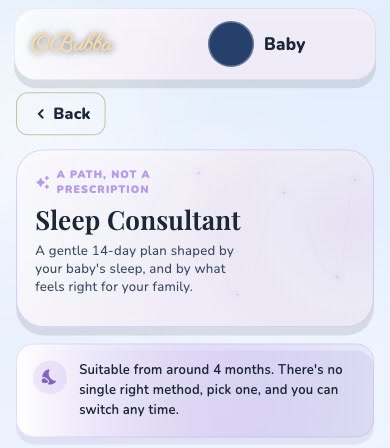
The Sleep Consultant looks at the dominant bedtime settling method across recent logs. For a baby old enough for a structured plan—using corrected age when relevant—rocking can map to a dedicated Swap rocking/holding path rather than generic sleep-training advice.
The current path mirrors the gentle ladder above:
- build a song, cot and routine cue while rocking continues
- rock only to drowsy
- replace motion with a hand in the cot
- let the portable cues carry more of the settle
The app does not start a formal swap for a baby under roughly four months corrected age. It also holds the ladder through illness, teething or another active disruption instead of treating a difficult week as proof that the plan failed.
This is the product principle underneath OBubba: observe first, require a pattern, change one thing and never confuse missing data with bad sleep.
| OBubba can help show | OBubba cannot know for you | | --- | --- | | how often rocking was actually recorded | whether your arms or back have reached their limit | | whether rocking or another method usually resolves wakes faster | why your baby needed extra comfort on one particular night | | whether the same method appears at most logged wakes | whether you enjoy rocking and want to keep it | | whether settling time is improving across recorded days | whether a cry sounds medically unusual | | a gradual, age-gated rock-swap path when you choose it | whether tonight is the right night to make a change |
Try OBubba free to keep sleep timing, wakes, feeds and the help that actually worked in one calm timeline—then make a decision from your baby's pattern, not somebody else's rule.
The decision in one minute
Keep rocking if it is safe, reasonably sustainable and still feels right.
Make it easier if the method works but your body or handover needs support.
Change it gradually if the full rocking process is needed again and again and your family wants another option.
Pause the change when baby is young, unwell, intensely distressed or moving through a disruption.
You have not failed if your baby needs motion. You have not failed if you are ready to use less of it. Responsive care includes the baby's need for comfort and the parent's need for a method they can continue.
This article provides general information for UK families. It does not replace individual medical advice or safer-sleep guidance. Speak to your health visitor or GP if you are worried about your baby's sleep, crying, feeding or health.
Frequently asked questions
At what age should I stop rocking my baby to sleep?
There is no universal age at which rocking must stop. It is common and appropriate for newborns and young babies to need hands-on help. Consider a gradual change later only if the pattern is safe but no longer sustainable or wanted. OBubba conservatively avoids a structured swap below roughly four months corrected age.
Am I creating a bad habit by rocking my newborn?
No. Newborn sleep is immature and fragmented, and many young babies need feeding, holding or rocking to settle. Responding to that need is not spoiling them.
Will rocking cause my baby to wake every sleep cycle?
Not automatically. Requiring the same full rocking process at most wakes can be one clue that the method has become a strong sleep association, but hunger, discomfort, development, timing and normal partial waking can produce the same pattern. Record what happens before deciding.
Should I put my baby down drowsy but awake?
You may try it if it suits your baby, but it is not a developmental test. A gentler first step may be rocking until calm and heavy-eyed, then holding still. Comfort and try again if the change becomes distressing.
How long should I try each rocking-fade step?
Long enough for it to feel familiar—often several nights, not one attempt. OBubba's first “build the anchors” rung lasts at least four logged nights. Illness, teething, travel or a major disruption are good reasons to hold or step back.
What if rocking is the fastest way back to sleep?
Use it if it is safe and you need the rest. “Fastest” and “most sustainable” are different questions. You can lean on the working method tonight and build another cue at bedtime when everyone has more capacity.
Ready to try OBubba?
Use OBubba to track feeds, sleep, naps, nappies, growth, milestones and family handovers in one calm baby tracker app.