Your baby settles at 7:30pm, then wakes at 9:30, 11:30, 1:30 and 3:30. By the third wake, all the neat explanations you read in daylight, hunger, sleep cycles, overtiredness and “bad habits”, blur into one question: why every two hours?
The clock gives you a clue, not a diagnosis. Young babies commonly sleep and feed in short stretches. Older babies may surface between sleep cycles and need help again, but similar timing can also appear with hunger, discomfort, illness, a mistimed day or a burst of development. The cause is not automatically the way you settled your baby.
Do not try to solve every wake at once. First check health, feeding and safer sleep. Then record three representative nights, identify the clearest repeatable pattern and test one gentle change. If your baby needs milk or comfort, respond; data should support your judgement, never overrule it.
Is waking every two hours normal?
It can be, especially for a newborn.
The NHS says newborns wake repeatedly during the night in their first few months and may wake because they need feeding or because they are too hot or cold. Newcastle Hospitals explains that young babies often sleep in two-to-three-hour periods and that waking at the end of a sleep cycle is normal.
That does not make broken sleep easy. It does mean a newborn's two-hour rhythm is not proof that anything is wrong or that you have created a habit. In the early weeks, feeding, growth, warmth, closeness and safe rest matter more than stretching intervals.
As babies grow, some sleep longer and need fewer night feeds, but there is no birthday on which every baby should suddenly sleep through. Between six and twelve months, the NHS says night feeds may no longer be necessary for some babies, not all. Prematurity, growth, milk supply, illness and an individual feeding plan can change the picture.
| What you see | What it may mean | Best first move | |---|---|---| | Young baby wakes and takes an active, substantial feed | Normal feeding need may be driving the interval | Feed responsively and follow your midwife, health visitor or clinician's plan | | Older baby wakes at similar intervals and only takes a token feed | The feed may be one part of the settling sequence | Check daytime intake and health before gently changing one settle | | Waking suddenly increased with congestion, pain, fever or poor feeding | Illness or discomfort may be disrupting sleep | Pause schedule experiments and get appropriate medical advice | | Wakes follow a long final awake period or a very difficult bedtime | Overtiredness may be contributing | Protect naps or move bedtime 10–15 minutes earlier for several nights | | Baby is awake and cheerful for a long period overnight | Sleep timing or unusually high daytime sleep may be relevant | Compare several days before changing naps | | Timing varies but the parent is becoming dangerously exhausted | The urgent issue is family safety, not a perfect schedule | Share shifts where possible and plan feeds away from sofas and armchairs |
Why the two-hour timing does not prove a “sleep association”
Babies move through lighter and deeper sleep. They may stir, vocalise or briefly wake at transitions. That is normal biology. An older baby who wakes at most transitions and needs the exact bedtime condition again, such as feeding, rocking, a dummy or contact, may have learned to expect that condition. But the clock alone cannot tell you that.
A more convincing settling pattern has several parts:
- the baby is beyond the early newborn period
- the wakes land at broadly similar intervals on multiple ordinary nights
- there is no clear illness, pain, temperature or feeding concern
- the baby wants the same help used at bedtime
- feeds are brief or mostly soothing rather than active, full feeds
- the baby returns to sleep quickly when that condition is restored
Even then, “association” is a description, not blame. Feeding or rocking to sleep is not inherently bad. The only practical question is whether the current arrangement remains safe and sustainable for your family. If it does, you do not have to change it. If it does not, you can add another reliable cue and fade help gradually; crying-it-out is not the only option.
Read Is feeding to sleep a bad habit? before removing a useful settle just because the internet says you should.
Seven things to check before changing sleep
1. Is your baby actually hungry?
Look at the feed, not just the wake. Rooting, eager attachment and sustained sucking and swallowing support hunger as an explanation. A few sleepy sucks followed by immediate settling are less conclusive.
Check the whole 24 hours:
- Were daytime milk feeds calm and effective?
- Has distraction shortened feeds?
- Is your baby taking much more milk overnight than during the day?
- Are wet nappies and weight gain reassuring for your baby?
- Has a clinician asked you to wake or feed at particular intervals?
Do not withhold a feed to test a theory, especially for a young baby. If daytime feeds have become brief and night feeds full, the reverse-cycling guide gives a gradual plan. If you are considering reducing milk overnight, use the night-weaning readiness checklist and seek individual advice when growth, supply or feeding is uncertain.
Starting solids is not a sleep treatment. The NHS specifically says introducing solid foods will not make a baby more likely to sleep through. Milk remains the main drink through the first year.
2. Is there pain, illness or discomfort?
A sudden change deserves more caution than a familiar pattern. Check for:
- fever, unusual sleepiness or a baby who is hard to wake
- fast or difficult breathing, colour change or persistent congestion
- poor feeding, repeated vomiting or nappies that are drier than usual
- an unusual, weak or inconsolable cry
- eczema, reflux symptoms, constipation or a sore nappy area
- a red, sore gum and extra chewing around an emerging tooth
Teething can make a baby more fretful and disturb sleep, but it should not explain every symptom. The NHS describes teething temperatures as slightly raised but below 38°C. Do not write off a fever or an unwell baby as “just teething”.
The current NHS urgent-help guide lists breathing difficulty, blue, grey, pale or mottled skin, being difficult to wake, a seizure, a non-fading rash and a very high temperature among reasons to call 999 or go to A&E. That temperature threshold is 38°C or above for a baby under three months and 39°C or above for a baby aged three to six months. Call NHS 111 if you are worried about any symptom or do not know what to do. Trust your instincts and get immediate help whenever you think something is seriously wrong.
3. Was the day overtiring?
An exhausted baby does not always sleep more deeply. A long last wake window, several missed naps or a stimulating late afternoon can make settling harder and sleep more fragmented.
Clues include a frantic bedtime, false starts soon after bedtime and more unsettled wakes in the first half of the night. Try protecting the final nap or moving bedtime just 10–15 minutes earlier for three comparable nights. Avoid a dramatic schedule overhaul after one bad evening.
If your baby fights sleep before the frequent wakes begin, start with Why is my baby fighting bedtime?.
4. Was there unusually high daytime sleep?
Sometimes a baby has less sleep pressure at night after substantially more daytime sleep than is typical for that baby. The useful evidence is a repeated relationship: high-sleep days followed by long, alert night wakes, not simply one good nap followed by a rough night.
Do not cap naps blindly. Total sleep needs vary, and reducing rest can create overtiredness instead. Compare at least three to five days, preserve age-appropriate sleep and adjust gently only when the pattern is consistent.
5. Did development temporarily disrupt the pattern?
Rolling, crawling, standing, language bursts and separation awareness can all coincide with unsettled nights. At around four months, sleep organisation matures and some families notice more frequent waking. That does not mean the baby has “forgotten” how to sleep.
Give new physical skills safe practice on the floor in daytime, keep bedtime familiar and offer reassurance. Developmental labels describe a possible window; they cannot diagnose tonight's wake. Read the four-month sleep change guide for a gentler reset.
6. Does the sleep environment change overnight?
Check the simple things:
- room temperature and sleep clothing
- household, street or sibling noise
- light entering before dawn
- a dummy repeatedly falling out
- a nappy leak or uncomfortable clothing
- whether the baby fell asleep in one place and woke in another
Make one safe change at a time. Do not add cot bumpers, pillows, pods, wedges, nests or weighted products to solve waking. Keep the sleep space firm, flat and clear.
7. Is the parent running out of safe capacity?
Frequent waking is also a parent-safety issue. The Lullaby Trust says the safest place for a baby is their own clear, flat, separate sleep space and warns never to sleep with a baby on a sofa or armchair. If there is any chance you may fall asleep while feeding, prepare the environment in advance and return the baby to their cot as soon as you wake.
Where possible, split the night: one adult settles while the other sleeps, or one handles the early stretch and the other takes the morning. Expressing or using formula is not automatically required for sharing care; a partner can bring the baby, change nappies and resettle after a breastfeed.
The three-night audit: what to record
Memory at 3am is unreliable. For three reasonably typical nights, capture only the details that help distinguish causes:
- Actual sleep onset, not when the bedtime routine began.
- Each wake time and duration, including whether the baby was fully awake.
- What happened before the wake: last milk feed, bedtime settle and room change.
- What the baby did at the wake: rooted, cried in pain, chatted, rolled, searched for a dummy.
- What worked: full feed, brief feed, cuddle, patting, dummy, nappy change or time.
- Day context: naps, final awake period, unusually poor feeds, new food, vaccination, illness or travel.
- Morning start, so a long early-morning wake is not accidentally recorded as night sleep.
Add one plain-language note: “This wake felt like hunger,” “very blocked nose,” or “wide awake and playing.” Parent observation is valuable evidence.
Then compare the first wake with the later wakes. The first may follow a bedtime timing problem while later wakes are full feeds. Treating all four as one problem can lead to the wrong change.
How to read the pattern
| Repeatable pattern | More plausible explanation | What would strengthen it | |---|---|---| | Full, active feed after a meaningful gap | Hunger | Day feeds were poor or distracted; baby has reassuring output after feeding | | Brief comfort feed at nearly every transition | Familiar settling condition | Same condition starts bedtime; baby settles rapidly once it returns | | First wake 20–60 minutes after sleep onset, then mixed wakes | Bedtime false start | Difficult final wake window, overtired signs or transfer problem | | Long, happy wake in the middle of several nights | Timing or high daytime sleep | Repeated link with unusually high day sleep or too-early bedtime | | Sudden frequent wakes plus pain or illness signs | Discomfort or illness | Daytime symptoms, temperature, poor feeding or altered nappies | | Temporary increase while practising a new skill | Development | New milestone visible by day; schedule otherwise unchanged | | No stable pattern | Normal variability or missing context | More representative nights are needed; do not force a confident answer |
This table is a way to form a hypothesis, not diagnose a baby. Multiple factors can coexist: a teething baby can also be hungry; an overtired baby may still prefer feeding to resettle.
Choose one gentle experiment
Once health and feeding needs are covered, choose the smallest change matched to the clearest pattern.
If the wakes look hunger-led
Offer calm, responsive daytime milk more often, especially if an older baby is easily distracted. Feed on waking rather than withholding milk to reach a schedule. Keep night feeds responsive while you watch whether daytime intake naturally improves.
If wet nappies, swallowing, supply or growth concern you, speak to a midwife, health visitor, GP or qualified feeding specialist. Sleep advice cannot replace a feeding assessment.
If overtiredness looks likely
Protect the most fragile nap or bring bedtime forward 10–15 minutes. Hold the change for three comparable nights. A tiny adjustment is easier to interpret than simultaneously shortening every wake window and changing the settle.
If a settling condition looks central
Keep the current help but add a cue you can sustain: the same phrase, hand on chest, short song or predictable sequence. Practise at bedtime or at the easiest wake first. Over several nights, reduce one layer of help, such as slightly less rocking, unlatching before fully asleep or pausing before replacing a dummy, while staying responsive.
You do not need to remove every feed. You might keep full hunger feeds and change only the first brief comfort wake.
If the day may contain too much sleep
Confirm the pattern across several days. Then trim only the least restorative edge, perhaps waking 10 minutes earlier from the final nap, without compromising total sleep or forcing a tired baby awake. Stop if bedtime becomes harder or wakes increase.
If the environment is the clue
Fix the specific issue: use appropriate sleep clothing, darken early-morning light, move a noisy device or choose a consistent low-level sound. Keep safer-sleep guidance unchanged.
If development is the likely context
Often the best experiment is steadiness. Offer daytime practice, familiar cues and extra reassurance for several nights. A temporary change does not always need a new permanent schedule.
What not to do at 3am
- Do not assume every wake is manipulation or a bad habit.
- Do not stretch a young baby's feeds because an app or chart shows a target.
- Do not start solids early or add cereal to a bottle to produce sleep.
- Do not change naps, bedtime, feeds and settling all on the same night.
- Do not leave a sick or hungry baby to test whether the wake is behavioural.
- Do not use a sofa, armchair or unsafe sleep product because exhaustion has peaked.
- Do not compare one unusually bad night with another family's highlight reel.
The aim is not zero wakes at any cost. It is a safer, more understandable night and a plan the family can repeat.
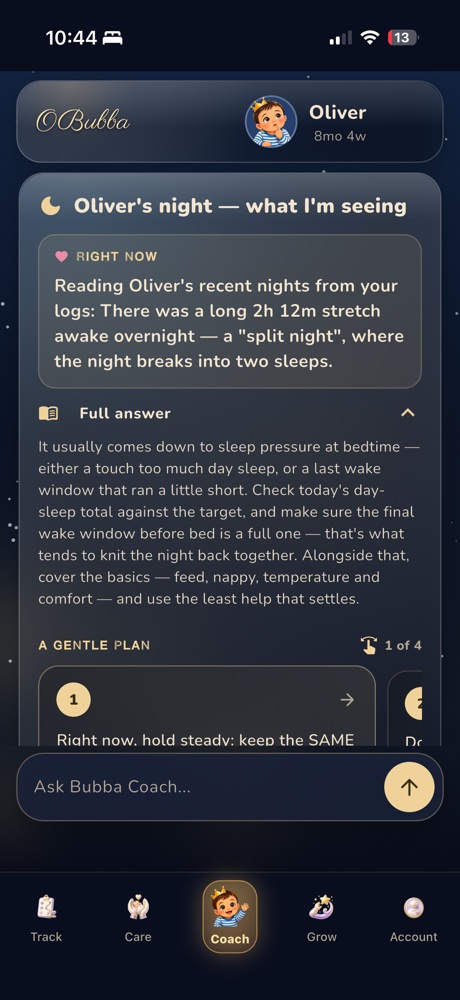
How the current OBubba app reads night wakes
The article's method comes directly from the app's current logic, not from a generic content brief.
After a newly recorded night wake, OBubba can show a short Read this wake card when the saved details support a useful read. The current card uses the parent's chosen reason, the wake's time and position in the night, recorded day-sleep total, and recent teething, illness or developmental context. It ranks the strongest grounded signals and shows at most three. It does not currently receive the exact last-feed gap, bedtime or final wake window, so the article's wider three-night review should not be confused with what this immediate card can calculate.
The guardrails matter:
- for babies under roughly 16 weeks, it treats waking for feeding or comfort as expected and does not label the wake a training or habit problem
- a parent-recorded reason such as hunger, discomfort, noise, nappy or unsettled behaviour comes first
- illness and teething outrank schedule theories
- the immediate card only labels hunger when the parent selected hunger; it does not infer hunger from an unavailable feed gap
- it does not infer overtiredness from an unavailable final wake window
- high daytime sleep is flagged conservatively rather than after one ordinary long nap
- the immediate card only uses a sleep-cycle label when the parent selected “just unsettled”; it does not currently infer one from cycle timing alone
- if there is not enough grounded evidence, the immediate card stays out of the way instead of guessing
The broader disruption check is separate and conservative. It reviews ten prior nights and stays quiet unless at least two of the latest five nights contain three or more recorded wakes, or the latest nights show a clear rise above the baby's own baseline. Recent illness, teething, a recorded milestone, new food and measured feeding-volume changes can then provide context. None of those signals prove causation, so the wording remains tentative.
That is the difference between useful tracking and a rigid schedule: your baby's baseline, your observation and the actual night lead the answer.
Logging wakes, feeds and naps in Track, including the grounded post-wake card, is free. The deeper personalised Guidance panel and Care → Sleep Consultant are Premium features. OBubba unlocks Premium during pregnancy and through the first two corrected-age months; plan options follow after that early-free period.
Turn repeated wakes into one useful question →
Keep the night in one timeline, including what you noticed and what helped, so OBubba can separate a grounded immediate read from the broader pattern that only repeated nights can support.
A realistic plan for tonight
If you need a plan before your head hits the pillow, use this one:
- Check that your baby seems well and the sleep space is safe.
- Decide who can cover which part of the night.
- Feed and comfort responsively.
- Record wake time, feed quality and what worked. Nothing more.
- Do not redesign the schedule overnight.
- In daylight, compare the first wake with the rest.
- After three nights, choose one small experiment and review it after another three.
Two-hour waking can be normal, temporary or a sign that one part of the day needs attention. The clock is the beginning of the investigation, not the verdict. A calm record helps you move from “something is wrong” to a specific, testable question. Sometimes the honest answer is simply that your baby still needs you at night.
This article provides general information, not medical advice. Follow your baby's individual feeding or care plan and contact a qualified health professional whenever feeding, growth, breathing, pain, fever or illness concerns you.
Ready to try OBubba?
Use OBubba to track feeds, sleep, naps, nappies, growth, milestones and family handovers in one calm baby tracker app.