The bath is done. The feed is finished. The room is dim. Yet your baby is rolling, chatting, pulling up, crying or springing awake every time you think sleep has finally arrived.
It is tempting to call this a sleep regression, a bad habit or proof that bedtime must be later. But an overtired baby and an undertired baby can both fight sleep—and the wrong adjustment can make tomorrow harder.
Look at the day, not just the protest. A playful baby after a late or generous nap may not have enough sleep pressure yet. A frantic, tearful baby after a long final wake window may be overtired and need an earlier bedtime. If the pattern is new around six months or later, separation awareness and new physical skills may be part of it. Change one thing by 10–15 minutes for three nights, then judge what actually happened.
First: is this really bedtime resistance?
Bedtime resistance means your baby takes a long time to move from the bedtime put-down to sleep. It is different from:
- a false start, when the baby falls asleep and wakes 20–60 minutes later
- a night wake, after a longer first stretch of sleep
- a long routine that begins early but ends with quick settling
- one unusual evening after travel, visitors, illness or a missed nap
Start the settling clock when you genuinely try to put your baby to sleep—not when the bath begins. Stop it when they are asleep. If the routine starts at 6:30pm, cot time is 7:05pm and sleep arrives at 7:18pm, settling took 13 minutes, not 48.
One 40-minute bedtime is a hard night. Two or more similar nights make a pattern worth investigating.
Overtired and undertired can look surprisingly similar
| What you notice before bed | More consistent with | First experiment | |---|---|---| | Missed or short naps; final awake stretch ran long; frantic, clumsy or hard to soothe | Overtired | Start the wind-down 10–15 minutes earlier | | Late or long final nap; bedtime is early; baby is cheerful, rolling or chatting | Undertired | Protect a little more awake time or gently trim the late nap | | Baby falls asleep quickly, then wakes after one short cycle | False start rather than resistance | Use the false-start guide | | Sudden clinginess when you step away; repeated standing or practising a new skill | Development or separation | Reassure and keep the routine predictable | | Rooting, searching, taking a full feed | Hunger | Feed responsively | | Arching, coughing, fever, unusual crying or obvious discomfort | A care or health need | Pause sleep experiments and address the need |
These are clues, not diagnoses. A tired baby can still smile. An undertired baby can become cross after forty minutes in a dark room. Use timing across several evenings rather than one facial expression.
Signs bedtime may be too late
Overtired does not always mean droopy. Some babies become louder, more active and harder to settle after staying awake beyond the window they can comfortably manage. Parents often describe this as a “second wind”.
Look for the combination of:
- less daytime sleep than usual
- a missed or unusually short final nap
- a final wake window longer than your baby's recent successful pattern
- bedtime drifting later while settling becomes longer
- frantic movement, rubbing the face, turning away or escalating crying
- falling asleep almost instantly once calm, then having a restless first part of the night
Do not respond by keeping an already exhausted baby awake until they “really cannot resist”. More awake time is not always more useful sleep pressure. It can make settling harder.
For three nights, begin the calm routine 10–15 minutes earlier. Keep the morning wake, naps and settling method as steady as life allows. If the baby falls asleep more easily and the first stretch improves, that small earlier shift was useful.
Avoid jumping bedtime an hour earlier after one poor nap. A very large change can create an undertired bedtime instead.
Signs bedtime may be too early
An undertired baby has not built enough pressure for sleep at the moment you are asking. They may be calm but clearly awake: turning the cot into a practice area, babbling, pulling up, smiling at every check-in or repeatedly resettling without crossing into sleep.
The day may show:
- a final nap ending later than usual
- a long or extra rescue nap
- more total daytime sleep than the baby normally takes
- a short final wake window
- a bedtime chosen by the clock even though sleep now consistently arrives much later
Do not conclude that all naps need cutting. Babies need daytime sleep, and aggressive nap caps can create the overtired pattern you were trying to solve.
Choose one modest experiment:
- end only the late final nap 10–15 minutes earlier
- start the routine closer to the time your baby has actually been falling asleep
- allow 10–15 minutes more calm awake time before the put-down
For a bedtime that has drifted very late, the NHS advice for young children describes starting the wind-down around 30 minutes before the child's usual sleep time, then bringing it forward gradually. This “meet sleep where it is, then shift” approach is often gentler than spending an hour repeatedly attempting an unrealistic bedtime.
If your baby becomes frantic with the extra awake time, stop. That result points away from undertiredness.
The final wake window matters—but it is not a stopwatch
A wake window is simply the time from the end of one sleep to the start of the next. It can help explain bedtime, but it is not a medical prescription and it does not need to be exact to the minute.
The useful number is your baby's own recent pattern:
- Find three to five evenings when settling was relatively smooth.
- Note when the final nap actually ended.
- Note when sleep actually began—not only the intended bedtime.
- Compare those final wake windows with the difficult nights.
If smooth nights cluster around a similar range and difficult nights sit far outside it, you have a personalised starting point. Read the wake-window guide for broad age context, but let your baby's repeated response refine it.
Do not count a baby as awake throughout a nap that briefly paused or a transfer that lasted two minutes. Equally, do not use the planned nap end when the baby actually slept thirty minutes longer. Small logging errors can point the bedtime adjustment in the wrong direction.
Around six months and beyond: separation can arrive at bedtime
Sometimes timing looks sensible and the protest begins exactly when the parent steps away. The NHS says separation anxiety is common from about six months to three years and is a normal part of development.
Your baby may suddenly:
- cry when placed down but calm when you return
- object more strongly to one parent leaving
- pull to stand repeatedly instead of lying down
- practise crawling, sitting or new sounds in the cot
- settle normally once you remain close
This is not manipulation. They are more aware that you can leave and are still learning that you return.
Keep the sequence short and recognisable. Use the same phrase, song and response. Practise new physical skills during the day, including how to bend the knees and sit back down after pulling up. At bedtime, calmly help if they are stuck.
You can stay beside the cot, use a reassuring hand, pick up to calm and try again, or gradually reduce your presence only if that suits your family. A developmental protest does not require leaving a baby alone to become exhausted.
Never place a soft toy, pillow or loose comforter in a baby's cot to solve separation. Familiarity should come from the routine and your response while the sleep space stays clear.
Newborns are a different case
In the early weeks, a baby may need feeding, holding or rocking all the way to sleep and may wake when transferred. This is common, not bedtime defiance.
The NHS Best Start in Life guidance says it is very common for a newborn to fall asleep while held and wake when placed in a cot. It encourages parents to allow time to adjust rather than worrying about what they “should” be doing.
For a young baby:
- feed on cue
- keep night care calm and dim
- use daylight and ordinary activity by day
- watch early tired cues
- soothe as much as needed
- treat a routine as a sequence, not a schedule
Do not hold a newborn awake to reach a target bedtime or diagnose undertiredness from a lively ten-minute spell. Use corrected age for a baby born prematurely and get individual feeding or medical advice when needed.
Check the ordinary needs before moving the clock
Timing is only one explanation. Before changing bedtime, check whether your baby may be:
- hungry or in a period of increased feeding
- too hot or cold
- uncomfortable in their nappy or clothing
- teething or unwell
- overstimulated by bright light, screens or lively play
- unsettled by travel, visitors, nursery or a changed carer
- reacting to a settling method that changed abruptly
A baby who takes a full feed was not “using hunger as a sleep association”. A baby who wants contact during illness does not need a stricter routine. Meet the need first and review timing when the week is ordinary again.
Seek medical advice if bedtime distress comes with fever, breathing difficulty, poor feeding, fewer wet nappies, repeated vomiting, unusual sleepiness, a non-blanching rash, persistent pain or a baby who seems unlike themselves. Trust your instincts. Use NHS 111 or your GP as appropriate and call 999 for a life-threatening emergency.
A calmer routine cannot fix the wrong bedtime—but it can reveal it
The NHS suggests a simple, soothing routine with dim lights and calm activities such as a story, cuddle or lullaby. Keep it short enough that you know when the genuine sleep attempt begins.
A practical sequence might be:
- Feed and address ordinary care needs.
- Dim the room and stop lively play.
- Change into sleepwear and a sleeping bag if used.
- Read one short book or sing the same song.
- Give a cuddle and use the same sleep phrase.
- Place the baby on their back in the clear cot and respond in your chosen gentle way.
If a calm routine repeatedly ends in forty minutes of cheerful play, the timing needs review. If the routine begins with a frantic baby who cannot tolerate the nappy change, it may be starting too late.
The routine is diagnostic as well as soothing: it removes some noise from the experiment.
The three-night one-change test
You do not need a month of data. Start with three comparable nights.
Record:
- morning wake time
- each nap's actual start and end
- total daytime sleep
- final nap end
- wind-down start
- bedtime put-down
- actual sleep onset
- feeding and obvious disruptions
- what settling support was used
Then choose one lever:
If the pattern looks overtired
Move the wind-down and put-down 10–15 minutes earlier. Protect naps rather than cutting them. If the final nap failed completely, an earlier bedtime may be more useful than forcing a very late rescue nap.
If the pattern looks undertired
Keep needed naps but gently shorten or move the late nap, or allow 10–15 minutes more awake time. Do not cut every nap and change bedtime together.
If the pattern looks developmental
Keep timing steady. Add more daytime skill practice and more predictable reassurance at bedtime. Judge the week by how supported and sustainable it feels, not by whether protest vanishes immediately.
After three nights, compare median settling time rather than the single best night. If settling shortens and the night does not worsen, hold the change. If it becomes harder, return to the previous timing.
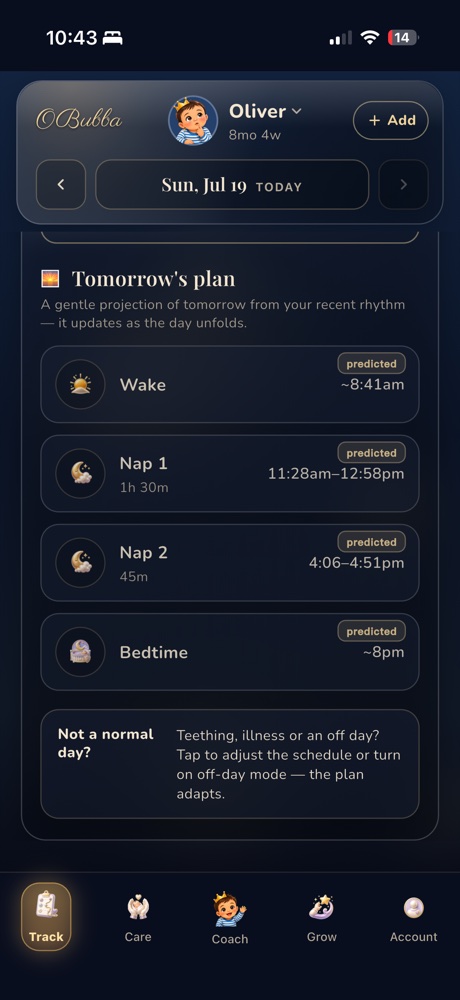
How the current OBubba app reads bedtime resistance
OBubba does not call a bedtime a “fight” merely because it looks late or a wake window falls outside a generic chart. The current detector needs a real settling-time signal—recorded manually or captured by supported sleep timing—and requires at least two recent nights where put-down-to-sleep took 25 minutes or longer.
It then compares the resistant nights with bedtime, age and total daytime sleep:
- late bedtime: a median bedtime at or after 8:30pm produces an overtired/second-wind hypothesis and an earlier-bedtime experiment
- early bedtime plus high day sleep: a median bedtime before 7pm combined with day sleep above the app's age range produces an under-pressure hypothesis and a gentle day-sleep cap
- roughly 8–10 months with neither timing signal: the app highlights separation awareness and new skills, then recommends a steady wind-down
- no clear discriminator: it reports the long settling pattern without inventing a precise cause
The dedicated resistance detector deliberately never tells a resisting baby to go later. A later-bedtime recommendation is only available elsewhere in the Sleep Consultant when a fuller set of logs supports an undertired or split-night pattern and conflicting overtired signals are absent. This protects against the common error of extending an already excessive final wake window.
The insight reports its sample size—“from 2 nights”, for example—rather than presenting a guess as certainty. Tomorrow's plan then keeps predicted naps and bedtime on the same screen, because a late nap, low day sleep and a missed nap should not all produce the same evening advice. Illness, teething and an unusual day can hold or adjust the plan.
OBubba cannot see tired cues, know when a baby is truly asleep, diagnose pain or illness, or verify that a cot is safe. Its conclusion is only as good as the sleep-onset and nap times recorded.
Recording sleep, the end of the final nap and bedtime settling in Track is free. Personalised Tomorrow's plan, Guidance and Care → Sleep Consultant are Premium features. OBubba unlocks Premium during pregnancy and through the first two corrected-age months; plan options follow after that early-free period.
Find the bedtime lever before changing everything →
Log the final nap end, the real put-down and when sleep begins. OBubba can then compare the repeated pattern before you change bedtime in the wrong direction.
Safer sleep still applies during a difficult settle
Always place your baby on their back at the start of sleep. Use a firm, flat mattress and keep the cot clear of pillows, duvets, bumpers, toys, pods, positioners and loose items. The Lullaby Trust's clear-cot guidance explains that a clear, flat, separate sleep space is safest.
If you pick your baby up to calm them, return them to their safe sleep space before you sleep. Never fall asleep together on a sofa or armchair. Do not incline the mattress or add a sleep positioner for reflux or difficult settling.
Frequently asked questions
Why does my baby cry as soon as the bedtime routine starts?
They may already associate the first step with separation, or the routine may be starting after they are overtired. Shorten it, add calm connection and compare the final wake window with easier nights. Also check hunger, discomfort and illness.
Does fighting bedtime mean my baby needs to drop a nap?
Not after one or two nights. A nap transition is more likely when the same nap is repeatedly refused, wake windows are lengthening and the pattern persists across one to two weeks. Use the nap-transition checklist before removing sleep.
Should I keep my baby up later so they are more tired?
Only if repeated logs show an early bedtime, generous day sleep and calm wakefulness. If the final wake window is already long or your baby is frantic, later can worsen overtiredness. Test changes in 10–15-minute steps.
Why is my eight-month-old suddenly standing in the cot?
New mobility and separation awareness often overlap. Practise standing-to-sitting during the day, calmly help if they are stuck and keep the bedtime response predictable. Do not add objects to the cot.
How long should it take a baby to fall asleep?
There is no universal pass mark. OBubba uses 25 minutes as the threshold for its pattern detector, and it still requires at least two nights. Your practical threshold is whether settling has changed, is repeatedly difficult and is no longer sustainable.
Is this the four-month sleep regression?
Possibly, but age alone does not explain a specific bedtime. Check naps, the final wake window, feeding and how long settling actually takes. Read the four-month sleep regression guide if the change includes more frequent waking and shorter sleep cycles.
What if moving bedtime earlier does not help?
Return to the old time and review the rest of the day. The baby may have had high day sleep, a late nap, separation discomfort or another unmet need. A failed experiment is useful evidence, not parental inconsistency.
Bedtime is data, not a battle
Your baby is not trying to win. Their behaviour is information: not ready yet, past ready, hungry, uncomfortable, practising, or asking whether you are still close.
Measure the real settle, use the day to choose a direction and change one small thing. A bedtime that works is not the earliest, latest or most independent one. It is the one that fits your baby's current sleep pressure and your family's capacity to respond.
Sources
- NHS: Helping your baby to sleep
- NHS Best Start in Life: Helping your baby sleep
- NHS: Sleep and young children
- NHS: Separation anxiety
- The Lullaby Trust: Keeping a clear cot
OBubba supports sleep records, pattern summaries, predictions and educational guidance. It cannot observe tired cues, diagnose a cause of distress, supervise sleep or replace advice from a health visitor, GP, NHS 111 or emergency services.
Ready to try OBubba?
Use OBubba to track feeds, sleep, naps, nappies, growth, milestones and family handovers in one calm baby tracker app.