Your baby finishes a feed with heavy eyelids, a relaxed jaw and one warm hand resting on you. It works. Then somebody calls it a “bad habit”, and suddenly a peaceful part of bedtime feels like a problem you created.
You did not create a bad baby or fail to teach sleep. Milk, sucking, warmth and closeness are powerful settling cues. In the early months, falling asleep during a feed is especially ordinary: the NHS says that a breastfed baby may doze during a feed and parents can carry on until the baby has finished or is fully asleep.
Feeding to sleep is not inherently bad, harmful or something every family must stop. Keep doing it while it works for you. Consider a gradual change only when your baby is developmentally ready, repeated waking appears to depend on recreating the feed and the pattern is no longer sustainable for your family. Even then, change how sleep begins—not whether genuine hunger is fed.
The short answer for tonight
| Your situation | What it means | What to do tonight | |---|---|---| | A young baby falls asleep feeding and transfers well | Common early-baby behaviour | Finish the feed and use a safe sleep space | | Feeding to sleep is peaceful and everyone is coping | It is working | Nothing needs changing | | Baby wakes, takes a substantial feed and returns to sleep | Hunger may be part of the wake | Feed responsively; do not call it a habit | | Baby wakes often, sucks briefly and needs the same feed to resettle | A feed-to-sleep link may be contributing | Log several ordinary nights before changing anything | | Bedtime feeding works but one parent is exhausted or unavailable | The routine may need another route to sleep | Build a song, cuddle and cot cue alongside the feed | | Waking changed suddenly with illness, pain or poor feeding | This is not a sleep-association project | Meet the need and seek advice when appropriate |
The important question is not “Does my baby feed to sleep?” It is “Is this still working, and what does the whole pattern show?”
Why feeding to sleep works so well
Feeding is more than calorie delivery. Responsive feeding includes noticing cues, offering closeness and responding to a baby's need for comfort as well as hunger. Sucking, skin contact, a familiar smell and a parent's regulated body all help a baby settle.
That makes feeding an efficient bedtime tool, particularly for newborns whose day-night rhythm and sleep cycles are still developing. The NHS also notes that babies have individual sleep patterns and that repeated night waking is normal in the first months.
Calling this a “bad habit” adds shame but does not improve the decision. In sleep language, an association is simply a condition a baby connects with falling asleep. A song is an association. The cot is an association. Being rocked, held, patted or fed can be associations too.
Associations are neutral. The practical difference is how easy they are for the family to recreate:
- the cot remains beneath the baby
- a consistent background sound can continue
- a short sleep phrase can be repeated by another carer
- feeding requires the feeding parent, milk and often a full transfer afterwards
If your baby surfaces between sleep cycles and looks for the conditions present at sleep onset, feeding may be the fastest way back. That can be completely manageable—or exhausting when it happens every hour. The family's experience matters.
A night feed is not the same as feeding to sleep
These ideas are often blurred together, but they require different decisions.
Feeding to sleep describes how a baby crosses from awake to asleep. Night feeding describes when milk is offered. Night weaning means deliberately reducing or removing one or more night feeds. Changing the bedtime association does not automatically mean a baby is ready to lose night calories.
A baby may fall asleep independently at bedtime and still wake genuinely hungry. Another may feed all the way to sleep at 7pm yet sleep a long first stretch. A third may take tiny, frequent comfort feeds because the feed has become the main resettling route. The clock alone cannot tell these apart.
Before reducing any milk, consider:
- age, including corrected age after prematurity
- growth and any feeding or medical guidance
- daytime milk intake
- whether the night feed is substantial or only a few sucks
- wet nappies and overall wellbeing
- whether waking is new, escalating or linked with illness
Do not stretch, dilute or withhold feeds to teach sleep. If you are thinking about reducing night milk, use the separate night-weaning readiness guide and speak to your health visitor, feeding professional or GP when you are unsure.
When feeding to sleep may be part of repeated waking
One difficult night is not evidence. A pattern becomes more plausible when several ordinary nights show most of the following:
- the baby is beyond the very early newborn phase
- the feed is essential at initial sleep onset
- many wakes are brief and settle only by breast or bottle
- the baby takes little milk at several of those wakes
- another need such as hunger, discomfort, illness or poor timing does not better explain them
- the pattern is wearing the family down
Even then, “association” is a working hypothesis, not a diagnosis. Babies can wake because a wake window was off, daytime sleep changed, they are learning a skill, the room is uncomfortable, they are teething, or they simply need their parent.
Track only meaningful wakes for three to five ordinary nights. Note bedtime, feed start and end, how the baby fell asleep, each wake that needed help, whether a real feed happened and how sleep resumed. A pattern across nights is more useful than a perfect spreadsheet from one terrible Tuesday.
Read what to track when your baby wakes at night for a short, practical record.
Before roughly three to four months: there is nothing to train
For a newborn or young baby, feeding and rocking all the way to sleep are developmentally normal. “Drowsy but awake” can be something you occasionally offer if it happens naturally; it is not a test your baby should pass.
Focus on:
- feeding responsively
- calm, low-light care at night
- daylight and normal household activity by day
- noticing early tired cues
- a simple, flexible wind-down
- safe transfer after the feed
- protecting the feeding parent's rest where possible
If your baby wakes during the transfer, soothe them again. You have not undone a lesson. There was no lesson due.
For premature babies, use corrected age when thinking about developmental readiness. Get individual advice when feeding, growth or medical needs complicate the picture.
If it still works, you can keep it
You do not need to change feeding to sleep because:
- another parent's baby settles differently
- social media says independent sleep is compulsory
- you fed to sleep during a regression or illness
- your baby sometimes needs extra closeness
- you enjoy this part of bedtime
It may continue to work until your baby naturally outgrows it. It may remain at bedtime while a partner uses a different method. Babies can learn that different carers have different routes to safety and sleep.
A change becomes reasonable when you want more flexibility: feeding is painful, transfers repeatedly fail, every wake falls to one depleted parent, a return to work changes availability, or short comfort feeds appear to be running the whole night.
The goal is not “never fall asleep at the breast or bottle again”. It is to add another reliable path.
A gentle four-stage feed-to-sleep swap
Do not start by taking the feed away. Start by making other cues familiar while the feed remains completely available. Use each stage for several nights and move only when the current one feels calm enough.
Stage 1: build the anchors without reducing the feed
Feed exactly as you normally do. Add the same short song or phrase at every bedtime and nap, use a steady routine order and finish in the same safe sleep space.
For example:
feed → cuddle → same song → cot
At first, your baby may already be asleep before the song. That is fine. Repetition is doing the work; you are not testing independence.
Keep this stage for at least four ordinary nights. Familiarity has to exist before it can carry any part of settling.
Stage 2: move the feed a little earlier
When the anchors feel familiar, move milk towards the start of the wind-down without reducing the amount offered:
feed → nappy or pyjamas → short book or cuddle → song → cot
For bottle feeds, keep using responsive, paced feeding: hold your baby and the bottle, allow pauses and stop when they show they are finished. Never prop a bottle or leave a baby feeding alone.
If moving the feed makes your baby frantic, hungry or much harder to settle, move it back. The sequence is a tool, not a rule.
Stage 3: end the feed drowsy rather than fully asleep
Once the earlier feed is accepted, try ending it when your baby is relaxed and heavy-eyed but not completely asleep. Continue with the cuddle, song and your reassuring presence.
For breastfeeding, if sucking has slowed and you want to try a gentle release, slide a clean finger into the corner of the mouth to break the seal. For a bottle, remove the teat only when the baby has stopped actively drinking and shows they are satisfied. If they root, search, protest or seem hungry, re-offer the feed.
“Drowsy but awake” is a direction of travel. If your baby falls asleep, the night is not failed. If they become distressed, settle them fully and try again another day.
Stage 4: let the song, cot and presence carry the last step
Keep the full feed early in the routine. Use the established song and cot as the final sleep cues, staying close and responding when your baby asks for more help.
At night, continue feeding genuine hunger. For a wake that usually involves only a few comfort sucks, you can first offer the new cue and calm presence. If the baby does not settle or shows feeding cues, feed them.
You can stop at any stage. A bedtime feed followed by a book may be all the flexibility your family needed.
What if another parent takes bedtime?
A non-feeding partner or carer does not need to imitate the feeding parent. They can use the shared parts of the routine—the same dim room, phrase, book, song and cot—then add their own cuddle, hold or hand-on-chest settling.
Start with an evening when the baby is fed and comfortably tired, not extremely hungry or overtired. The feeding parent may need to leave the immediate room because being visible can understandably prompt a request to feed.
Expect the new route to feel different. Responsive settling can include picking up, calming and trying the cot again. It does not require leaving a baby to cry.
If bedtime becomes a battle, return to the familiar method and practise only one small piece tomorrow. One successful cuddle after the feed is progress.
Pause the plan when the context changes
Optional sleep work should yield to real needs. Pause and use whatever safe settling works during:
- illness or fever
- a painful teething peak
- a growth spurt or noticeably increased hunger
- travel or a major childcare transition
- a developmental burst with unusually unsettled sleep
- feeding difficulty, poor weight gain or fewer wet nappies
- a week when the parent does not have enough support to continue gently
Going back to feeding to sleep is not regression. It is responsive care in a harder context. Resume from an easier stage only when life settles.
Safe sleep after a bedtime feed
The sleep method never changes the safe-sleep fundamentals. The NHS safer-sleep guidance says the safest place for a baby in the first six months is a cot or Moses basket, on their back, in the same room as a parent.
Use a firm, flat mattress and keep the sleep space clear of pillows, cot bumpers, toys, pods, positioners and loose bedding. After the feed, put your baby back in their cot before you go to sleep.
Never fall asleep with a baby on a sofa or armchair; this is a particularly high-risk situation. If you think you may drift off while feeding, plan ahead rather than relying on willpower at 3am. Ask another adult to stay awake with you where possible and read current Lullaby Trust co-sleeping guidance, including the situations when bed-sharing is especially unsafe.
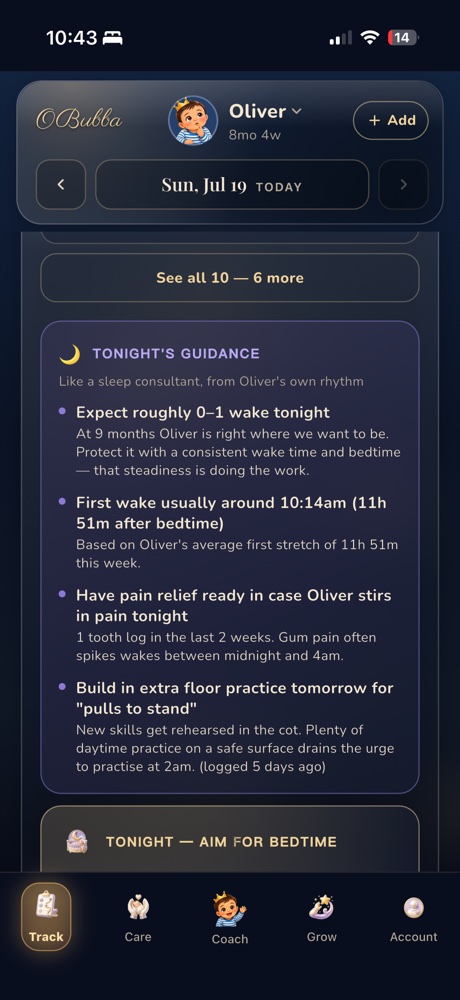
How the current OBubba app handles feeding to sleep
OBubba does not label a feed as a problem just because it happened before sleep. Its current logic separates ordinary feeding, genuine hunger, night-weaning readiness and a repeated sleep-onset pattern.
When a parent records how meaningful wakes were settled, the app can compare methods across the night. Its comfort-dependency insight needs at least three recorded resettles and only highlights one method when it accounts for at least 80% of them. That avoids turning one feed or one rough night into a verdict.
The app also checks context. Newborn age prevents a structured association plan. Illness, teething, travel and developmental disruption can downgrade or pause the interpretation. A large feed with low daytime intake can point towards hunger instead; logged hunger is not rebranded as a habit.
From roughly 17 weeks, if repeated records support feeding as the dominant parent-recreated settling cue and the family chooses to work on it, Care → Sleep Consultant can offer Swap feeding-to-sleep:
- Build the anchors: keep feeding exactly as now while adding the same song, cot and routine for at least four nights.
- Feed earlier: move milk to the start, followed by a book or cuddle, the song and the cot.
- End drowsy, not asleep: let the baby finish the final part of settling with the new cues.
- The song carries it: keep the awake feed early; use the song and cot for the last step while continuing to feed real night hunger.
This is a closed-loop plan rather than a four-night countdown. The Coach considers whether the current rung was actually tried and whether sleep improved. It can hold, advance or step back; disruption pauses progression.
OBubba cannot see latch quality, measure milk transfer, determine whether a baby is hungry, assess growth or verify that the sleep space is safe. The usefulness of its pattern depends on accurate records and never replaces personalised feeding or medical advice.
Recording feeds, sleep, meaningful wakes and how a wake was settled in Track is free. The personalised association Guidance and Care → Sleep Consultant plan are Premium features. OBubba unlocks Premium during pregnancy and through the first two corrected-age months; plan options follow after that early-free period.
Keep hunger and settling in the same picture →
Track feeds and meaningful wakes together, then use a gradual plan that knows the difference between a bedtime cue and milk your baby still needs.
Frequently asked questions
Is breastfeeding my baby to sleep bad for their teeth?
For a baby without teeth, dental decay is not the issue behind sleep-association advice. Once teeth arrive, follow current toothbrushing guidance and ask a dentist or health visitor about your child's individual risk. Do not abruptly remove needed milk based on a generic internet warning. Read when to start brushing your baby's teeth.
Will feeding to sleep cause more night waking?
Not necessarily. Some babies feed to sleep and manage long stretches. In others, frequent brief wakes repeatedly requiring the same feed suggest it may be one contributor. Look at multiple nights and rule in hunger, timing, discomfort and illness before changing the routine.
Can I feed to sleep for naps but not bedtime?
Yes. Babies can learn different routines for different contexts and carers. Consistency can make change easier, but it does not require identical settling at every sleep.
What age should I stop feeding to sleep?
There is no universal stopping age. The OBubba structured swap is age-gated from roughly 17 weeks, but age only makes an optional experiment developmentally plausible; it does not create an obligation. Keep feeding to sleep while it suits your family.
Does moving the bedtime feed earlier mean night weaning?
No. You can offer the same full bedtime feed earlier in the routine and still feed every genuine night hunger. Night weaning is a separate decision based on readiness and individual feeding needs.
What if drowsy-but-awake never works?
Treat it as a direction, not a destination. End the feed thirty seconds earlier, add a cuddle or let the song accompany the transfer. If your baby needs full help, give it. A tiny increase in flexibility is a valid outcome.
Should I give a bigger bottle so my baby sleeps longer?
No. Follow your baby's feeding cues rather than encouraging extra milk for sleep. The NHS advises holding both baby and bottle, allowing breaks and never forcing a baby to finish. Speak to your health visitor if you are worried about intake or growth.
You are allowed to keep the part that works
Feeding to sleep can be nourishing, regulating and deeply convenient. It can also become a job one exhausted parent no longer wants to perform twelve times a night. Both experiences are valid.
Do not start with removal. Build another cue, move the feed a little, follow hunger and keep responding. The gentlest change is the smallest one that gives your family the flexibility it actually needs.
Sources
- NHS: Helping your baby to sleep
- NHS: Safer sleep advice for babies
- NHS: Bottle feeding your baby
- UNICEF UK Baby Friendly Initiative: Responsive feeding
- The Lullaby Trust: Co-sleeping
OBubba supports records, pattern summaries and educational guidance. It cannot assess feeding, diagnose the cause of waking, determine whether a baby is ready to reduce milk, supervise sleep or replace advice from a health visitor, infant-feeding specialist, dentist, GP, NHS 111 or emergency services.
Ready to try OBubba?
Use OBubba to track feeds, sleep, naps, nappies, growth, milestones and family handovers in one calm baby tracker app.