Your baby barely pauses for milk all afternoon, then wakes ready for a proper feed at 11pm, 2am and 5am. By breakfast, they seem satisfied. By bedtime, you are wondering whether the whole feeding day has moved into the night.
Parents often call this reverse cycling: a baby takes a larger share of their milk overnight than during the day. It can happen when an older baby becomes distractible, starts nursery, spends more time away from a breastfeeding parent, refuses daytime bottles or simply discovers that night is quiet and feeding is easy.
Reverse cycling is an informal description, not a diagnosis. Do not suddenly remove night feeds. First check that feeding, growth and wet nappies are reassuring; then make daytime feeds easier and offer more calm opportunities. Night milk often reduces only after daytime intake grows—and some babies still genuinely need night feeds.
Is this reverse cycling—or just normal night feeding?
Night feeding is expected in young babies and remains normal for many older babies. A few night feeds do not automatically mean the pattern is reversed.
The label becomes useful when the contrast is consistent:
- daytime feeds are repeatedly brief, small or refused
- the baby takes fuller or longer feeds after bedtime
- much of the reliable daily milk intake happens overnight
- the pattern continues across several ordinary days
- night waking appears closely tied to taking a substantial feed
| What you see | More likely explanation | First response | |---|---|---| | A newborn feeds around the clock, including frequently at night | Normal newborn feeding | Feed responsively; do not try to shift intake into a schedule | | An older baby has one hungry night after a distracted or busy day | Day-to-day variation | Offer calmly the next day and watch, rather than changing the night immediately | | Day feeds stay small while repeated night feeds are full | Possible reverse-cycling pattern | Improve daytime feeding opportunities before reducing night milk | | A baby breastfeeds by day and has measured bottles at night | The daytime amount is unknown | Do not compare bottle millilitres as though they represent total intake | | Feeding drops day and night, with fewer wet nappies or unusual sleepiness | Possible illness, dehydration or feeding problem | Seek professional advice promptly |
The difference matters. Trying to “fix” normal newborn feeding can compromise intake and milk supply. Missing unmeasured breastfeeds can make a thriving combination-fed baby look as if they take almost nothing by day.
Why babies move more milk into the night
Usually there is not one single cause. Look for what changed shortly before the pattern began.
Daytime distraction
Around four months and beyond, the world becomes difficult to ignore. A voice, dog, sibling, bright window or passing trolley can interrupt a feed. At night, the same baby finds a dark quiet room, a familiar parent and no interesting competition.
A distractible baby may latch or take the bottle enthusiastically, stop after a few minutes, turn to look, then become hungry again sooner. This is not deliberate schedule manipulation. Attention is developing faster than the ability to ignore stimulation.
Returning to work or starting childcare
A baby who is separated from a breastfeeding parent may take less from a bottle or cup while away, then breastfeed frequently after reunion. Sometimes this is called “catch-up feeding”. The NHS confirms that returning to work does not mean breastfeeding has to stop: options include feeding before and after work, expressing, flexible arrangements and combination feeding.
Before a new routine begins, trial it gradually. Share the baby's early hunger and fullness cues with the carer, plus how the baby prefers to be held. Avoid saving all offered milk for one enormous bottle; smaller responsive opportunities may be less pressuring.
Bottle preference—or bottle refusal
Flow that is much faster or slower than the baby expects can change how they feed. Some breastfed babies wait for the breast; some bottle-fed babies become frustrated by a teat that does not match their comfortable pace.
Use paced feeding and invite rather than insert the teat. The NHS responsive bottle-feeding guide recommends following hunger cues, holding the bottle nearly horizontal, allowing pauses and never forcing a baby to finish.
If every daytime bottle has become a battle, stop turning each refusal into another attempt. Repeated pressure can make feeding more stressful. Our gentle bottle-refusal plan separates practical experiments from signs that need feeding support.
Feeding is easier when sleepy
Reflux discomfort, congestion, teething, oral pain, fast flow, slow flow or feeding-skill difficulty may be less obvious when a baby is drowsy. A baby who repeatedly refuses while fully awake but feeds only asleep deserves more attention than a baby who was distracted twice.
Do not diagnose reflux, tongue-tie or an oral aversion from the clock pattern alone. Ask a health visitor, GP, paediatrician or qualified feeding specialist to observe a feed when there is pain, coughing, choking, persistent arching, poor gain or ongoing refusal.
Solids displaced milk too quickly
Starting solids does not mean milk should disappear from the day. The NHS says breast milk or first infant formula should remain the main drink during the first year. A baby offered a large meal immediately before every milk feed may be less interested by day, then seek milk overnight.
Keep early portions small and follow your baby's cues. During the first stages of weaning, offer milk in the familiar rhythm and let solids provide practice with flavours, textures and eating skills. Read Will starting solids help my baby sleep through? before using food as a night-sleep strategy.
A temporary need for more milk or comfort
Growth, illness, teething and development can all change feeding and sleep for a few days. Breastfeeding is also comfort and connection, not only calories. UNICEF UK's responsive feeding guidance recognises feeding as nutrition, reassurance and relationship.
If the week is unusual, support the baby first. Decide whether there is a persistent rhythm after health and routine settle.
Do night feeds cause the night waking?
Sometimes hunger brings the baby fully awake. Sometimes a baby wakes for another reason and feeding is the quickest way back to sleep. Timing alone cannot prove which came first.
Ask what the feed looks like:
- Is there active, sustained drinking and swallowing?
- Is it a similar size or duration to a useful daytime feed?
- Does the baby stop on their own and appear satisfied?
- Or is it a few sucks after every brief stir?
A substantial feed is evidence that milk was wanted. Do not replace it with resettling simply because the clock says the baby “should” manage longer. A tiny comfort feed is still valid, but it may allow a different experiment if the baby is old enough, growing well and the family wants one.
Feeding to sleep and reverse cycling overlap, but they are not the same. One describes how sleep begins; the other describes when milk intake happens. Use the feeding-to-sleep guide if the settling association—not total intake—is the concern.
A gentle plan to move more milk into the day
The goal is not to make a baby consume a target volume. It is to remove daytime obstacles and create more chances to feed comfortably.
1. Observe for three complete days
Record actual feeds rather than impressions:
- start time
- breast side and approximate active minutes, or bottle amount offered and taken
- whether the feed happened by day, at bedtime or after a night wake
- alert, sleepy, distracted, upset or comfortable
- childcare and who offered the feed
- wet nappies and any relevant symptoms
Do not turn breast minutes into millilitres. Pump output does not measure what a baby transfers at the breast. If a feed is missing from the log, the daily total is incomplete rather than zero.
For night wakes, log one wake and link the feed to it rather than creating duplicate events. The guide to tracking night wakes without logging everything keeps the record useful at 3am.
2. Make one or two daytime feeds boring—in a good way
Try a calm, dimmer room before the baby is exhausted. Put the phone away, reduce conversation and ask siblings to give a little space. Some babies feed well just after waking, before stimulation builds.
This is an experiment, not a rule that every feed must happen in darkness. Daylight and normal family life still matter. Use the quiet setting for the feeds most often cut short.
3. Offer earlier cues, without pressure
Rooting, hand-to-mouth movement, lip movements and restlessness can appear before crying. Offer when the baby first signals interest. If they turn away, close their mouth, slow down or push the teat out, pause.
For bottles, keep the flow paced and let the baby decide when they are finished. Do not repeatedly encourage “just another 30ml” to buy sleep. The NHS explicitly notes that a bigger bottle does not guarantee a longer gap.
4. Add an opportunity, not a compulsory feed
If the day has a long gap, offer an extra breastfeed or responsive bottle at a naturally calm point: after waking, before going out, on reunion after childcare or before the bedtime routine becomes too sleepy.
An offer can be declined. Do not wake a thriving older baby from every nap or spend the afternoon coaxing milk. The aim is more accessible daytime intake, not conflict.
5. Review the childcare handover
Ask what “refused” meant. Did the baby turn away immediately, take a little, become distracted, dislike the position or accept milk from a different carer later? Check that feeds and leftover milk are being recorded accurately.
Share one concise plan: early cues, preferred position, teat and pace, usual approximate range, stop cues and who to contact. The shared baby-tracker guide helps carers build one record instead of separate versions of the day.
6. Let the night change second
After daytime feeding improves for several days, night feeds may become smaller, shorter or less frequent without being withheld. That is the safest direction of travel.
If nothing changes, do not cut harder. The baby may still need night intake, the daytime total may be underestimated, or a feeding difficulty may need support. For an older baby, use the night-weaning readiness checklist only after feeding and growth are reassuring.
Breastfeeding, bottles and combination feeding need different evidence
Breastfeeding
You cannot judge intake from minutes alone. A five-minute effective feed may transfer more milk than a long sleepy one. Look at swallowing, breast softening, contentment, wet nappies and growth, and ask for a feeding observation if concerned.
The NHS says night breastfeeding supports milk production in the early weeks. Do not use a reverse-cycling plan with a newborn or abruptly remove night feeds while supply is being established.
Bottle feeding
Volumes make day-night comparison easier, but they can tempt adults to chase a number. Feed responsively, pace the flow and accept fullness cues. Compare several days, not the single smallest daytime bottle with the single largest night bottle.
Combination feeding
Measured bottles are only part of intake. If breastfeeds by day are not measured—and they usually cannot be—the fact that night bottles contain more millilitres proves nothing about the full day-night balance.
That is why a trustworthy tracker should say “we do not know” rather than calculate a precise-looking deficit from partial data.
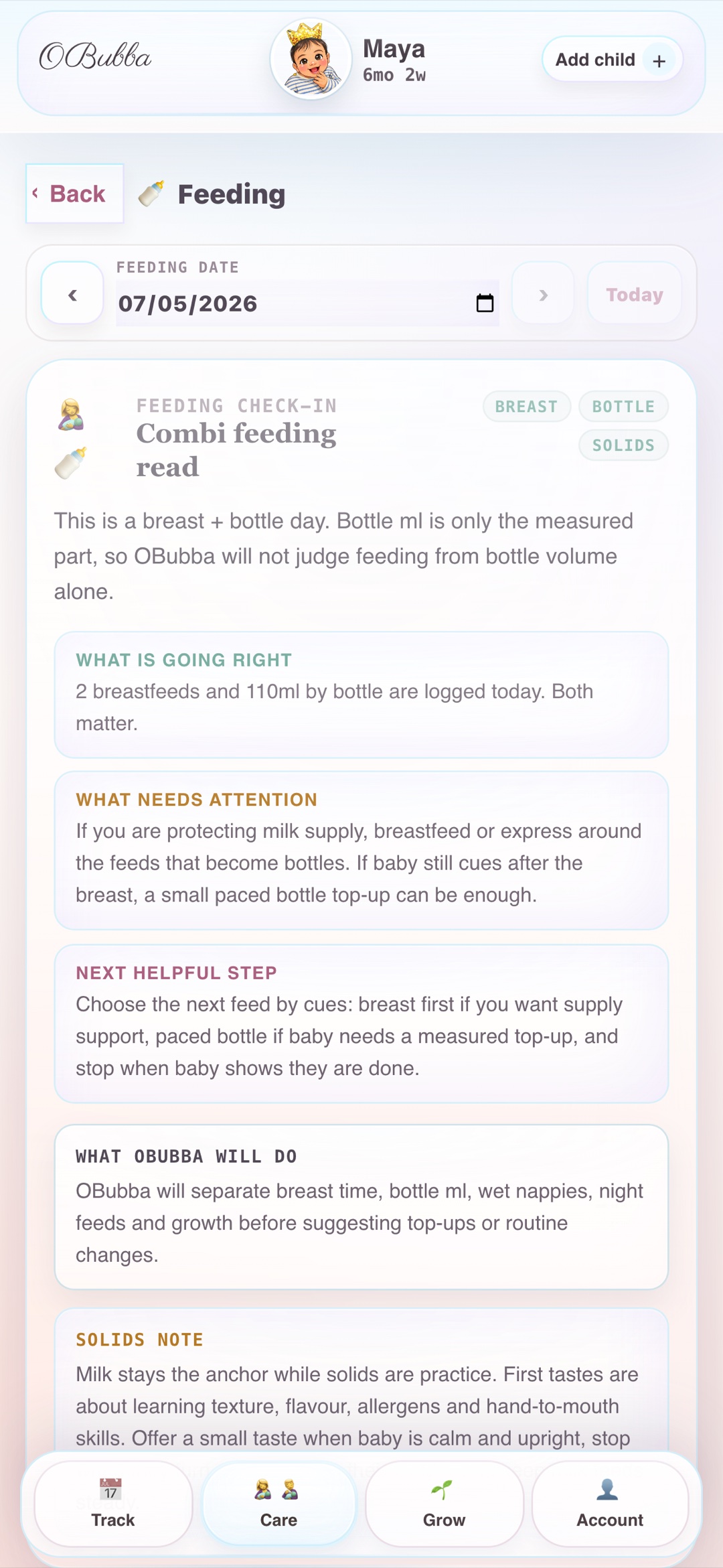
How the current OBubba app detects the pattern
OBubba does not label every night-fed baby as reverse cycling. The current feeding engine uses a deliberately narrow measured-volume signal:
- the baby must be at least 16 weeks corrected age when corrected age applies
- the recent record needs at least two measured daytime milk feeds and two measured night milk feeds
- the average measured night feed must be more than 30% larger than the daytime average
- the night-feed average must also exceed 100ml, avoiding a warning from a cluster of tiny comfort feeds
- solids, pumping output and dream feeds are excluded from the comparison
- if any unmeasured daytime breastfeed appears in the window, the detector switches off rather than pretending daytime bottle millilitres are the whole intake
When the signal is strong enough, OBubba says the baby is taking bigger feeds overnight and suggests offering a little more milk and an extra opportunity by day. It does not instruct the parent to stop a night feed suddenly.
The current Feeding deep-dive shows today's breast, bottle and solids feed counts, measured milk and the last recorded feed. On Track, the separate daily milk card says clearly when its total covers bottle and expressed milk only because breastfeeding is not measured in millilitres. Wet nappies stay visible in their own Track card, while growth remains in Grow. Those surfaces give parents useful context, but the narrow reverse-cycling detector itself does not pretend that nappy or growth records prove why night feeding changed.
These thresholds are product guardrails, not medical definitions of reverse cycling. OBubba cannot see swallowing, assess latch, diagnose a feeding aversion or know whether weight gain is appropriate. Its job is to surface a possible pattern without converting incomplete data into a confident claim.
Logging breast, bottle and night feeds in Track is free. Personalised feeding-pattern insights and the Care → Feeding deep-dive are Premium features. OBubba unlocks Premium during pregnancy and through the first two corrected-age months; plan options follow after that early-free period.
See whether night is carrying the feeding day →
Keep day and night feeds on one timeline, including which feeds were measured and which were breastfeeds. OBubba can then distinguish a repeated measured pattern from one exhausting evening without inventing missing intake.
When to get feeding or medical help
Speak to your health visitor, GP, paediatrician or an appropriately qualified feeding specialist if:
- your baby persistently refuses feeds while awake
- feeds involve coughing, choking, colour change, sweating, pain or marked breathlessness
- vomiting is frequent, forceful, green or bloody
- your baby has fewer wet nappies than expected
- weight gain has slowed or you have been told growth is faltering
- your baby is unusually sleepy, difficult to wake or seems unwell
- feeding pressure and refusal are escalating
- you are concerned about milk supply or breast pain
The updated NHS guide to signs a breastfed baby is getting enough milk uses effective feeding, weight gain, wet nappies and stools—not pump output or a single feed duration.
Seek urgent help for breathing difficulty, blue or grey colour, severe dehydration, a baby who cannot be roused or any life-threatening emergency. In the UK, call 999 for an emergency and use NHS 111 or your GP for urgent advice as appropriate.
Make night feeds safer while the pattern changes
Sleep deprivation can make feeding riskier. Prepare what you safely can before bed, keep the baby close and return them to their own clear, firm, flat sleep space before you go to sleep.
Never feed on a sofa or armchair if you may fall asleep. Never leave a baby alone with a bottle or prop a bottle in bed. If you are struggling to stay awake, wake another adult where possible and follow safer-sleep guidance rather than relying on willpower.
UNICEF UK's Caring for your baby at night brings night feeding, parental rest and safer sleep together. A plan to shift feeding should never make the immediate night less safe.
Frequently asked questions
What age does reverse cycling start?
There is no official age threshold because reverse cycling is not a diagnosis. It is often discussed after babies become more distractible or spend time away from a parent. OBubba waits until 16 weeks before surfacing its measured-volume signal; younger babies need responsive around-the-clock feeding rather than intake shifting.
Can a breastfed baby reverse cycle after I return to work?
Yes, a baby may take less milk while separated and breastfeed more after reunion or overnight. It does not mean breastfeeding must stop. Plan trial days, expressing or partial breastfeeding according to your goals, and get support if intake, supply or bottle refusal is a concern.
Should I offer a bottle before bed to stop night feeds?
Only if it fits your feeding plan and your baby shows hunger. A large bottle does not guarantee longer sleep, and forcing the finish risks overfeeding. A responsive bedtime feed is different from using milk as a sleep dose.
Will solids fix reverse cycling?
Not reliably. Milk remains the main drink through the first year, and large solid meals can displace daytime milk. Keep solids developmentally appropriate and do not add cereal or food to a bottle.
Should I wake my baby for an extra daytime feed?
Follow any individual feeding plan. For a healthy older baby, try offering at natural waking points before routinely interrupting naps. The nap-waking decision guide explains when feeding or timing may justify a gentle wake.
How quickly can the pattern change?
Some families notice night feeds soften after several days of easier daytime opportunities; others need longer, especially around childcare transitions. Judge a week of complete data rather than expecting one quiet feed to transform that night.
Is every wake with a feed caused by hunger?
No. Babies wake for many reasons and feeding also provides comfort. Active, substantial drinking suggests milk was wanted, but the app cannot prove why the wake began. Meet the need, then review the pattern rather than withholding first and asking questions later.
The calm bottom line
If your baby feeds more at night than by day, start by making daytime feeding easier—not by making night feeding unavailable.
Protect newborn and medically necessary feeds. Respect hunger and fullness cues. Separate measured bottles from unmeasured breastfeeding. Look for three complete days, then offer quiet feeds, earlier cues and an extra low-pressure opportunity. If day intake grows and the baby is ready, the night may adjust behind it.
And if it does not, that is information. It may mean your baby still needs the milk, the daytime record is incomplete or a feeding professional should help you look more closely.
This article provides general information and is not medical advice. Follow your baby's individual feeding plan and seek professional support for concerns about intake, growth, hydration, pain, illness or feeding skill.
Ready to try OBubba?
Use OBubba to track feeds, sleep, naps, nappies, growth, milestones and family handovers in one calm baby tracker app.