Your baby is finally asleep. The house is quiet, the washing can wait—and then you notice the time. The nap has run longer than usual. Do you protect the sleep they clearly need, or wake them before bedtime disappears over the horizon?
For a healthy baby who is growing and feeding well, you usually do not need to wake them because one nap ran long. Wake when an individual feeding plan requires it, or consider a gentle nap limit when the same late or long nap repeatedly makes bedtime or night sleep harder. The younger the baby, the more cautious you should be about restricting daytime sleep.
The useful question is not “How long is a baby allowed to nap?” It is “What does this baby need today, and what pattern appears across several ordinary days?”
The quick decision guide
| What is happening? | Let the nap run or wake? | Why | |---|---|---| | Your newborn has a feeding plan from a midwife, health visitor, neonatal team or doctor | Follow the plan, including waking if advised | Feeding, hydration, jaundice and weight gain take priority over a sleep schedule | | A healthy, growing baby has one unusually long nap after a poor night, travel, vaccination or a busy morning | Usually let them sleep | One restorative nap is not a pattern and may be exactly what they need | | A late final nap repeatedly pushes bedtime much later | Consider a gentle wake-up or shorter late nap | The timing of the nap may leave too little awake time before bed | | Several days of unusually high daytime sleep repeatedly coincide with long bedtime settling or more night waking | Test a small cap, not a dramatic cut | A repeated relationship is more useful than a generic chart | | An older baby or toddler's single nap routinely runs into late afternoon and bedtime is becoming difficult | A consistent end time may help | A stable limit can protect the evening without removing the nap | | Your baby is ill, unusually sleepy, feeding poorly or difficult to wake | Do not treat this as a scheduling problem | Seek clinical advice; urgent symptoms need urgent care |
If none of these describes the day, pause before waking. A timer reaching a round number is not, by itself, a reason.
Newborn feeding changes the answer
In the early weeks, a long sleep can mean a feed is missed. That makes “Should I wake my newborn?” a feeding and health question before it is a nap question.
The NHS says newborns may sleep in short or long bursts and that their sleep patterns vary. It also advises responsive feeding. As a rough guide, the NHS breastfeeding guidance says babies feed at least eight times in 24 hours in the first few weeks; another NHS guide notes that eight to twelve feeds or more can be common.
Those numbers are not permission to replace your baby's individual plan with an online schedule. You may be specifically advised to wake for feeds if your baby:
- was born prematurely or had a low birth weight
- has jaundice
- has not yet regained birth weight
- is gaining weight slowly
- is not taking enough milk or producing the expected wet nappies
- is very sleepy at the breast or bottle
- has another medical or feeding concern
For jaundice, the NHS advises trying to wake a sleepy baby for feeds and seeking support if needed. If your maternity or neonatal team gave you an interval for feeds, use that interval until they tell you it is safe to change it. Corrected age may matter for a premature baby.
Do not stretch feeds in pursuit of a longer nap or better night. If you are unsure whether your baby is taking enough, use weight, feeding effectiveness, alertness and nappy output with professional support. The NHS guide to signs a baby is getting enough milk is a useful starting point, but it does not replace an assessment.
Once a clinician is happy with growth and feeding, many babies can lead more of the timing. Ask at the next review rather than guessing when to stop waking.
When it is usually fine to let the nap continue
Letting a nap run is often the gentler choice when the day is unusual rather than repeatedly difficult.
After a poor night
A baby who woke frequently, started the day early or had discomfort overnight may need more daytime recovery. Cutting the first good nap can turn tiredness into a harder afternoon. Watch the whole day before deciding that bedtime needs protecting.
During recovery or a growth spurt
Sleep can change around illness, immunisations, developmental bursts and increased feeding. Rest and comfort matter more than preserving a perfect timetable. Follow clinical advice during illness and return to experiments when your baby is well. The post-illness sleep reset explains how to rebuild rhythm without forcing it on the first recovery day.
When the nap is early enough not to crowd bedtime
A generous morning or lunchtime nap does not automatically cause a difficult bedtime. Timing matters. A two-hour nap that ends at noon has a different effect from a two-hour nap that ends at 5pm.
When nights and bedtime are already working
If your baby settles comfortably, wakes in a way that feels manageable and is thriving, there may be nothing to fix. A chart can provide context, but it cannot see the family outcome. Do not manufacture a problem because another baby takes shorter naps.
When contact is helping your baby sleep
A contact nap is not spoiled sleep. If the adult is fully awake, it can be a practical way to rescue rest. If there is any chance you may fall asleep, move the baby to a safer sleep space; sofas and armchairs are especially hazardous. Read Do contact naps ruin night sleep? for a gradual, no-shame approach.
When waking may genuinely help
A nap cap should solve an observed problem. It should not be a rule looking for one.
1. Your feeding or medical plan says to wake
This is the clearest reason. Follow the plan even if the baby seems deeply asleep. Ask the professional who made it what signs and milestones will allow it to change.
2. The last nap repeatedly pushes bedtime late
Suppose your baby normally settles comfortably after a final nap ending around 4:30pm. On three recent days the nap ended after 5:30pm, bedtime took forty minutes and actual sleep moved much later. That is a pattern worth testing.
Try waking just 10–15 minutes earlier for three comparable days. Keep the rest of the routine steady. If settling becomes easier without creating an exhausted evening, hold the change. If the baby becomes frantic or the night worsens, restore the sleep.
This is different from waking every nap. The late final nap is the most precise lever. Our guide to a baby fighting bedtime helps distinguish a content, undertired protest from overtired distress.
3. Total daytime sleep is repeatedly high for this baby
Some babies naturally sleep more than average. The useful signal is not merely being above an age table; it is high daytime sleep occurring repeatedly alongside a real problem such as very long settling, long periods awake overnight or a much later morning start than the family can sustain.
Look at at least three nap days. Missing logs are unknown, not zero. If only one complete day looks high, gather more information before cutting sleep.
Then make the smallest change available: trim one nap by 10–15 minutes, preferably the late one. Do not shave time from every nap. Compare bedtime settling, night wakes and mood over the next three to five days.
4. An older baby or toddler needs a stable single-nap end
When a child is established on one nap, a long sleep running late into the afternoon can repeatedly crowd bedtime. A reasonably consistent wake time may help the body anticipate the evening.
Keep the nap itself. Move its start earlier if possible, or wake gently at the chosen end. If the child suddenly needs much more sleep for a few days, consider illness, a very early morning or accumulated tiredness before assuming the cap has failed.
If naps are being refused rather than running long, use the nap-transition checklist. Do not drop a nap solely because bedtime was difficult twice.
Time of day matters more than an arbitrary maximum
Parents often search for “Is a three-hour nap too long?” But duration without context is incomplete.
Ask four questions:
- How old is the baby? Young infants need frequent, irregular sleep. Older babies and toddlers usually have a more consolidated pattern.
- When did the nap begin and end? Late sleep is more likely to affect bedtime than early sleep of the same length.
- What happened before it? A poor night or short earlier naps may explain a longer recovery nap.
- What happens afterwards, repeatedly? Easy bedtime means the nap may fit. Repeated long settling provides a reason to experiment.
A schedule should describe a pattern, not police it. Even on a fairly regular week, feeding, nursery, travel and development can move a nap.
A five-day nap-cap experiment
If you have identified a repeated problem, use a small experiment rather than rebuilding the entire day.
Days 1 and 2: observe
Record:
- the actual start and end of each nap
- whether the baby woke independently
- total daytime sleep
- the last nap end
- bedtime put-down and actual sleep onset
- night wakes and morning wake
- feeds, illness, travel or other disruptions
Do not infer a zero-minute nap from a blank day. If childcare or a contact nap was not logged, mark the day incomplete.
Days 3 to 5: change one thing
Choose one gentle adjustment:
- wake from the final nap 10–15 minutes earlier
- keep a toddler's one nap ending near a consistent time
- move the late nap earlier if the day allows
Keep feeds responsive and do not extend an already difficult wake window just to hit bedtime. If the baby is clearly exhausted, use an earlier bedtime instead of forcing them through.
At the end, compare medians or the typical experience—not the best single night. Did settling become shorter? Did the first night stretch improve? Was the evening calmer? Did the baby become overtired? A failed experiment is evidence to restore the sleep, not proof that you were inconsistent.
How to wake a sleeping baby gently
If it is time to wake, make the transition gradual:
- Open the curtain or raise the room light a little.
- Use your ordinary voice and say their name.
- Place a calm hand on their chest or gently stroke a hand or foot.
- Unzip or remove the sleeping bag if the room is warm enough.
- Pick them up slowly and hold them upright.
- Offer a feed if one is due, especially when waking under a feeding plan.
Allow a few minutes of grogginess. A baby woken from deeper sleep may seem cross or confused. Do not shake, startle, splash with water or use loud noise.
If your baby is unusually hard to rouse, floppy, breathing differently, feeding poorly, has fewer wet nappies or seems unlike themselves, seek medical advice promptly. Call 999 for a life-threatening emergency; in the UK use NHS 111 or your GP for urgent advice when appropriate.
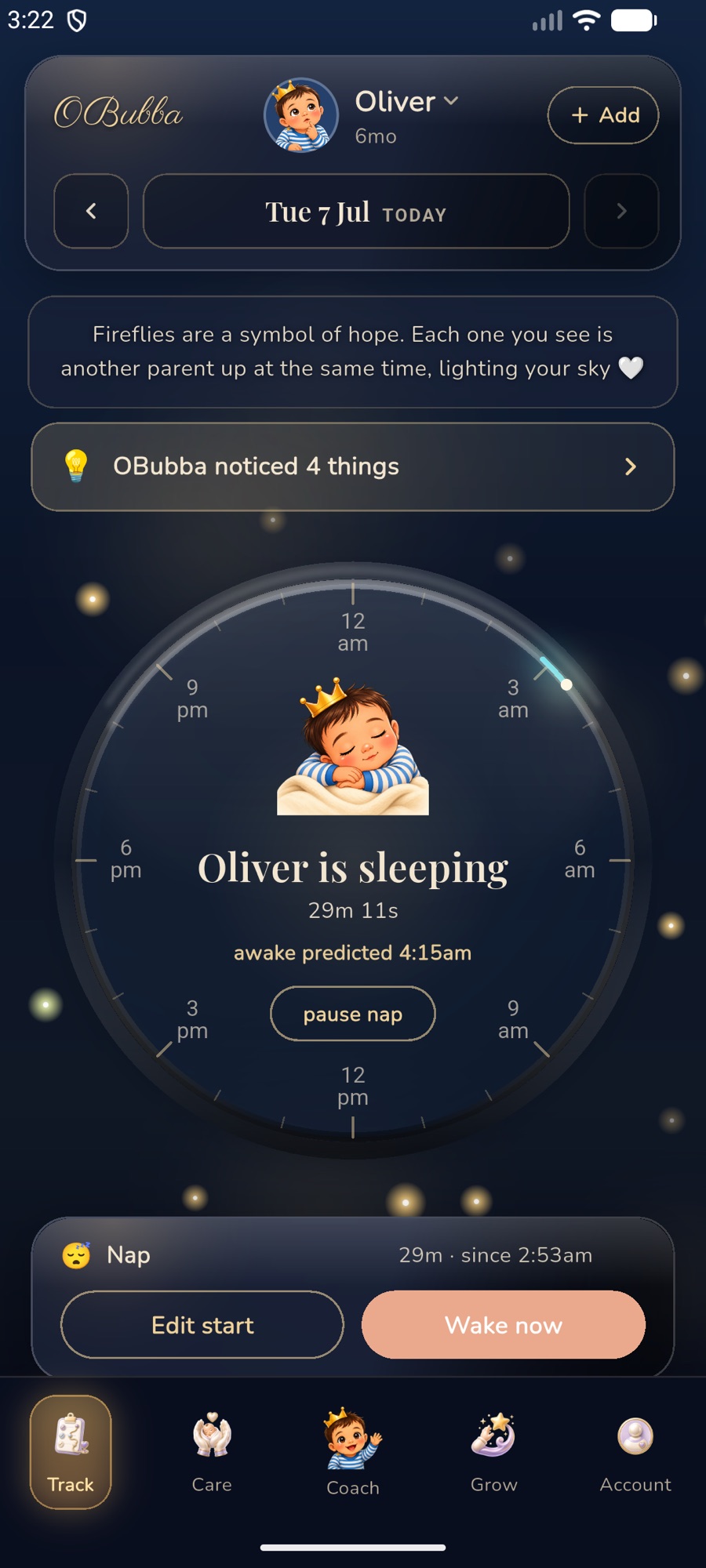
How the current OBubba app handles long naps
OBubba's live nap clock shows elapsed sleep and a predicted awake time, but the prediction is not an alarm or an instruction. The parent ends the record with Wake now when the baby actually wakes or when they choose to wake them. A brief stir can be paused and resumed without falsely ending the nap.
The current app is deliberately conservative about nap caps:
- Young infants are protected. The Sleep Consultant uses generous age ranges under about three months and explicitly avoids prescribing restrictive nap caps to newborns.
- One day is not enough. A high-day-sleep finding needs at least three days with naps logged, and stronger wording requires excess sleep on repeated days. A missing nap day is treated as missing data, not as a day with no sleep.
- Personal patterns need real samples. Correlation insights require at least eight nights carrying the relevant factor. For a continuous factor such as late last-nap time, both sides of the comparison need at least three nights and the difference must be meaningful—at least 0.7 extra wakes on average.
- Correlation is not declared as cause. The app says a factor “tends to” accompany more wakes. It proposes a small experiment rather than claiming the nap caused the night.
- Only future predictions are adjusted. If a reliable late-nap pattern supports an earlier end, the day plan may shorten a projected nap to that personalised time, provided at least 15 minutes of nap remains. It never rewrites a nap the parent already logged.
- Conflicting advice is reconciled. The engine will not simultaneously tell a family to protect naps and cap naps. Illness, low daytime sleep and overtired signals can protect sleep instead.
For a toddler on one nap, the consultation may suggest gently waking when the single nap repeatedly exceeds the personalised daytime range. For a multi-nap baby, it can preserve the first nap and shorten a later one instead. That distinction keeps the intervention narrow.
OBubba cannot assess feeding effectiveness, weight gain, jaundice, tired cues or whether a baby is clinically difficult to rouse. A professional feeding plan always outranks the app. What it can do is keep actual nap times, bedtime settling and night waking together so parents can test whether the suspected relationship exists in their own family.
Using the live nap clock and recording when your baby actually wakes are free in Track. Personalised sleep correlations, Tomorrow's plan, Guidance and Care → Sleep Consultant are Premium features. OBubba unlocks Premium during pregnancy and through the first two corrected-age months; plan options follow after that early-free period.
See whether the nap is really the problem →
Record what happened instead of waking by a generic timer. Several complete days can show whether the nap is actually crowding bedtime or simply giving your baby the sleep they need.
Keep every nap safer
Put your baby on their back at the start of every sleep. Use a firm, flat mattress in a clear, separate sleep space without pillows, duvets, bumpers, pods, positioners, toys or loose bedding. The Lullaby Trust explains why a clear cot matters.
The NHS recommends that a baby's cot or Moses basket be in the same room as a parent for the first six months. If a contact nap is ending because the adult is becoming sleepy, transfer the baby to their sleep space. Never plan to sleep with a baby on a sofa or armchair.
Waking a baby does not make an unsafe sleep surface safer. Safe-sleep guidance applies whether the nap is ten minutes or three hours.
Frequently asked questions
Should I wake my baby from a three-hour nap?
Not automatically. Consider age, feeding, health, time of day and the repeated effect on the rest of sleep. A newborn may need waking under a feeding plan. A healthy older baby taking one restorative early nap may not. A late three-hour nap that repeatedly delays bedtime is a reasonable target for a small, gentle cap.
Should I wake my newborn to feed?
Follow the plan given by your midwife, health visitor, neonatal team or doctor. Waking is often advised in the early weeks when there is jaundice, prematurity, low birth weight, slow gain or concern about intake. If you do not know whether your baby still needs waking, ask rather than extending the interval yourself.
Will a long nap ruin night sleep?
One long nap rarely proves anything. In some babies, repeated high daytime sleep or a late final nap accompanies harder nights; in others it does not. Track several complete days and test a 10–15-minute change before making a large cut.
Should I wake my baby at the same time every morning?
A reasonably consistent morning can help anchor an older baby's day, but newborn sleep is irregular and feeding comes first. If an older baby sleeps far later after a disrupted night, a little recovery may be more useful than rigidly enforcing the clock.
Should the last nap end at a particular time?
There is no universal last-nap deadline. Work backwards from the bedtime at which your baby actually settles well, using their recent comfortable final wake window. If later nap endings repeatedly create bedtime resistance, move the end earlier in small steps.
What if my baby wakes angry from every capped nap?
The cap may be too early, the change may be too large, or the baby may need the sleep. Restore 10–15 minutes and reassess. If nights were already manageable, there may be no benefit to capping at all.
Can I wake a baby to prevent a false start?
Only if repeated logs connect a late or excessive nap with the false start. False starts can also follow overtiredness, discomfort or a mistimed bedtime. Use the baby false-start guide before removing daytime sleep.
The gentle bottom line
Let a healthy baby sleep unless there is a clear feeding, health or repeated timing reason to intervene. If there is a reason, wake gently and change as little as possible.
Newborn feeding plans come first. One unusual nap is not a pattern. For an older baby, three to five complete days can reveal whether a late nap or high daytime sleep genuinely accompanies a harder bedtime. That is enough to run a small experiment—without turning every precious nap into a stopwatch.
This article is general information, not medical advice. Follow your baby's individual feeding and care plan. Seek professional help for concerns about feeding, weight gain, jaundice, hydration, breathing or unusual sleepiness.
Ready to try OBubba?
Use OBubba to track feeds, sleep, naps, nappies, growth, milestones and family handovers in one calm baby tracker app.