You open the book. Your baby grabs the cover, chews a corner, wriggles backwards and closes it before the first sentence is over.
That was still story time.
Reading with a baby is not a test of sitting still, listening quietly or reaching the final page. It is a shared moment made of your voice, a picture, a touch and a pause. Some nights that lasts ten minutes. Some nights it lasts forty seconds.
The useful goal is not finish the story. It is make books feel warm, familiar and easy to return to.
What does a bedtime story do for a baby?
A baby may not understand a plot, moral or every word, but they can take part in the rhythm of reading: hearing your voice change, watching your face, touching a picture and noticing the same phrases return.
The NHS guide to helping a baby learn to talk says you do not have to read every word; looking at a book and talking about what you can see counts. The Department for Education’s early-years reading guidance also describes adults sharing books with babies by following a favourite picture, letting them grab or point and talking about what they notice.
At bedtime, a short story can also become one familiar part of winding down. The NHS baby sleep guide includes reading among the calm activities that can form a simple bedtime routine.
If you want the rest of the sequence to feel just as manageable, use our simple baby bedtime routine as a flexible starting point rather than a checklist you have to complete perfectly.
That does not make a story a sedative. It cannot guarantee a faster settle, prevent night waking or teach a baby to sleep independently. Its job is smaller and kinder: offer connection and a predictable bridge towards sleep.
How long should a baby’s bedtime story be?
Start with one to five minutes and stop while the experience still feels calm. A newborn may only listen to a paragraph. An older baby may turn the same two pages repeatedly. A toddler may ask for the entire book again.
The right length is the one your baby can enjoy tonight—not the time printed on the cover.
Look for signs they are still available for interaction:
- looking towards your face or the page
- relaxing against you
- reaching, patting or turning a page
- babbling, smiling or copying a sound
- bringing the book back after moving away
Slow down or finish when they turn away repeatedly, close their eyes, yawn, arch, cry, push the book away or become more frantic. “Goodnight, book” is a perfectly good ending.
Bedtime stories by age: what participation can look like
Age bands are suggestions, not performance targets. Follow your baby’s corrected age where relevant and any individual advice from your neonatal or healthcare team.
Newborn to 3 months: your voice is the story
Choose a calm moment when your baby is awake and settled. Hold them securely or read while they lie beside you on a clear floor mat. Keep the book out of the sleep space.
You can:
- read one short paragraph slowly
- recite a rhyme you know by heart
- describe a single picture
- repeat your baby’s name in a gentle phrase
- pause when they move or make a sound
The words do not have to be written for babies. The NHS neonatal guidance from University Hospitals Sussex notes that parents can read a children’s book, something they enjoy or simply describe pictures; familiar voice and interaction matter more than completing a particular text.
If your baby is receiving neonatal care, ask the unit when and how they are ready for voice interaction, especially if they are medically fragile or showing stress cues.
3–6 months: look, sound and touch
Babies at this stage may watch faces, reach towards pictures and enjoy exaggerated rhythm. Try a sturdy book with one clear image per page.
Point and use a short phrase: “Soft bunny. Hop, hop.” Make one quiet animal sound, then wait. If your baby reaches for the page, bring the book closer rather than guarding it like a precious object.
They may mouth the book. Use an intact, wipe-clean baby book without loose paper, damaged laminate or detachable pieces, and supervise the whole time.
6–12 months: let the story move
An older baby may twist around, bang the cover, skip pages, crawl away and return. This is not poor concentration. It is how they explore.
Try:
- letting them choose between two books
- reading on the floor so movement is safe
- pointing to one object and naming it
- copying their babble before continuing
- letting them turn forwards or backwards
- reading the same line each time they reopen a favourite page
The NHS 6-to-12-month language guide encourages sharing stories, letting babies touch shapes and textures, and using everyday moments for communication. Listening does not have to look like stillness.
12–24 months: invite, do not quiz
Toddlers may point, label, finish a repeated phrase or act out a sound. Keep questions playful: “Where is the moon?” is an invitation, not something they need to answer correctly.
If questions interrupt the calm, return to simple comments: “The bear is sleepy. The moon is bright.” Let your child choose the page, supply a funny noise or carry the book to another safe spot.
A five-minute bedtime-story routine
Use this tiny sequence when the evening already feels full.
1. Settle the room, not the baby
Dim bright overhead lights and reduce background television or noise. Sit somewhere safe and supported: on the floor, in a chair or beside the cot. Do not place books, cushions, phones or toys inside the cot.
2. Offer one choice
Show one familiar story, or two if your baby is old enough to reach for a preference. Too many options can turn a quiet transition into another stimulating activity.
3. Read less than you think you should
Open with the title or one repeated phrase. Read slowly. Leave space for a look, touch, sound or page turn. If your baby skips ahead, follow them.
4. Use the same closing line
Choose something simple: “The story is finished. It is time for sleep.” Repetition can make the transition recognisable even when the book changes.
5. Put the story away before sleep
Move the physical book and any device out of the cot, then follow your usual safe-sleep steps. The Lullaby Trust advises a clear, flat, separate sleep space with a firm mattress and no toys, pillows, bumpers or other unnecessary items.
What if my baby will not sit still for books?
Change your picture of successful reading.
Read beside movement
Sit on the floor and read while your baby rolls, crawls or stands with safe support. They may still be listening even when they are not looking at the page.
Use one page as the whole story
Point to the moon. Whisper “moon.” Trace its shape with your finger. Add “goodnight, moon.” You have created a beginning, middle and end without turning the page.
Let them control the book
Allow safe grabbing, closing and page skipping. A baby learning that their action changes the shared experience is participating, not ruining it.
Tell instead of read
If the printed sentences are too long, paraphrase. Name the pictures, make a gentle sound or tell a twenty-second story about the character. The National Literacy Trust’s early-language guidance stresses that looking, pointing and talking about pictures all count.
Move story time earlier
If every book ends in tears, your baby may be too tired by that point in the routine. Try the story before the final feed, before tooth-brushing or ten minutes earlier. The story does not have to be the final action before the cot.
Is it okay to read the same bedtime story every night?
Yes. Repetition gives your baby familiar sounds and lets them participate differently as they grow. One night they may watch your mouth; weeks later they may reach for the rabbit or anticipate a repeated phrase.
You do not need to introduce a new moral, vocabulary list or educational theme every evening. A favourite story can be valuable precisely because nobody has to work hard to know what comes next.
If you are bored, change your voice, describe a different picture or swap in a short rhyme while keeping the same opening and closing ritual.
What if I do not feel confident reading aloud?
Your baby is not reviewing your performance.
Read in the language that feels most natural. Use your ordinary voice. Skip words you dislike. Make up a line. Talk about the illustration. If another carer feels more comfortable singing, they can sing the page instead.
The connection is not created by perfect pronunciation or dramatic character voices. It comes from attention and response.
Using a story app without turning bedtime into screen time
If you read from a phone, treat it as your script, not a video for the baby to watch:
- hold and control the device yourself
- lower the brightness and silence notifications
- keep the baby focused on your voice and face
- avoid animations, autoplay and rapid visual changes
- put the device away before placing the baby in their sleep space
The World Health Organization’s under-five activity guidance encourages interactive, non-screen reading and storytelling with a caregiver during sedentary time. That makes a phone best treated as your script, not the baby’s show. If the lit screen makes your baby more alert, preview the story earlier and retell it from memory, or choose a physical book instead.
How OBubba’s current bedtime-story library works
In the current app, open Care → Bedtime Stories, or tap Choose a bedtime story inside the Bedtime Routine screen. The separate Track → More logs → Bedtime Story tile records a story-time moment; it does not open the library.
The library contains 12 original, curated stories about kindness, sharing, honesty, patience, courage, gratitude, perseverance, empathy, helping others, forgiveness, keeping promises and gentleness. They are stored in the app and work offline; the library does not generate a new story or send story content to an external service each time you read.
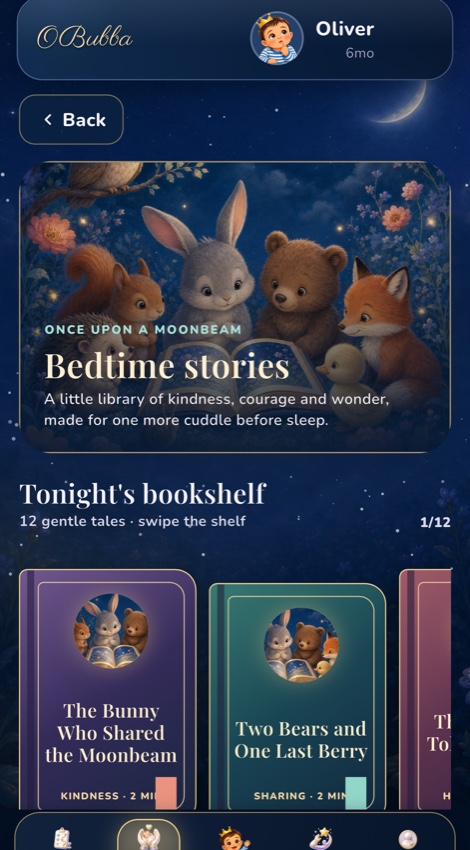
Each book shows its value and an estimated calm reading time. Open one and the reader presents:
- a cover and dedication using your baby’s first name
- one story paragraph per page
- a final “little lesson” and personalised goodnight line
- progress and page numbers
- Open the story, Turn the page and Finish story controls
Tapping Finish story on the final page adds a reading entry with the story title to the child’s timeline. If a late-night read finishes after midnight but before the app’s morning boundary, it is filed with the previous evening rather than making the routine look split across two days.
The stories themselves are content, not baby data. OBubba does not infer whether your baby listened, understood the lesson or fell asleep. Finishing and logging are optional; closing after one page is still a valid story time.
This library is also different from OBubba’s Tonight’s Story sleep feature. Bedtime Stories are tales to read aloud. Tonight’s Story is a separate summary of logged sleep patterns and evening guidance. Neither can observe your baby or guarantee sleep.
Make story time easy to return to → Bedtime stories, a repeatable routine, sleep and feed tracking, weaning, play ideas and family memories in one calmer app.
Quick answers
When should I start reading bedtime stories to my baby?
You can read aloud from birth. Begin with a few quiet lines when your baby is awake and comfortable. There is no need to wait until they understand the plot or can hold a book.
Does a baby need to look at the book?
No. A baby can listen while looking at your face, wriggling nearby or touching the cover. Keep the interaction safe and responsive rather than demanding eye contact.
What type of book is best for a baby?
Choose an intact, age-appropriate book that is easy to hold and inspect. Sturdy board, cloth or bath books often cope best with grabbing and mouthing. Simple pictures and repeatable language make it easy to shorten the story.
Should story time happen before or after the final feed?
Either can work. Place it where your baby is calm enough to enjoy it and where it fits your family’s sequence. If they become very sleepy during the feed, try reading earlier.
Will a bedtime story make my baby sleep through?
No single routine step can promise that. Reading can provide a calm, familiar transition, but babies still wake for hunger, comfort, development, illness and many other reasons.
Sources and further reading
- NHS: Helping your baby to sleep
- NHS: Help your baby learn to talk
- NHS Start for Life: Listening and learning, 6 to 12 months
- Department for Education: Early-years reading comprehension
- National Literacy Trust: Their story starts with you
- BookTrust: Bookstart Baby for parents and carers
- WHO: Physical activity, sedentary behaviour and sleep for under-fives
- NHS Best Start in Life: Safer sleep
- The Lullaby Trust: Keeping a clear cot
OBubba provides records, general educational content and a curated reading library. It cannot observe a child, assess language or development, diagnose sleep problems, guarantee safer sleep or replace advice from a health visitor, GP or other qualified professional.
Ready to try OBubba?
Use OBubba to track feeds, sleep, naps, nappies, growth, milestones and family handovers in one calm baby tracker app.