You have offered broccoli, pear and avocado. The tiny spoon is getting more attention than the food. Then somebody says babies need iron from six months and suddenly a relaxed tasting plate feels like a nutritional exam.
The useful answer is much simpler: once your baby starts solids at around six months, regularly include an iron-containing food alongside their usual breast milk or first infant formula. You do not need to weigh every lentil, calculate a daily milligram total or make your baby finish a portion.
The NHS recommends including iron-containing foods such as meat, fish, fortified breakfast cereal, dark green vegetables, beans and lentils. At the beginning, how much a baby eats matters less than learning to eat. Milk remains their main source of nutrition while food variety and quantity build gradually.
The five-second version
At a meal, choose one iron-rich base, prepare it in a safe texture and add a fruit or vegetable containing vitamin C when convenient.
| Iron-rich base | Baby-safe starting texture | Easy vitamin C partner | |---|---|---| | Beef, lamb, chicken or turkey | Slow-cooked and finely shredded, minced or blended into mash | Broccoli, tomato or soft pepper | | Lentils, beans or chickpeas | Cooked until very soft and mashed into dhal, houmous or a thick purée | Tomato, cauliflower or strawberries | | Fish | Cooked, carefully checked for bones and flaked finely | Peas, broccoli or potato | | Egg | Properly prepared for the egg type, then mashed or cut into graspable strips | Kiwi, berries or broccoli | | Tofu | Soft tofu mashed, or firm tofu cooked and offered in soft strips | Soft pepper, tomato or orange segments prepared safely | | Iron-fortified baby cereal | Mixed to a soft texture with breast milk, formula or water | Mashed berries, pear or kiwi |
Vitamin C can help the body absorb iron, particularly the type found in plant foods. It is a useful pairing, not another rule that makes a meal “fail”. Lentils without a strawberry still count.
Why iron comes up when weaning begins
Iron helps the body make haemoglobin, the part of red blood cells that carries oxygen. It also supports normal growth and development. That is why UK guidance shifts attention towards iron-containing foods when complementary feeding starts.
This does not mean breast milk has suddenly become inadequate or that formula should stop. “Complementary feeding” means solid foods begin to complement milk. Breast milk or first infant formula remains the main drink throughout the first year.
It also does not mean every healthy six-month-old is iron deficient. Iron deficiency anaemia is a medical condition confirmed through clinical assessment and, when indicated, blood tests. A meal diary can show what was offered; it cannot show a baby's haemoglobin or iron stores.
Some babies need individual guidance earlier or more urgently. This includes babies born prematurely or with a low birth weight, babies with restricted diets, feeding or absorption difficulties, poor growth, or a condition affecting their blood. Ask your health visitor, GP, paediatrician or dietitian rather than trying to solve those needs from a general food list.
When should I offer iron-rich foods?
For most babies, solids begin at around six months when the three readiness signs appear together: they can stay sitting with a steady head, coordinate food to their mouth, and swallow rather than push food straight back out.
From the start, iron-rich foods can sit beside vegetables and fruit. There is no need for a vegetables-only “stage” lasting several weeks before protein foods appear. The NHS guidance for babies from around six months includes meat, fish, eggs, beans, pulses and tofu as suitable foods at this age.
A realistic progression looks like this:
- At the first tastes: offer a small amount once a day, including iron-rich choices regularly.
- As eating skills grow: increase variety and the number of eating opportunities gradually.
- From about seven months: many babies move towards three meals a day alongside their usual milk feeds.
- At every stage: respond to hunger and fullness rather than setting a clean-plate target.
A baby who licks a lentil spoon has still met a new flavour. Repeated calm exposure is how eating skills develop.
The best iron-rich foods for babies
There is no single “best” food. A useful rotation includes different sources because they bring different nutrients, tastes and textures.
Soft meat
Beef, lamb, pork, chicken and turkey provide iron as well as protein and zinc. The iron in meat is generally absorbed more readily than iron from plant foods.
Try:
- slow-cooked beef shredded across the grain
- soft minced lamb stirred into mashed potato
- chicken blended with sweet potato and broccoli
- turkey mince cooked into a low-salt tomato sauce
- a large, very tender strip of meat for a baby to suck and gnaw while supervised
Meat must be cooked safely. Remove bones, gristle, tough skin and hard or rubbery pieces. A dry cube of meat can be difficult to manage; moisture and a soft texture matter more than presenting a perfect-looking portion.
Fish
Fish provides iron, protein and other useful nutrients. Oily fish such as salmon also supplies omega-3 fats.
Cook it thoroughly as appropriate, remove the skin if tough, and check carefully for every bone before mashing or flaking it. Mix with potato, peas or soft vegetables if the flakes are dry. Follow current NHS limits for particular fish, and never offer shark, swordfish or marlin to babies and children.
Lentils, beans and chickpeas
Pulses are affordable plant sources of iron and work well for both spoon feeding and baby-led weaning.
Try:
- red lentil dhal cooked until completely soft
- cannellini beans mashed with tomato
- chickpeas blended into smooth, low-salt houmous
- black beans mashed into soft sweet potato
- thick lentil patties that squash easily between finger and thumb
Whole firm beans and chickpeas can be difficult for early eaters. Cook them until soft and mash or flatten them. Check canned versions for added salt and rinse them well.
Egg
Egg contributes iron alongside protein, fat and choline. It is also a common allergen, so introduce it in a small amount on its own at first, earlier in the day when you can observe your baby.
Eggs carrying the British Lion mark can be served raw or lightly cooked under NHS guidance, but many parents find a fully set omelette strip, hard-boiled egg mashed with avocado, or softly scrambled egg easier for early weaning. Eggs without the Lion mark should be cooked until the white and yolk are solid.
Once egg has been introduced and tolerated, keep it in the baby's usual diet. See the step-by-step baby allergen guide for reaction signs and safe pacing.
Tofu and soya
Tofu supplies plant iron and protein. Silken tofu can be mashed into vegetables; firm tofu can be cooked and cut into soft strips. Soya is a major allergen, so introduce it deliberately and continue offering it if tolerated.
Choose plain tofu rather than salty, smoked or heavily seasoned adult products.
Iron-fortified cereal
Fortified porridge or baby cereal can be a practical iron source, especially on busy mornings. “Fortified” means nutrients have been added; ordinary oats are not automatically fortified.
Check the label rather than relying on the front of the packet. Look for iron in the nutrition information, an age-appropriate product, and no unnecessary added sugar. Mix it to a manageable texture and change the thickness as your baby's skills progress.
Wheat and some cereals contain gluten, another allergen to introduce individually and then keep in the diet if tolerated.
Dark green vegetables
Spinach, broccoli, kale and peas contribute some iron and plenty of other nutrients. They are valuable, but a spoonful of broccoli does not provide the same kind or concentration of iron as meat or a deliberately chosen pulse or fortified cereal.
Think of green vegetables as part of the iron picture rather than making them carry the whole plan. Pair spinach with lentils, broccoli with beef, or peas with fish.
Animal iron and plant iron: what is the difference?
Iron in food is often discussed as two types:
- Haem iron, found in meat and fish, is absorbed more easily.
- Non-haem iron, found in pulses, tofu, vegetables and fortified foods, is absorbed less efficiently.
That does not make plant foods inferior or mean a baby needs meat. It means variety and helpful pairings matter more in a plant-based pattern. The NHS says children who do not eat meat or fish can obtain iron from foods including fortified cereals, green leafy vegetables, beans and lentils.
For a vegetarian baby, rotate lentils, beans, chickpeas, tofu, egg if included, fortified cereals and dark green vegetables. For a vegan baby, careful planning is important because iron is only one of several nutrients to consider, including vitamin B12, calcium, iodine, vitamin D, protein, fats and energy. Ask a health visitor or paediatric dietitian for personalised advice.
Use vitamin C as an easy helper
The NHS explains that vitamin C helps the body absorb iron. You do not need juice or a supplement to create the pairing. Ordinary fruit and vegetables work.
Easy combinations include:
- beef and tomato
- lentils and broccoli
- chickpea houmous and soft pepper
- tofu and cauliflower
- porridge and mashed strawberries
- beans and sweet potato
- egg and kiwi
- salmon and peas
Serve fruit in an age-appropriate form: berries sliced or mashed, hard fruit cooked, grapes quartered lengthways, stones and pips removed. Juice is not necessary and is best avoided before 12 months.
Do milk feeds block iron absorption?
Do not drop, delay or ration normal breastfeeds or formula feeds to “make room” for iron. Milk remains central during the first year, and the NHS does not ask parents starting solids to run a precise milk-versus-iron timetable.
As appetite develops, meals and milk naturally find a rhythm. A relaxed practical approach is to offer solids when your baby is awake and receptive, not extremely hungry or completely full, and continue responsive milk feeds.
Do not change responsive milk feeds to chase iron absorption. NHS guidance says milk remains the main drink while iron-containing foods join the diet from around six months.
Cow's milk can be used in cooking from around six months but should not replace breast milk or first infant formula as the main drink before 12 months.
How much iron-rich food does a baby need?
Public NHS weaning guidance does not give parents a universal gram target for each six-month-old meal. Appetite, milk intake, developmental stage, prematurity and health all differ.
Use a food-pattern goal instead:
- Put a small iron-containing choice on the plate.
- Add a familiar fruit, vegetable or starch.
- Let your baby decide what enters their mouth and when they stop.
- Offer another iron-rich choice at a later meal rather than compensating or force-feeding.
As a baby moves towards three meals, it becomes easier to include an iron source regularly across the day. You are responsible for what, when and where food is offered. Your baby decides whether and how much to eat.
Do not use an adult supplement, iron tonic or multivitamin containing iron unless a qualified clinician specifically recommends the product and dose for your baby. Iron supplements can be harmful when used incorrectly and should be stored securely away from children.
Seven quick iron-rich meal combinations
These are ideas, not a prescribed meal plan. Adapt the texture to your baby's skills and introduce allergens individually before combining them.
1. Lentil, tomato and sweet potato mash
Cook red lentils until they collapse. Mix with soft sweet potato and cooked tomato. Leave it smooth, mashed or gently lumpy depending on stage.
2. Beef and broccoli bowl
Slow-cook unsalted beef until very tender, shred finely and mix through mashed potato. Add very soft broccoli on the side or stirred in.
3. Strawberry porridge
Prepare an iron-fortified cereal according to its instructions. Stir in mashed strawberry after it cools. Check whether the cereal contains a new allergen such as gluten or milk.
4. Egg, avocado and kiwi plate
Offer an omelette strip or mashed egg, soft avocado and prepared kiwi. Introduce egg alone before serving this combination.
5. Chickpea and pepper houmous
Blend very soft chickpeas with cooked red pepper and a little water or suitable milk to loosen it. If adding tahini, introduce sesame separately first.
6. Salmon, pea and potato mash
Cook the salmon, check meticulously for bones and flake it through soft potato and peas. Fish is a major allergen, so start with a small amount on its own.
7. Tofu, tomato and soft rice
Mash plain tofu into a low-salt tomato sauce and soft rice. Confirm that the texture holds together rather than scattering into dry grains.
No added salt, stock cube, honey or sugar is needed. Family food can work if you remove the baby's portion before salting and prepare it in a safe shape.
Safe serving still comes first
Nutrient-rich food is not useful if it is presented as a choking hazard.
- Sit your baby fully upright in a stable highchair.
- Stay within arm's reach throughout the meal.
- Cook food until it can be squashed easily between finger and thumb.
- Remove bones, stones, pips, gristle, tough skins and hard pieces.
- Mash round beans and chickpeas for beginners.
- Never offer whole nuts or a thick spoonful of nut butter.
- Adapt shape and texture as skills change rather than following age alone.
Gagging can be noisy and is part of learning; choking may be quiet because the airway is blocked. Read the gagging versus choking guide and learn infant first aid before you need it.
Common iron-rich foods such as egg, fish, wheat cereal, soya and sesame in houmous may also be allergens. Introduce new allergens one at a time in small amounts. If tolerated, keep offering them as part of the usual diet. Stop and seek appropriate advice if a reaction occurs.
What if my baby refuses every iron-rich food?
One refusal tells you almost nothing. Babies may need many calm exposures to accept an unfamiliar flavour or texture.
Try changing one variable:
- mash lentils more smoothly or make them thicker for easier self-feeding
- serve shredded meat mixed into a familiar vegetable
- offer a loaded spoon and a soft finger-food option together
- use the same iron source in a different format
- eat the food alongside your baby
- offer a tiny amount without praise, pressure or bargaining
Avoid hiding every iron-rich food indefinitely. Familiarity includes seeing, touching and tasting the ingredient. If refusal is broad, meals are persistently distressing, swallowing looks difficult, growth is a concern or your baby accepts very few textures, speak with your health visitor or GP.
The no-pressure solids plan can help you separate ordinary learning from signs that need support.
Can I tell if my baby is low in iron?
Not from a single symptom and not from an app. Babies have tired days, variable appetites and changing complexions for many reasons.
Iron deficiency anaemia can be associated with pallor, low energy, poor appetite, breathlessness or growth concerns, but these signs are not specific. Some children with mild anaemia have no obvious symptoms. A clinician considers the whole picture and may arrange a blood test.
Ask for professional advice if your baby:
- was premature or had a low birth weight and you are unsure about their iron plan
- has a very restricted diet or prolonged feeding difficulty
- is unusually pale, lethargic or breathless
- is not growing as expected
- has persistent vomiting, diarrhoea or another condition affecting nutrition
- was prescribed iron and you are unsure how to give it
Do not wait for an app insight if your baby seems seriously unwell. Use NHS 111, your GP or emergency services according to the severity of the symptoms.
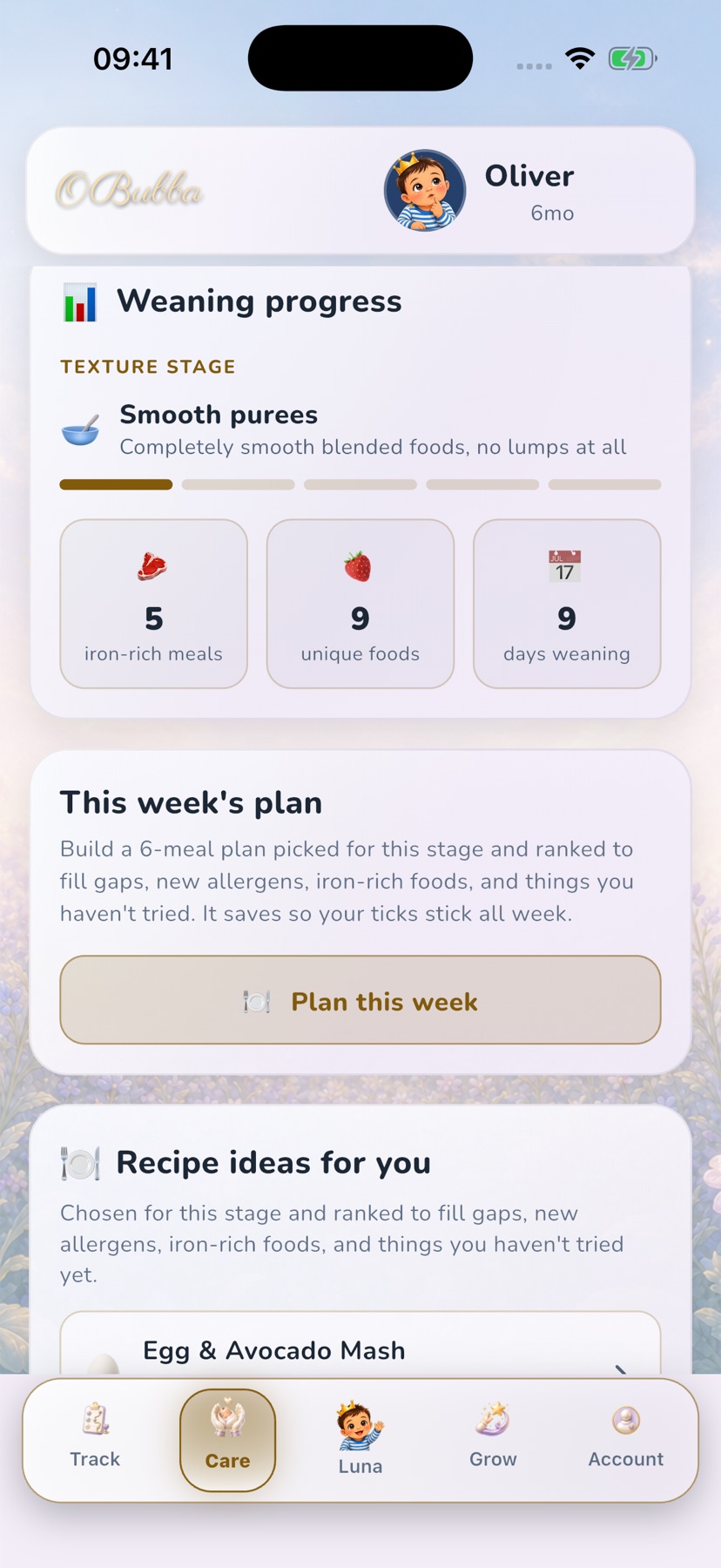
How the current OBubba app helps
OBubba's Care → Weaning & First Foods area is designed around the real question parents face at 5pm: “What could I offer next?”
The current app can:
- search 34 first-food ideas by food, nutrient or allergen
- show age guidance and a safer serving suggestion for each food
- recognise logged iron-rich meals using food-name boundaries, so “goat” does not falsely count as “oat” and “jellybean” does not count as “bean”
- surface a gentle iron-gap prompt from 26 weeks only after at least three recent solids meals and no recognised iron source in roughly the last 21 days
- count iron-rich meals and unique foods in Weaning Progress
- rank recipe ideas around developmental stage, iron, untried foods and new allergens
- exclude any allergen with a recorded reaction from future recipe suggestions
- build a saved six-meal weekly plan and derive a tickable shopping list from its ingredients
The intelligence stays deliberately bounded. A logged “beef stew” can count as an iron-rich meal, but OBubba does not know how much beef was swallowed, how much iron was absorbed or what a blood test would show. Missing logs are missing information, not proof that a baby ate no iron.
That is the product's useful role: carrying the mental load of variety and remembering what was tried, while leaving appetite to the baby and medical assessment to qualified professionals.
The 34-food reference, solids logging, Weaning Progress and the six-meal weekly plan are free. Premium expands the personalised recipe selection and full recipe garden. The whole app is unlocked during pregnancy and through your baby's first two corrected-age months.
Let the app remember which food comes next → Keep first foods, allergens, milk feeds, nappies, growth and sleep in one calm record, then let the app suggest what could fill the next genuine gap.
A calmer way to think about this week
Instead of asking, “Did my baby hit the iron target today?”, try three smaller questions:
- Did I make an iron-containing food available?
- Was it prepared in a way my baby could safely explore?
- Can I offer another source later in the week without pressure?
That is enough to build a pattern. Some meals will be eaten. Some will decorate the bib. Some foods will disappear for a month and return as favourites.
Iron matters, but the goal is not a perfect plate. It is a growing rotation of safe, varied foods beside responsive milk feeds, with a parent who can see the bigger picture without needing to remember every spoonful.
This article provides general information, not medical advice. Follow your baby's individual feeding plan and seek advice from your health visitor, GP or paediatric dietitian for concerns about prematurity, restricted diets, feeding, growth, iron deficiency or supplements.
Ready to try OBubba?
Use OBubba to track feeds, sleep, naps, nappies, growth, milestones and family handovers in one calm baby tracker app.