You want to write something your child can read one day. Then the blank page starts asking impossible questions. Should it be profound? Should you summarise the whole year? What if the beautiful words arrive only after the baby wakes?
The best letter to your baby is not a perfect account of parenthood. It is a small piece of life that only you can give them: what they are like now, what you notice, what this season feels like and what you hope they will always know.
Start with one concrete detail. “You kick both feet when the bath begins” will carry more of this moment into the future than a page of polished generalities.
A simple structure when the page feels too big
Use five short parts. One or two sentences for each is enough:
- Date the moment: your baby's age and where you are writing
- Describe now: one expression, sound, habit or favourite thing
- Tell one tiny story: something that happened this week
- Say what changed in you: an honest thought about being their parent
- Leave one promise or hope: something loving that does not depend on who they become
That might produce a letter as simple as this:
3 September — six months old
Right now, you greet the morning by thumping both heels against the cot mattress. Yesterday you laughed when the dog sneezed, then stared at us as if we had all missed the funniest joke in the world. I am learning that ordinary days can feel enormous. I hope you always know that you never had to perform to be loved here.
It is specific, truthful and short enough to finish during a nap.
12 prompts for a letter to your baby
Choose one prompt, not all twelve. A focused letter often feels more alive than a complete yearly report.
1. “Right now, you always…”
Describe a repeated action you would recognise anywhere: rubbing the corner of a muslin, squealing at the mirror, examining every label on a toy or wrinkling their nose before a smile.
These details are easily forgotten precisely because they are ordinary.
2. “The sound of this season is…”
Perhaps it is early babbling, the same bedtime song, the click of bottles being assembled or rain against the window during night feeds. Sound can bring a period of family life back instantly.
3. “Today, you surprised us by…”
Write about a new movement, expression, taste or response without turning it into a performance score. The value is in your observation, not whether it happened before another baby's.
4. “The person who can always make you smile is…”
Record a relationship in motion. What does the person do? Is there a private greeting, ridiculous noise or game that belongs to them?
5. “Something difficult we made it through was…”
You can acknowledge reflux, broken sleep, feeding uncertainty, illness or a hard family transition without making your child responsible for adult feelings. Keep the focus on care, endurance and what helped.
Try: That month was tiring, but we kept taking turns, asking for help and finding our way back to one another.
6. “A completely ordinary moment I want to keep is…”
Bath water on the floor. A warm head against your shoulder. The serious concentration required to pick up a pea. Ordinary moments are often the most recognisable years later.
7. “You are learning…”
This can be a skill, but it can also be something broader: trusting a new carer, exploring textures, making your preferences known or returning to play after frustration.
Describe what you see. Avoid predicting what it means about their future personality or ability.
8. “Parenthood is teaching me…”
A letter does not have to pretend you arrived fully formed. You might be learning patience, how to accept help, how little control a timetable offers or how many emotions can exist in one tired afternoon.
Write to your future self as much as to your child. The person who opens the letter may need reminding of how far the whole family travelled.
9. “Our family looks like this today…”
Families change. Name the people, pets, places and rituals that surround your baby now. Include chosen family and carers who matter, without forcing the story into a standard family tree.
10. “One thing I hope never changes is…”
Choose something unconditional: that home can be a safe place to return to, that questions are welcome or that love will not be measured by achievements.
Avoid prescribing a career, identity, interest or version of success. A future letter should make room for the child who actually arrives.
11. “If you are reading this on a hard day…”
Offer a message that works beyond a birthday: rest is allowed, help is available, one difficult day is not a verdict and they belong before they achieve anything.
Keep it in your own voice. Your familiar words will matter more than a quotation found online.
12. “Before I close this letter, I want you to know…”
Say the thing you do not want lost beneath logistics: you love them; you are glad they are here; they did not need to earn delight; you were watching closely even when the days moved quickly.
This prompt also gives an unfinished letter a natural ending.
What to write when the year was not picture-perfect
A keepsake does not need to erase difficult parts, but it should respect the child who may read it later.
Write from your own position:
- “I felt frightened and asked for support” rather than “you made me terrified”
- “feeding took time for us to work through” rather than assigning blame
- “we were living through a difficult change” rather than including adult conflict the child did not choose
- “there were days I felt low” without making the child responsible for fixing it
Some experiences belong in a private adult journal, a conversation with a trusted person or professional support rather than a future child's keepsake. Before sealing, ask: is this theirs to carry, or mine to process elsewhere?
Honesty and emotional burden are not the same thing. You can say a season was hard while also making clear that your child was loved through it.
A five-minute writing method
If you are tired, use this timer-friendly version:
- Pick one photo from today or this week.
- Write what is outside the frame: the sound, smell, joke or feeling.
- Add one sentence beginning “I hope you know…”
- Read it once for anything too private or unfair.
- Save or seal it before editing the life out of it.
Aim for 100 to 250 words. A longer letter is welcome, but length is not proof of love. If you have only thirty seconds, save three lines: Today you… / I felt… / I hope…
When should the letter be opened?
Choose a reveal moment that matches the purpose of the letter.
- Next birthday: close enough to become a yearly family ritual
- A milestone birthday: more distant, but easier to forget to maintain or deliver
- A difficult future day: meaningful, though impossible to schedule precisely
- No fixed date: flexible, but it may remain unopened indefinitely
If you write often, an annual reveal is manageable: each letter captures one chapter while it is still fresh. You can read it privately, share it with your child when age-appropriate or keep it as part of the family archive.
The reveal date does not need to make the letter ceremonial. Reading it over breakfast in pyjamas still counts.
How OBubba’s current Time Capsule works
In the current app, open Account → Memories & data → Time Capsule. The screen invites you to write a letter to your future self about the fleeting chapter you are living with your baby. The text field holds up to 3,000 characters, so there is room for a few lines or a substantial letter.
OBubba calculates the child's next birthday from the date of birth stored in the profile. If no date of birth is available, it falls back to one year from the day the letter is sealed. After you tap Seal this letter, the app confirms the reveal date and the letter body remains hidden in the Time Capsule until that date.
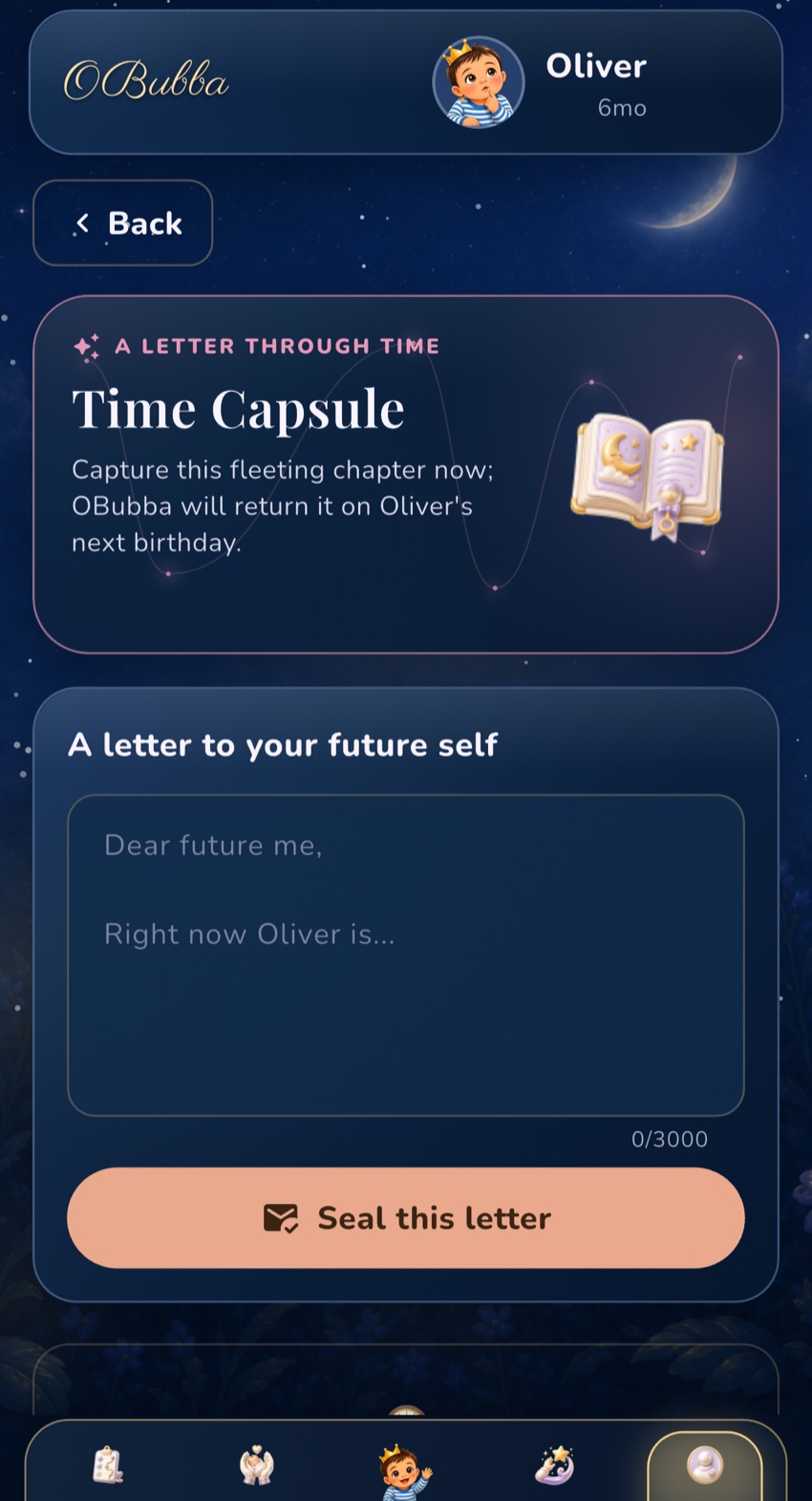
There are important boundaries worth knowing:
- the current screen has no edit or delete action after a letter is sealed, so reread it first
- “sealed” means the app conceals the body until its reveal date; do not treat that wording as a promise of end-to-end encryption
- the reveal happens inside the app; do not rely on a notification or email arriving automatically
- letters are saved locally and, for a connected child profile, backed by the child's cloud data
- the app treats letters as append-only and merges copies so a concurrently added co-parent letter is not overwritten
While the text stays hidden, the child's Grow → Memory Book can include a dated “A letter sealed for later” teaser and count the sealed letter. It does not expose the contents in the timeline or shared Memory Book text. If you want a lighter weekly keepsake habit too, use this low-pressure baby Memory Book system.
The pregnancy experience also offers a Write to baby action. It saves into the same Time Capsule format and uses the next birthday when a date of birth is available, or a one-year fallback when it is not.
This is what makes the feature more than a notes box: it links the words you write during pregnancy or daily family life with a future reveal, while allowing the existence of that letter to become part of the baby's broader keepsake story.
Try OBubba free → — track the care happening today and preserve a few words for the parent and child who will look back tomorrow.
Before you seal it: a 30-second check
Read the letter once and ask:
- Is the date or age clear?
- Does it contain at least one detail only our family would know?
- Have I written from my experience rather than blaming my child?
- Is there anything too private to store or eventually reveal? Our pregnancy and baby app privacy checklist can help you make that decision.
- Am I comfortable with other authorised carers on this child profile sharing its data context?
- Have I kept another copy if these words are irreplaceable?
Then stop polishing. A living voice is a better gift than a flawless one.
Quick answers
Should a letter be written to the baby or to my future self?
Either works. Writing directly to your child creates a personal keepsake. Writing to your future self can preserve what parenting feels like from the inside. OBubba's Time Capsule prompt uses “Dear future me,” while its pregnancy journey also supports writing to the baby.
What if I am not a confident writer?
Use facts and small details. Begin with your baby's age, describe one thing they did today and finish with what you hope they know. Clear and recognisable beats literary.
Can I include difficult feelings?
Yes, when they are yours to own and are expressed with care. Avoid giving a future child responsibility for an adult's wellbeing or including conflict and confidential details they should not have to hold.
Can I edit an OBubba Time Capsule letter later?
Not in the current screen. There is no edit or delete action once it is sealed. Review the wording, privacy and reveal date before tapping the button.
Will OBubba notify me when the letter opens?
Do not depend on a notification. The current implementation changes the letter from locked to readable when the reveal date has passed and you view it in the app; it does not establish an automatic email or notification delivery flow.
OBubba's Time Capsule is a family keepsake feature, not a confidential messaging service or permanent archive. Avoid information you would not want stored with the child profile, keep a separate copy of irreplaceable writing and review who has authorised access to shared family data.
Ready to try OBubba?
Use OBubba to track feeds, sleep, naps, nappies, growth, milestones and family handovers in one calm baby tracker app.