At first, every feed, wet nappy and 37-minute nap feels important. Months later, you may still be reaching for the phone while already knowing exactly what your baby needs.
When are you allowed to stop?
There is no universal age when every family should stop tracking. You can usually reduce or stop a category when it no longer changes a care decision, supports a handover or fulfils a professional plan. Keep temporarily precise records for newborn feeding concerns, medicines, suspected food reactions, illness or clinician-requested monitoring. Otherwise, graduate from full-day logging to one question, a few anchors—or nothing at all.
> A baby tracker should earn every tap. If a field no longer changes what you do, it may no longer deserve a place in your day.
The quick decision table
| Category | Keep detailed tracking when | Lighten it when | Stop routine tracking when | |---|---|---|---| | milk feeds | baby is newborn, feeding or weight is being assessed, intake is uncertain, or a professional asked for a record | the pattern is established and only a handover or one question needs times or amounts | the baby is feeding well, no individual plan requires it and the record no longer changes care | | wet and dirty nappies | newborn output is part of a feeding check, hydration or illness is a concern, or a clinician needs a count | you only need “last change” for shared care | nappies are predictably normal and nobody is using the total for a decision | | sleep | you are learning the current rhythm, planning around naps or investigating a repeated pattern | morning wake, naps, bedtime and meaningful night wakes answer the question | predictions or charts no longer help, or tracking is increasing anxiety | | solids | introducing allergens, watching a suspected reaction, progressing textures or following a dietetic plan | record new foods, allergens and notable responses rather than every familiar meal | food history is established and ordinary meals need no memory aid | | growth | use measurements taken on the schedule set by the health-visiting or clinical team | add professionally measured points only | never collect frequent home weights merely to keep a graph busy | | medicine | while any dose is being given or carers are sharing responsibility | do not lighten the actual administration record | stop only when the medicine course or need ends; retain relevant instructions and seek advice about missed or uncertain doses |
This table is not permission to ignore a concern. If your baby is feeding poorly, has fewer wet nappies than usual, is difficult to wake, seems unwell or has a professional care plan, contact the appropriate midwife, health visitor, pharmacist, GP, NHS 111 or emergency service.
Five signs a category has finished its job
1. It no longer changes the next decision
If knowing that the last bottle was at 10:18 rather than “late morning” does not change when you respond to hunger, the exact time may no longer be useful.
If a nap record helps you recognise tiredness and plan the afternoon, keep it. If you already follow the baby’s pattern comfortably and the prediction adds no value, stop maintaining it for the app’s sake.
2. The answer is already obvious without the chart
The early newborn weeks can blur. A record may protect feeding assessment and carer handovers. Later, a stable rhythm often becomes part of family knowledge.
You do not have to keep proving a settled pattern simply because the history looks attractive.
3. No health professional is using the record
A midwife may ask for a complete feed and nappy record. A dietitian may need food, symptom and timing details. A doctor may need exact medicine doses. Those records have a defined purpose.
Ask at the follow-up: “What still needs recording, how accurately and until when?” Do not assume a temporary monitoring plan must continue indefinitely—but do not end it without checking.
4. Other carers can manage safely with less
Some families stop full logging but keep three handover anchors:
- last milk feed
- last sleep and wake
- medicine, reaction or health information that affects the next carer
That may be all a partner, grandparent or nursery needs. A handover record is successful when it prevents guessing, not when it recreates the entire day.
5. The cost is greater than the return
Tracking should lower mental load. If it causes repeated checking, arguments over missing entries, pressure to complete fields or anxiety about normal variation, reduce the scope.
Pause completely if necessary. Your baby is not less cared for because a chart is empty.
When can I stop tracking newborn feeds and nappies?
The earliest weeks are the period when casual advice to “just stop” is least appropriate.
Feed quality, swallowing, alertness, weight and nappy output can help a midwife or health visitor assess whether a newborn is getting enough milk. The NHS guidance on signs a breastfed baby is getting enough milk describes changing nappy expectations across the first days and says that from day five, at least six heavy wet nappies in 24 hours is one reassuring sign alongside effective feeding and growth.
That does not mean an incomplete app count can certify hydration or feeding. It means that when output is being assessed, the focused record needs to be complete enough for a professional to interpret.
Continue detailed tracking when:
- baby is in the first days or weeks and the care team wants it
- birth weight has not yet been regained as expected
- breastfeeding attachment or milk transfer is being assessed
- bottle intake needs measuring under an individual plan
- baby was premature or has neonatal, cardiac, metabolic or other medical needs
- nappies are fewer than usual or dehydration is a concern
- more than one carer needs an exact overnight handover
You may be ready to lighten the record when feeding is established, weight is progressing as expected, nappies are consistently reassuring and the midwife or health visitor no longer needs the totals.
Move first from every detail to useful anchors. For direct breastfeeding, the last side and rough time may help a handover; minutes at the breast do not measure milk transferred. For bottles, record the amount actually taken when that still affects care—not the amount prepared.
When can I stop tracking baby sleep?
Any time the record stops helping.
Sleep tracking is not a health requirement for every baby. Its practical uses include:
- learning the current nap rhythm
- noticing when a nap transition may be happening
- distinguishing routine start, sleep onset and false starts
- remembering night wakes across shared shifts
- testing one small change across several comparable nights
Once the question is answered, switch from complete logging to four anchors: morning wake, nap start and end, bedtime asleep and meaningful night wakes. Then stop those too if you no longer need them.
Do not keep logging solely to obtain a perfect sleep score. A baby can sleep safely and responsively without producing a complete dataset. Conversely, an app cannot make an unsafe sleep space safe or diagnose snoring, breathing pauses, pain or illness.
If the record is supporting a nap transition, collect a bounded week and review. The guide to comparing weeks rather than single nights shows how to avoid reacting to one unusually good or difficult night.
When can I stop tracking solids?
Most families never need to record every spoonful.
During early weaning, a lighter food record can answer specific questions:
- which foods have been introduced
- which common allergens have been offered and tolerated
- whether a reaction occurred, what it looked like and when it began
- whether textures are gradually moving forward
- what to tell another carer, dietitian or allergy team
The NHS baby food-allergy guidance recommends introducing foods that may cause allergic reactions one at a time and in very small amounts from around six months, so a reaction is easier to spot. Once tolerated, those foods should continue as part of the usual diet.
That supports a first-exposure and repeat-tolerance log, not an obligation to photograph or count every meal.
Stop routine meal logging when the family already knows the baby’s established foods, new-food planning is manageable and no reaction, texture, nutrition or clinical question needs the history. Restart temporarily when introducing a new allergen, investigating symptoms or preparing for a professional appointment.
If breathing becomes difficult, the throat or tongue swells, or the baby becomes limp or unusually unresponsive, call 999. Treat the emergency first; do not spend time completing the app record.
When can I stop tracking weight?
Growth is a good example of why more data can create less clarity.
The NHS baby weight and height guidance says that after the first two weeks, babies should usually be weighed no more than:
- once a month up to six months
- once every two months from six to twelve months
- once every three months over one year
More frequent weighing may be advised when there is a health or growth concern. Follow that individual plan.
Do not turn an app graph into a reason to weigh between recommended checks. Feed timing, clothing, nappies, scales and technique can create noisy short-term differences. Copy the professionally measured value and date from the Red Book; let the longer pattern do the work.
The calm baby-weighing guide explains centile lines and why daily or weekly checking can mislead.
What should never become a casual memory?
Medicine actually given
When a baby is receiving medicine, record the exact product, dose, unit and administration time—and which child received it. Separate “planned” from “given”.
Never repeat a dose simply because the tracker is blank. Check the other carer, packaging and written instructions. The NHS medicines guidance for carers warns against doubling a later dose after one is missed. For a baby or child, ask a pharmacist, prescriber or NHS 111 about an uncertain or missed dose rather than improvising.
Suspected reactions
Record the food or medicine, time, symptoms, photos if clinically useful and advice received. The record supports the conversation; it does not determine whether re-exposure is safe.
A clinician-requested diary
Reflux, seizure, stool, intake, sleep or symptom diaries may need specific fields. Use the format and duration the professional requested. A generic “wellness streak” is not a substitute.
A New Year baby-tracker reset
Before deleting anything, simplify intentionally.
Step 1: export the history
Create a full-history backup while the record is intact. Check that the exported file opens and store it somewhere appropriate for your family. An export is not the same as a clinical Red Book, prescription record or hospital file.
Step 2: write the current questions
Examples:
- Is the last nap moving bedtime later?
- Which allergens have we repeated?
- Was medicine already given?
- What does nursery need at pickup?
If a field answers none of them, challenge it.
Step 3: choose one of three modes
Detailed mode: temporary, complete records for a newborn, clinical plan or focused concern.
Anchor mode: only the few times or events that change the next decision.
Off mode: no routine tracking; restart when a real question appears.
Step 4: remove unearned reminders
Turn off feed, nappy, nap and daily-log nudges that no longer serve a decision. Keep appointment or medicine reminders only when they are still accurate and assigned to a responsible adult.
Step 5: agree the handover
Tell every carer what still counts, what no longer needs logging and which safety items must remain exact.
Step 6: review after one week
Did anybody miss important information? Did anxiety fall? Did care remain clear? Add back one useful field if necessary—never the entire dashboard by default.
How OBubba’s real app lets parents track less
The current app treats tracking preferences as a real product setting, not a motivational failure.
Switch off Feeds, Nappies or Solids
Open Account → Preferences → What to track. Parents can turn off Feeds, Nappies or Solids separately. When a category is off, its totals, “too few” nudges and reminders disappear. The app does not keep asking for data the family has chosen not to collect.
The + Add button can still record an occasional event. Turning a category off removes the obligation, not access to the tool.
Sleep is deliberately not one of those three switches because the current Track clock and predictions use sleep as their backbone. You can still stop entering sleep events. If sleep predictions are not useful, ignore them; an empty record should not be filled for the app’s benefit.
Missing does not become zero
The summary logic only reports a measure when relevant records exist. No feed entries do not automatically become “0 feeds”, and an unlogged night does not prove there were no wakes. Low evidence can produce “not enough data” rather than a confident diagnosis.
That is essential when a family moves from detailed to anchor mode. The app may know less; it should not pretend otherwise.
Use Quick Log only during focused periods
When detail temporarily matters, Quick Log accepts a plain-English sentence by typing or speech, separates it into proposed entries and lets the parent review them before saving.
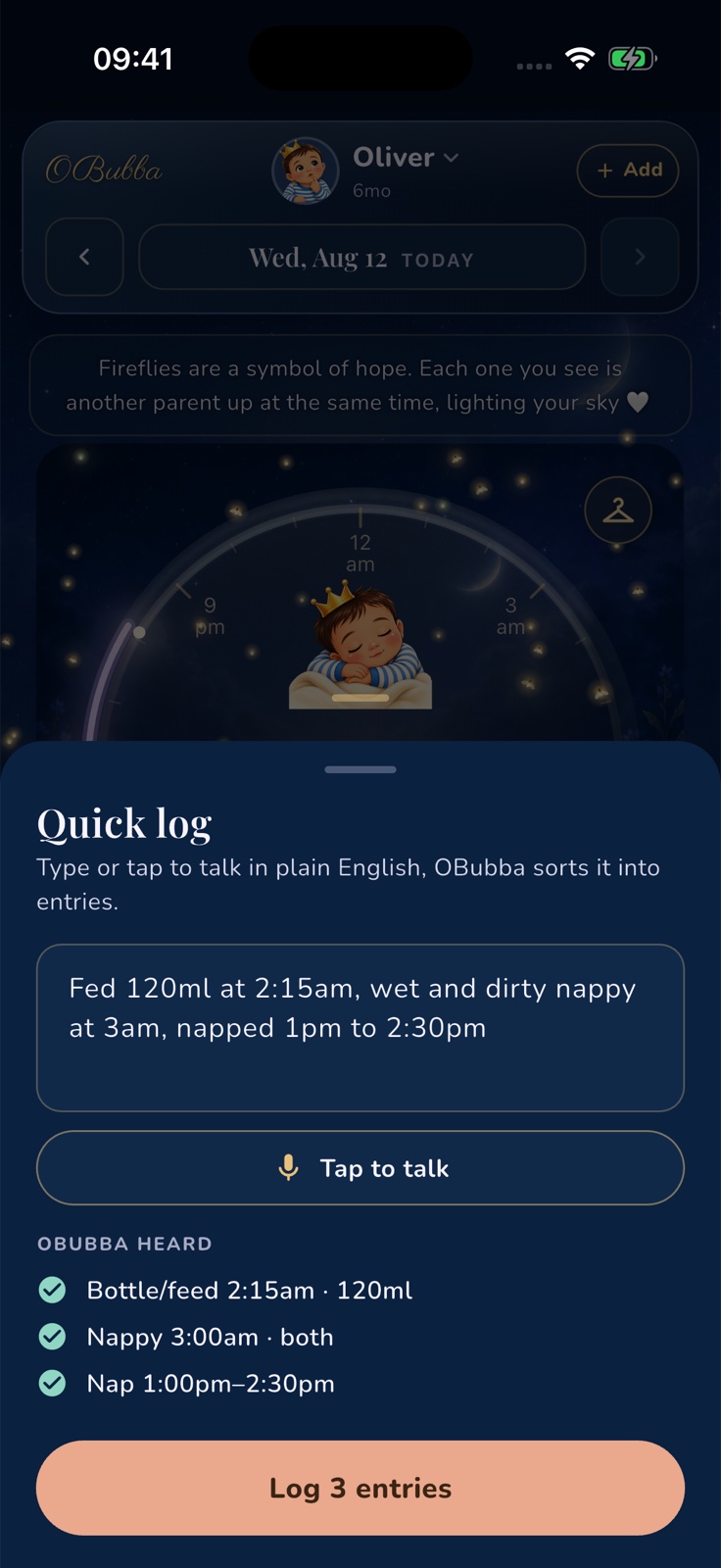
Use it for a three-day feeding check or a foggy shared night, then return to lighter tracking. Fast entry is not a reason to collect information forever.
Review the pattern, then graduate
In Care → Reports, the Insights Overview can compare recent sleep and feeds and show how much data supplied the picture. The app also provides a shareable weekly summary, a four-week clinical PDF and visit-prep text.
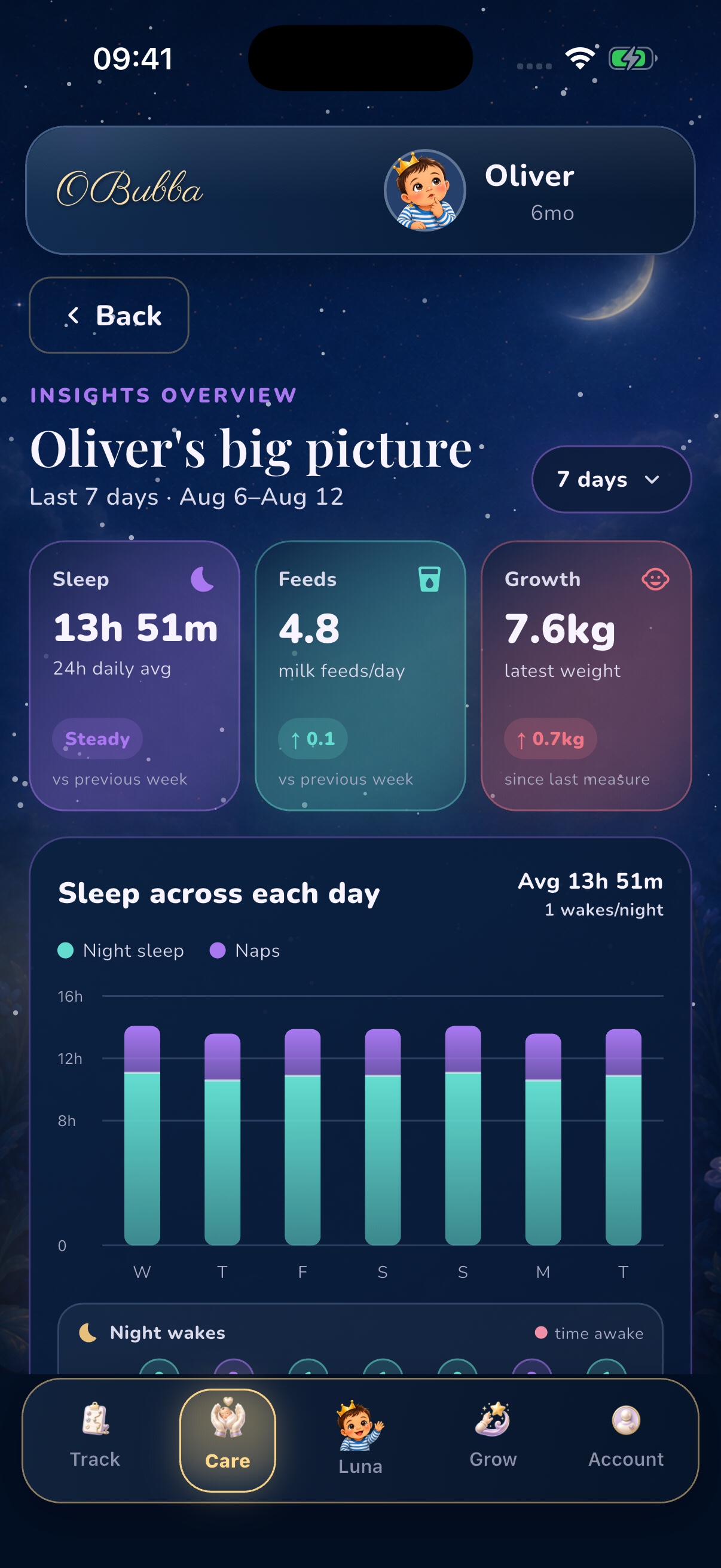
The report is a review point, not a reason to preserve logging. If the family’s question is answered, stop or reduce the category.
Export before simplifying
In Account → Export Data, OBubba creates a CSV file from the child’s history. The current implementation attempts to fetch archived days before export and warns if an offline or failed fetch may have left the file incomplete. That honesty matters: a partial backup should not be presented as complete.
Keep the export securely. It may help with app switching or personal review, but it is not a substitute for the Red Book or records held by health professionals.
Make the advice match your family
In Account → Preferences → How OBubba helps with sleep, choosing Follow my baby’s lead keeps timing and routine support while turning off suggestions to change how the baby falls asleep. Parents can also disable reminder types and set quiet hours.
The app should adapt to the family’s goal. The family should not perform more care for the app.
Try OBubba free → — start with one useful record, turn off what no longer helps, keep your history exportable and bring detail back only when a real question needs it.
Quick answers
When can I stop tracking every newborn feed?
Ask the midwife or health visitor when feeding is established and growth and nappy output are reassuring, especially if they requested the record. There is no single week that applies to every baby. Premature babies and babies with feeding or medical plans may need longer monitoring.
When can I stop counting wet nappies?
Once output is predictably normal and nobody is using the total for a feeding, hydration or illness decision, many families only remember the last change for handover. Restart a complete count if nappies become fewer than usual or a professional asks for it.
Do I need to track sleep after the first year?
No. Track only if naps, nursery, early waking or another question makes the pattern useful. A toddler does not need a permanent sleep diary simply because the app can store one.
Should I delete the old data?
Usually, no. Export it, check the file and then stop adding unnecessary entries. Old history can remain useful without staying part of daily care.
Will stopping feeds ruin sleep predictions?
The sleep clock primarily needs sleep anchors. Some guidance may have less feeding context, so it should become less specific rather than inventing a conclusion. Continue responsive feeding regardless of what is logged.
What if my partner wants to keep tracking?
Agree on the decision the record serves. One carer can keep a focused category, but do not turn completeness into surveillance or a parenting score. Define what must be shared for safe handover and make everything else optional.
What if tracking makes me anxious?
Turn off non-essential categories and reminders or stop completely. If repeated checking, fear or intrusive thoughts are affecting daily life, speak to someone you trust and a health professional. The app is optional; support is not.
OBubba supports parent-entered records, organisation and pattern summaries. It cannot assess milk transfer, hydration, allergy, growth, medicine safety, illness or sleep disorders; verify that an omitted event did not happen; or replace an individual plan, the Red Book, a midwife, health visitor, feeding specialist, dietitian, pharmacist, GP, NHS 111 or emergency service.
Ready to try OBubba?
Use OBubba to track feeds, sleep, naps, nappies, growth, milestones and family handovers in one calm baby tracker app.