You moved bedtime 20 minutes earlier. Night one had fewer wakes. Night two was worse. Night three included a late car nap, sore gums and a parent who forgot to stop the sleep timer.
Did the change work?
The honest answer is rarely hidden in one night. Baby sleep varies, and the thing you changed may affect a different part of the night from the one you first notice. An earlier bedtime might reduce wakes. Finishing a late nap sooner might lengthen the first stretch. A steady morning may shift the whole day only gradually.
A useful home test is therefore one safe, age-appropriate change, held broadly steady for seven nights, with an early check after three. Seven is a practical observation window—not a medical rule, a promise that sleep will improve or a reason to continue something that is making your baby or family less well.
The short answer: check at 3 nights, decide at 7
Use this as a calm decision rhythm:
| Checkpoint | What it can tell you | What to do | |---|---|---| | Before night 1 | What usually happens and which single outcome matters | Keep your usual approach for a few nights if you do not yet have a baseline | | After 3 nights | Whether the change looks clearly helpful, clearly unhelpful or too noisy to read | Continue if it is safe and tolerable; stop or ease back if things are clearly worse | | After 7 nights | Whether a repeatable signal is appearing across ordinary variation | Keep, adjust or retire the change based on the chosen outcome and family experience | | By 14 nights | Whether an initially mixed or sparsely logged result has settled | End the test rather than letting it become an indefinite project |
Some changes need less time. If a later bedtime repeatedly produces an exhausted, distressed baby, you do not owe the experiment seven nights. If one night is disrupted by illness, travel or fireworks, that night may be useful context but poor evidence about the routine.
The NHS says babies have their own patterns, and those patterns change with growth, teething and illness. A simple soothing routine may help, but variation is normal. That is why the goal is not seven identical nights. It is enough comparable nights to make a calmer decision.
First decide what question you are testing
“Fix sleep” is too large to measure. Choose one question:
- Does moving bedtime 20 minutes earlier reduce false starts or meaningful wakes?
- Does ending the last nap a little earlier lengthen the first unbroken night stretch?
- Does keeping morning wake time steadier stop bedtime drifting earlier and earlier?
- Does protecting a short first nap improve the rest of the day?
- Does repeating the same wind-down make settling less effortful?
Then make one corresponding change. Do not simultaneously move bedtime, cap every nap, remove a dummy, change feeding and ask another caregiver to use a new settling method. If the night changes, you will not know which lever mattered—and the baby has to absorb several unfamiliar things at once.
If you are unsure which question fits, start with our guide to overtired versus undertired bedtime resistance. A test should follow a plausible pattern, not a random internet rule.
Match the result to the change
Fewer night wakes are not the only form of progress. Judge the lever by the outcome it should reasonably affect.
| The one change | Most useful outcome | Do not judge it only by | |---|---|---| | Slightly earlier bedtime for an overtired pattern | meaningful night wakes and false starts | total time in the cot | | Slightly later, steadier bedtime for an undertired split-night pattern | longest unbroken stretch | whether bedtime looks “early enough” on a chart | | Earlier finish to a late last nap | longest first stretch and settling time | total nap count alone | | Steadier morning anchor | morning wake time and day drift | a single early wake | | Gentle review of a scheduled dream feed | actual night-feed pattern, daytime intake and wellbeing | a target of zero feeds | | More consistent wind-down | settling effort and distress | whether the baby falls asleep without any support |
This matters because the same night can improve in one way and worsen in another. Two wakes instead of three sounds positive, but not if the baby spent two hours awake between them. A longer first stretch may be valuable even if the wake count does not change yet. Parents also count: a routine that produces similar sleep with much less conflict can still be a worthwhile improvement.
A practical seven-night baby sleep test
Before night 1: write a one-sentence plan
Use this format:
> For seven nights, we will bring the start of the bedtime routine 20 minutes earlier. We will judge it by false starts and meaningful night wakes, while continuing to feed and comfort responsively.
Record the recent normal rather than hunting for a perfect week. Two usable pre-change nights are better than one dramatic memory; around a week gives a steadier comparison. Note bedtime, meaningful wakes, morning wake and the context most likely to confuse the result.
Do not manufacture a baseline by delaying a change that is clearly needed for safety, feeding or health. This is for ordinary routine questions, not urgent care.
Nights 1 and 2: gather, do not grade
The first night can contain novelty. The second can rebound in the other direction. Keep the new step modest, respond to your baby and record what actually happened.
Minimum useful log:
- when night sleep began
- meaningful wakes that needed care
- feeds actually given
- morning wake
- whether illness, teething, travel, nursery or an unusual nap changed the day
You do not need to record every rustle, dummy replacement or two-minute eye opening. If detailed tracking makes you more anxious, use the smallest record that answers the question.
Night 3: take the first read
After three nights, ask:
- Is the chosen outcome moving in the helpful direction?
- Is the baby no more distressed, hungry or overtired?
- Can the adults repeat the change without the household becoming brittle?
- Were at least two of the nights ordinary enough to compare?
If the answer is “possibly,” keep going. If it is “clearly worse,” ease back. If the only good night followed a completely different nap day, call the signal uncertain.
Three nights are enough for a first read, not always a confident verdict. OBubba's current product guardrail reflects that: it gathers during the first three nights, and the supervising logic cautions against treating a very early “working” or “not working” signal as settled.
Nights 4 to 6: keep the rest recognisable
Try to keep the comparison fair, not laboratory-perfect. Use the familiar feed response, sleep space and soothing approach. Ordinary life can continue.
If a disrupted night happens, label it rather than deleting it. A feverish night is real family history, but it should not quietly become the standard against which the new bedtime is judged. See how to track sleep during illness, travel and nursery for a simple context method.
Night 7: make one of four decisions
Keep it: the chosen outcome is meaningfully better, the baby is coping and the approach is sustainable.
Keep it, but soften it: the direction looks helpful, but the size of the change was too ambitious. A 30-minute move might become 15 minutes.
Stop it: the outcome is worse, distress is higher or family functioning is poorer.
Call it unclear: too few comparable nights, too much disruption or no meaningful difference. Return to the old approach or extend briefly to the next checkpoint; do not keep escalating the change to force a result.
When to stop before seven nights
Stop the routine experiment and prioritise care if:
- your baby seems unwell, unusually difficult to wake, is breathing differently or has another symptom that worries you
- feeds, wet nappies, growth or a clinical plan could be affected
- distress is escalating rather than settling with your response
- the change creates an unsafe sleep situation
- parental exhaustion makes the plan unsafe or impossible to carry out
- your instinct says the baby needs a different response tonight
For urgent symptoms, use NHS guidance on recognising serious illness in babies and toddlers or contact NHS 111; call 999 for an emergency.
A sleep change never overrides safer sleep. For the first six months, the NHS says the safest place is a cot or Moses basket in the same room as you, with baby placed on their back. Use a firm, flat mattress and keep the space clear. Do not introduce pillows, nests, positioners, weighted products or loose objects as part of a test.
What about newborns?
Repeated waking and night feeding are expected in the early months. A newborn sleep pattern is not a failed schedule. Follow feeding, weight and medical advice, and respond to needs rather than using wake reduction as the outcome.
The current OBubba app does not offer its structured sleep experiments before about 17 corrected weeks. That is an app guardrail, not an NHS developmental cut-off and not permission to use every approach after that age. Corrected age matters for babies born early, and individual feeding, growth, health and development still lead the decision.
For a younger baby, an appropriate “change” may simply be making night feel calm and distinct: lower lights, quieter voices, feeding and changing as needed, then returning to the safer sleep space. The NHS describes these gentle day-and-night cues without promising longer stretches.
How OBubba runs the test in the actual app
The experiment feature is not a decorative checklist. It connects the baby's recorded pattern to one opt-in change and a result.
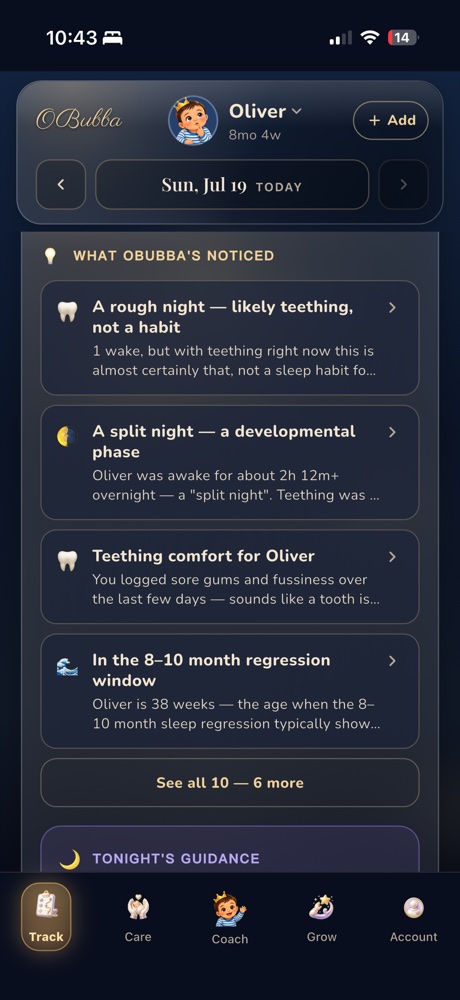
1. A pattern proposes one testable lever
When a sufficiently clear sleep insight maps to a sensible action, OBubba may offer Try this for 7 nights. Current examples include an earlier bedtime, an earlier finish to the last nap, steadier morning timing, gently tuning wake windows or testing whether day sleep relates to a split night.
The parent chooses whether to start. OBubba does not silently change the schedule, and only one experiment can run at a time.
2. It stores the baby's own baseline
For wake-count tests, the app looks back across up to seven nights before the start and needs at least two genuinely logged nights. A single unusually good or bad night is not treated as a reliable yardstick.
Illness, fever, travel, nursery and other disruption signals can be excluded from clean baseline learning. The record remains visible; it simply does not get promoted to “normal.”
3. Each lever has its own outcome
The current engine does not score every idea by night wakes:
- earlier bedtime can be judged by wake count
- a steady morning can be judged by morning wake time
- day-sleep or last-nap changes can be judged by the longest unbroken stretch
- a dream-feed test can be judged by actual night feeds
Its current signal thresholds are product heuristics: around half a wake or feed, 15 minutes for morning timing, or 30 minutes for longest stretch. They are not medical cut-offs, a guarantee of meaningful improvement for every family or a reason to ignore the wider night.
4. Missing logs do not become good nights
At least half of the elapsed nights need usable outcome data, with a minimum of two, before the engine settles a verdict. Otherwise it says Need a few more logged nights. An unopened app is not interpreted as zero wakes.
5. The app remembers the result
Finished tests appear in What we've tried for [baby] as Worked, Didn't help, No clear change or Not enough data. A recently unsuccessful lever is held back for roughly 60 days instead of being immediately prescribed again—unless that lever has also worked for this baby. Old results can expire because babies change.
This is the useful difference between a tracker and a static sleep schedule: the next suggestion can remember what your family already tested.
Try OBubba free → — turn one sleep question into one measured change, keep disrupted nights in context and let missing data stay missing.
A result is more than a prettier graph
At the seven-night review, ask what the change cost as well as what it produced:
| Question | A helpful answer may look like | |---|---| | Did the target outcome improve? | Fewer meaningful wakes, a longer first stretch, a later morning or easier settling | | Was the baby supported? | Feeding, comfort and reassurance remained responsive | | Did safety stay fixed? | Every sleep used the same safer sleep principles | | Can carers repeat it? | The plan fits both adults and survives an ordinary busy evening | | Did tracking help? | The record made the decision clearer rather than increasing anxiety |
If the graph improves but everybody dreads bedtime, the test needs revisiting. If the numbers barely move but settling becomes calmer and handovers easier, that may be a real family win.
Our guide to comparing weeks instead of single nights helps when the change looks promising but the nightly line remains jagged.
Frequently asked questions
Can I know after two nights whether a baby sleep change works?
Sometimes you can know that a change is clearly intolerable or unsafe, and you should stop. Two good nights can also be encouraging. But two nights are usually weak evidence of a repeatable sleep improvement because normal variation is large. Use them as an early signal, not a promise.
Do I have to continue if my baby cries more?
No. Respond to your baby. A seven-night window is an observation method, not a requirement to persist through escalating distress. Stop, comfort, feed when needed and reconsider the size or suitability of the change.
Should I try a sleep change during teething or illness?
Usually it is easier to judge ordinary routine when the baby is well. During illness or active discomfort, prioritise care and professional advice. Keep the nights as context, but pause the verdict rather than deciding a familiar routine has suddenly failed.
What if bedtime improves but morning starts earlier?
The result is mixed. Do not call it a win from settling alone. Compare the whole outcome: settling effort, first stretch, wakes, morning and daytime wellbeing. You may keep a smaller version of the change or return to baseline.
Does seven nights mean seven perfect logs?
No. Log the minimum needed to answer the question. OBubba needs bedtime and morning wake for many sleep outcomes, plus actual wakes or feeds when those are the measure. Missing nights should reduce confidence, not become invented zeroes.
Is this the same as sleep training?
No. Moving bedtime, protecting a nap or repeating a wind-down are routine adjustments. Structured sleep training is a broader choice about how a family responds at settling and wakes. If you are considering it, your baby's age, feeding, health, development and family values matter; seek health-visitor or clinical advice when unsure.
Carry one useful answer into the new year
You do not need a New Year sleep overhaul. You need one clear question, one modest change and permission to stop when the evidence—or your baby—says it is not helping.
Three nights can offer a first read. Seven can reveal a pattern. Fourteen is a sensible outer checkpoint for a mixed result, not a finish line your family must cross.
The best outcome is not “we followed the plan perfectly.” It is: we learned something true about our baby without losing sight of the baby in front of us.
OBubba supports parent-held tracking, routine planning and pattern awareness. It cannot assess your baby, diagnose a sleep or feeding problem, verify that a sleep space is safe, or replace advice from a health visitor, GP or other qualified professional.
Ready to try OBubba?
Use OBubba to track feeds, sleep, naps, nappies, growth, milestones and family handovers in one calm baby tracker app.