It is late, there is one bottle left, and someone asks: “Do we still have to sterilise these?”
In the UK, the NHS says to sterilise all baby feeding equipment, including bottles and teats, until your baby is at least 12 months old. That applies whether the bottle holds expressed breast milk or formula. Cleaning comes first; a dishwasher can clean feeding equipment but does not sterilise it.
This is general feeding-hygiene information, not individual medical advice. If your baby has a specialist feeding, neonatal or infection-control plan, follow that plan and ask the team caring for them when the routine can change.
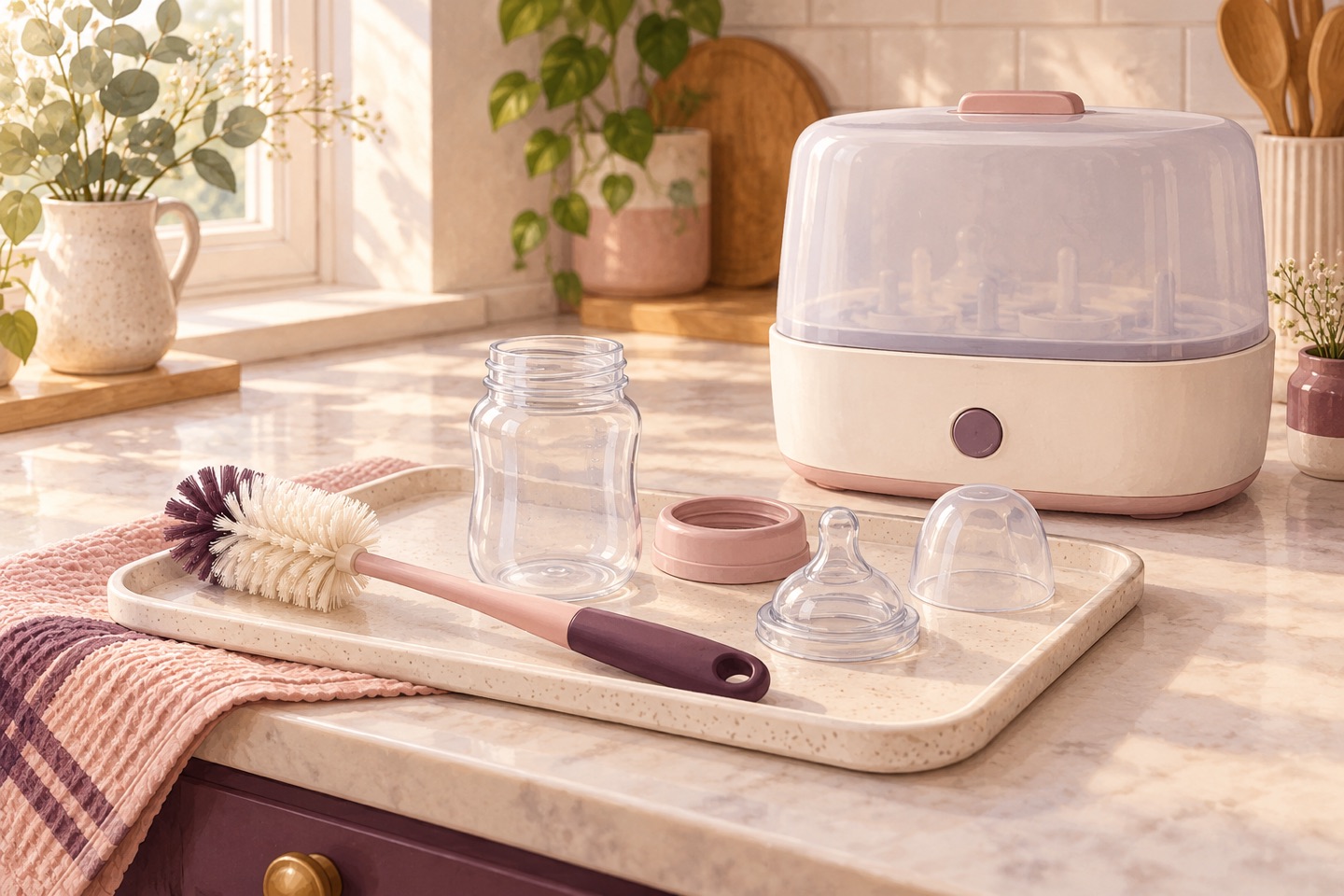
The two-step routine: wash, then sterilise
The simplest way to remember it is remove the milk first, then sterilise the clean parts. The NHS bottle-cleaning guidance says to:
- Wash bottles, teats and other feeding equipment in hot, soapy water as soon as practical after the feed. Use a clean bottle brush kept for that job, and a small brush for the inside of the teat.
- Rinse in clean, cold running water.
- Sterilise with a method suitable for the equipment: a steam steriliser, cold-water sterilising solution or boiling, following both NHS and manufacturer instructions.
- Leave bottles and teats in the steriliser or pan until needed where possible. If you take them out, wash and dry your hands and put the teat and lid on straight away, assembling on a clean surface.
A dishwasher is useful for the washing step if the equipment is dishwasher-safe, but it is not the sterilising step. Neither a quick rinse nor an apparently clean-looking teat replaces washing and sterilising before 12 months.
What about ready-to-feed formula or expressed milk?
The milk type does not change the equipment rule. The NHS explicitly says its cleaning advice applies to both expressed breast milk and formula. Its formula guidance says feeding equipment still needs sterilising when you use ready-to-feed formula.
Sterilising a bottle does not make milk safe to leave out indefinitely, and it does not replace safe formula preparation or expressed-milk storage. For a nursery day or trip out, agree the milk-handling plan separately from the clean-bottle plan. Our first nursery-day checklist has the questions worth asking the setting.
Does everything change on the first birthday?
"At least 12 months" is the NHS threshold for sterilising feeding equipment. For an otherwise healthy child, you can usually stop routine sterilising after their first birthday, but not thorough washing of bottles, teats and cups after every use. That is an interpretation of the NHS minimum-age advice, not a promise that every child's needs are identical. Check with your health visitor if an individual health plan might mean continuing longer.
The first birthday is also a natural point to think about the cup, but it need not be an overnight battle. The NHS recommends offering an open cup or free-flow cup from around 6 months and discourages bottle feeding after one. Milk feeding and a familiar bedtime do not need to be changed simply to retire a steriliser. If you are working through a bottle change, our gentle bottle-refusal guide is more useful than pressuring your baby to drink.
The tired-parent version
- Under 12 months: wash and sterilise bottles and teats before use.
- Dishwasher: cleans, but does not sterilise.
- After 12 months: keep washing equipment well; ask your child's clinician about any individual reason to continue sterilising.
- At any age: follow safe milk-preparation and storage guidance separately.
OBubba's Track → Feed → Bottle log records the feed time and amount, so two adults can see what baby actually drank without relying on memory. It does not track whether equipment was sterilised or certify that a feed is safe. If a shared feed record would ease the handover, you can explore OBubba; keep the NHS hygiene steps beside the sink where they belong.
Ready to try OBubba?
Use OBubba to track feeds, sleep, naps, nappies, growth, milestones and family handovers in one calm baby tracker app.