The front door closes. You wave and say “bye-bye”; your baby studies your face, grins, and keeps both hands firmly on the toy. Should you be worried?
Not waving on one particular day is not a diagnosis. The CDC lists waving “bye-bye” among the skills most babies can do by one year. Its milestone lists describe what at least 75% of children do by that age—not a deadline every child meets on their birthday. If your baby is near or past a year and not waving, bring it up with your health visitor or GP, especially if you are noticing fewer gestures or have another concern. You do not need to wait and worry alone.
This is general development information, not a screening test. Your health visitor can look at your baby's communication as a whole and advise on any next steps.
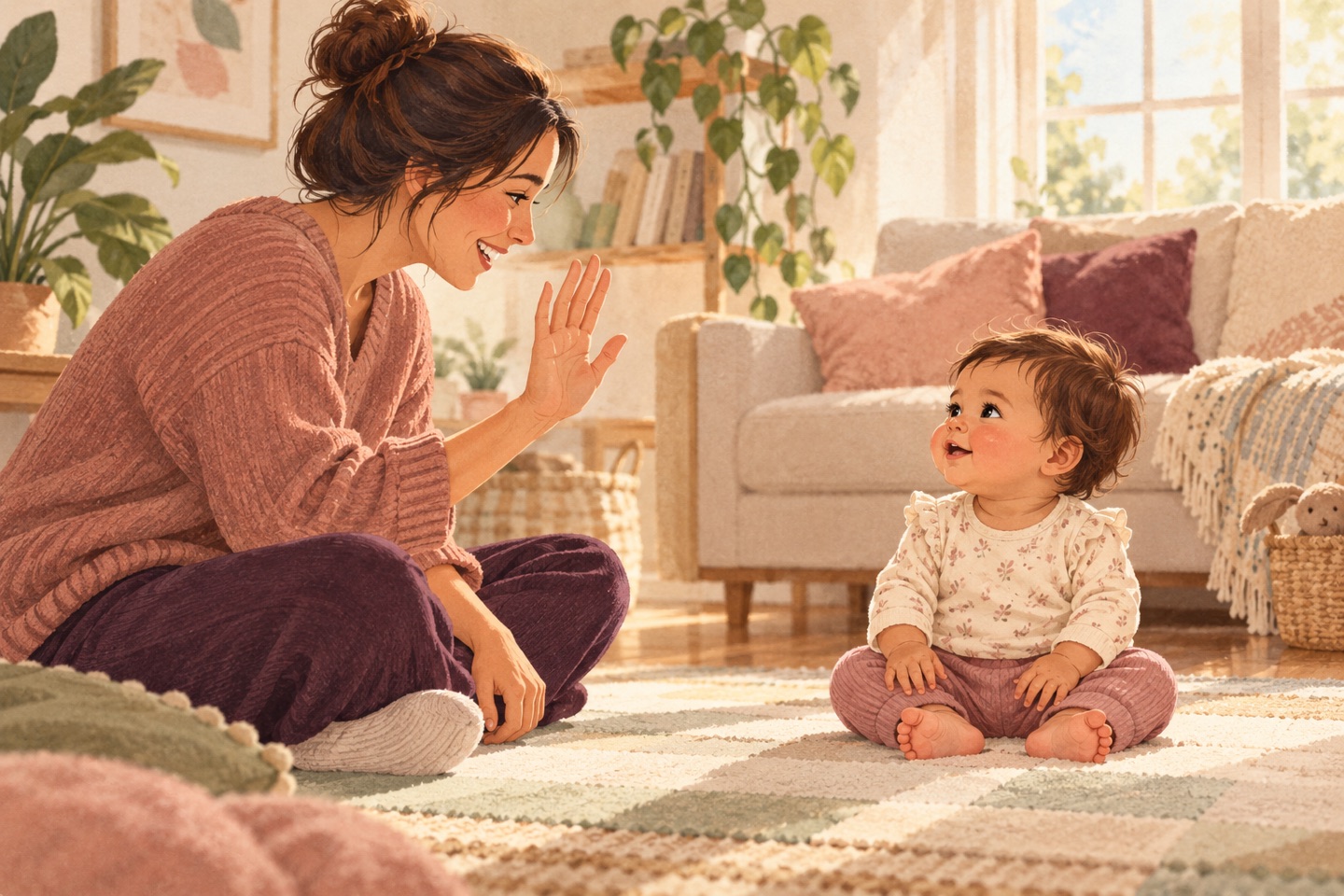
Look at connection, not just one hand movement
Waving is a gesture that carries a message. Notice how your baby communicates across ordinary moments: do they look between you and something interesting, respond to a familiar voice, copy a sound or action, reach to be picked up, or use another gesture? These observations are useful context for a conversation with a professional. They do not cancel out a concern about a missed milestone, and they are not a home diagnosis.
The NHS 6-to-12-month communication guide suggests matching gestures to your words—waving as you say hello or goodbye—and giving babies chances to copy in everyday routines. A baby may watch many goodbyes before trying a wave. The point is shared communication, not drilling a movement until they perform it.
Three small ways to invite a wave
- Make it real. When someone leaves, get down where your baby can see your face and hand. Wave slowly and say “bye-bye, Grandma” or “bye-bye, Daddy.” Give your baby a moment to look or respond. If they do not wave, the goodbye still counts.
- Use one familiar gesture at a time. Pair “hello” with a wave, or play a short round of peekaboo. Repeating a friendly cue in a real situation is more useful than switching through lots of commands. The NHS recommends gesture-and-word play in daily routines.
- Follow their interest. If your baby is busy holding a toy, let them watch your wave. Smile at any attempt to copy, including an arm lift or a different hand movement, without physically moving their hand for them. Stop when either of you has had enough.
You do not need special flashcards, a daily practice quota or a video of every attempt. If a five-minute play idea would help you make the moment enjoyable, see our stage-by-stage play guide.
When is it worth asking for help?
At around your baby's first birthday, if waving has not appeared, mention it at the next health-visitor review or contact your health visitor sooner if you are concerned. The CDC advises talking with a clinician when a child is not meeting a milestone, has lost a skill, or a parent has another developmental concern. Do not wait for every other item on a checklist to become a worry before asking. The NHS likewise advises speaking to a health visitor or local speech and language therapy service if you are worried.
It helps to bring two or three concrete observations: “We wave at goodbye most days; I have not seen a wave back,” “They do use this other gesture,” or “They used to wave and have stopped.” If your baby has lost a skill they previously used, say that clearly rather than simply noting the skill as “not yet.” If your baby was born prematurely or has an individual developmental plan, ask the clinician how to interpret milestones for them.
An app can help you remember those observations, but cannot tell you whether development is typical or replace a professional assessment. OBubba's Grow → Milestones screen includes “Waves bye-bye” and lets you record when you actually saw it. Its own reminder says milestone ranges are guidance, not a test, and advises speaking with a health visitor or GP when something feels off. Leave an item unticked until it happens; a child does not need a perfect row of ticks. Our milestones-without-comparison guide explains how to use a list without turning it into a scoreboard.
The best outcome of today's goodbye may simply be a shared smile. If you would like one place to keep the little firsts alongside the rest of your baby's story, you can explore OBubba whenever it feels helpful.
Ready to try OBubba?
Use OBubba to track feeds, sleep, naps, nappies, growth, milestones and family handovers in one calm baby tracker app.