It is your baby's first New Year's Eve. Do you keep them awake for midnight, wake them for the countdown or put them to bed while everybody else celebrates?
Let your baby sleep. There is no developmental benefit to reaching midnight, and waking them for a photo can turn one quiet milestone into an overtired night. Keep the ordinary sleep cues, make fireworks less intrusive from a safe distance, and plan the adults' alcohol and care responsibilities before the evening begins.
The family can mark the occasion earlier. Take the photo, share a cuddle, read a special book or count down at 7pm. Your baby does not know that the calendar changes at 12:00.
> The best first New Year's Eve is not the one your baby remembers. It is the one the adults can remember without compromising the baby's sleep or safety.
Three sensible New Year's Eve plans
| Family plan | Baby plan | Best fit | |---|---|---| | Celebrating at home | use the usual bedtime range and routine; keep the cot area calm while adults celebrate elsewhere | most babies, especially when local fireworks are likely | | An early family gathering | attend around feeds and naps, do an early countdown, then go home for bedtime or use a checked travel cot | families who want the baby included without a midnight target | | A sitter or grandparent takes over | give a direct handover covering the last feed, sleep, allergies, medicines, settling and safer-sleep plan | parents going out after bedtime |
Taking a baby to a close, loud midnight display is not the missing fourth option. Fireworks can produce sudden, extremely loud sound. The simplest protection is distance: keep a baby indoors and away from the display rather than trying to make close exposure acceptable.
Should I keep my baby awake until midnight?
Usually, no.
An older baby who is naturally awake a little later because of a late nap may join a calm part of the evening. That is different from stretching an exhausted baby for several hours so they can “see New Year”.
Look for the cost:
- rubbing eyes, staring away or losing interest
- frantic movement or escalating fussiness
- feeding that becomes disorganised because they are too tired
- a second wind that looks cheerful but ends in a difficult settle
- repeated false starts after bedtime
If those signs arrive, bedtime has more value than the countdown.
Newborns need an even simpler answer. Their sleep and feeds are distributed across day and night; midnight is just another possible feed. Follow their cues and any individual feeding plan rather than organising the night around the clock.
The NHS baby sleep guidance emphasises that babies have individual sleep patterns. It recommends ordinary light and activity during the day, then low light, quiet voices and little stimulation at night. New Year's Eve does not suspend that day–night contrast.
A New Year's Eve plan from morning to midnight
Morning: start normally
Open the curtains at the family's ordinary start of day. Feed responsively and avoid a deliberate lie-in simply to make midnight possible.
If Christmas has already shifted the whole week, do not attempt a dramatic reset and a late celebration on the same day. Use the gentle post-Christmas sleep reset, then treat New Year's Eve as one flexible evening.
Naps: protect sleep, not a perfect chart
Offer the first reasonable nap when tired cues and the baby's usual pattern line up. Count sleep in the car, pram or arms when it actually happened; it still changes the rest of the day.
Do not cut every nap short to manufacture a later bedtime. Overtiredness may make the evening harder without reliably producing a longer night.
If the last nap finishes late, bedtime may move modestly later. If naps are short or missed, an earlier bedtime is often kinder than trying to reach an arbitrary celebration.
Families fitting sleep around an early visit can use the guide to planning baby naps around an event.
Feeds: keep hunger out of the experiment
Continue responsive breast or bottle feeds. Do not delay milk so a feed lands neatly just before midnight, and do not encourage a baby to finish a larger bottle in the hope they will sleep through fireworks.
If your baby has started solids, serve an ordinary age-appropriate meal at a manageable time. New Year's Eve is not a reason to replace milk, pressure a tired baby to eat or introduce a complicated new food while several adults are distracted.
Early evening: have the family moment now
Choose a small ritual before the baby becomes overtired:
- take a family photo in ordinary sleepwear
- read one favourite or special bedtime story
- video-call a relative
- play a quiet song
- do a three-count “midnight” before bedtime
- write one sentence for the memory book about this stage
This gives the adults a real marker without asking the baby to perform wakefulness.
Bedtime: keep the sequence, flex the minute
Use the familiar wind-down in the familiar order. It can be shorter than usual if the baby is tired: fresh nappy, sleepwear, feed, book or song, cuddle, safe sleep space.
The routine matters more than starting at exactly 7:03pm. If bedtime has moved by 20 or 30 minutes because the day was different, preserve the cues instead of rushing every step.
Read what time counts as baby bedtime? if an evening nap and night sleep are becoming difficult to distinguish.
Before fireworks begin: prepare the room
- close the window
- draw curtains or blinds safely, keeping cords completely away from the cot
- move the cot away from the window if the room layout allows and it remains in the recommended room-sharing arrangement
- keep the sleep space clear
- silence unnecessary doorbells and household alerts, but never disable smoke or carbon-monoxide alarms
- tell arriving guests that the baby is asleep before they ring or knock
- choose which sober adult is responsible if the baby wakes
Do not wait for the first explosion before deciding who will respond.
Fireworks and baby's hearing
Fireworks are not merely surprising; nearby explosions can be intensely loud. The World Health Organization's safe-listening guidance explains that hearing risk rises with sound level and duration, that even one extremely loud exposure can cause damage, and that moving away from the sound source reduces exposure.
For a baby:
- Do not stand near fireworks. Keep the baby well away from private fireworks and loudspeakers.
- Prefer indoors. A closed home with distance from the launch point is simpler than trying to protect an infant at the display.
- Do not use louder white noise to “cancel” fireworks. Two loud sound sources do not create quiet at the baby's ear.
- Do not improvise ear protection. Adult foam earplugs, cotton or tissue do not belong in a baby's ears. If unavoidable travel or an event creates a hearing-protection question, ask an audiology professional about properly fitted infant equipment before the day.
- Leave a loud place. If you need to raise your voice at arm's length, the WHO describes that as a sign the environment is too loud. Distance and a quiet space come before preserving the plan.
The NHS information on sound sensitivity notes that children are often more sensitive to loud noise and that sensitivity can appear after sudden sound such as fireworks. If you notice an unusual response to sound or have concerns about hearing after exposure, seek professional advice.
Can white noise help with fireworks?
Low, steady sound may soften the contrast between a quiet room and distant bangs. It cannot make close fireworks safe, block every explosion or replace distance.
If you already use white, pink or another steady sound:
- keep the source as far from the baby as practical
- use the lowest effective level
- set it before sleep so a sudden new sound does not appear after the baby settles
- use a timer if a shorter masking period is enough
- make sure you can still hear the baby and all safety alarms
A phone's “30%” or “50%” volume is not a decibel measurement at the cot. Output changes with the device, speaker, room and distance.
Do not introduce white noise only because social media says every baby needs it. The NHS says there is no need to keep a home completely silent while a baby sleeps. For the full setup, read is white noise safe for babies?.
If fireworks wake the baby at midnight
Treat the wake as a wake, not an invitation to join the party.
- Pause briefly if the baby is only stirring and remains settled.
- Go in promptly if they are distressed.
- Keep lights low and voices quiet.
- Check the ordinary needs: hunger, nappy, temperature, comfort and illness.
- Use the familiar settling response.
- Feed responsively when hunger cues or the usual pattern suggest a feed.
- Return them to the safe sleep space when ready.
Avoid carrying a frightened or half-asleep baby into a bright room full of cheering adults. If a cuddle by the closed window calms an older, fully awake baby, stay well back from the glass and keep it brief; do not turn it into a fireworks viewing session.
One midnight wake does not prove that bedtime was wrong or that the baby has developed a new habit. Look at the next few ordinary nights before changing the routine.
Safer sleep when adults are drinking
This is the most important New Year's Eve plan to make in advance.
The Lullaby Trust's current co-sleeping guidance says not to co-sleep when anyone in the bed has recently drunk alcohol, taken drugs or used medicine that makes them sleepy. It also says never to fall asleep with a baby on a sofa or armchair.
Before anyone opens a drink:
- prepare the baby's own clear, flat, firm sleep space
- name a sober responsible adult for feeds, wakes and transfers
- keep the cot or Moses basket beside the sober adult when appropriate
- plan how the baby will get home without an impaired driver
- move feeding or cuddling away from a sofa if the adult may drift off
- hand over before the tired or drinking adult picks up the baby
“I only had one” is not a safer-sleep plan. Neither is assuming the less-tired adult will notice when the other falls asleep.
For at least the first six months, babies should sleep in the same room as an adult for every sleep, day and night. A monitor or app does not replace that room sharing.
If somebody else is doing bedtime
Give the sitter or grandparent a short, direct handover:
- last milk feed and any usual night-feed expectations
- last nap and likely bedtime range
- the actual bedtime sequence
- allergies, health conditions and current professional instructions
- any medicine already given, with exact name, amount and time
- what usually helps the baby settle
- safer sleep setup and the rule about alcohol
- parent and emergency contact numbers
Do not leave a prediction as an instruction. “Bedtime may be around 7:30” is useful; “do not feed before 1am because the app says so” is not.
For a complete template, use the first night away babysitter handover.
How OBubba's real app supports the night
OBubba cannot measure fireworks, certify a sound level, know whether an adult is sober or supervise safer sleep. It can reduce the number of decisions parents must reconstruct at 11:57pm.
Keep the ritual familiar
Open Care → Bedtime ritual. The current screen stores an editable step list for each child. Parents can add, remove, reorder and change the duration or note for each step, then walk through the routine one step at a time.
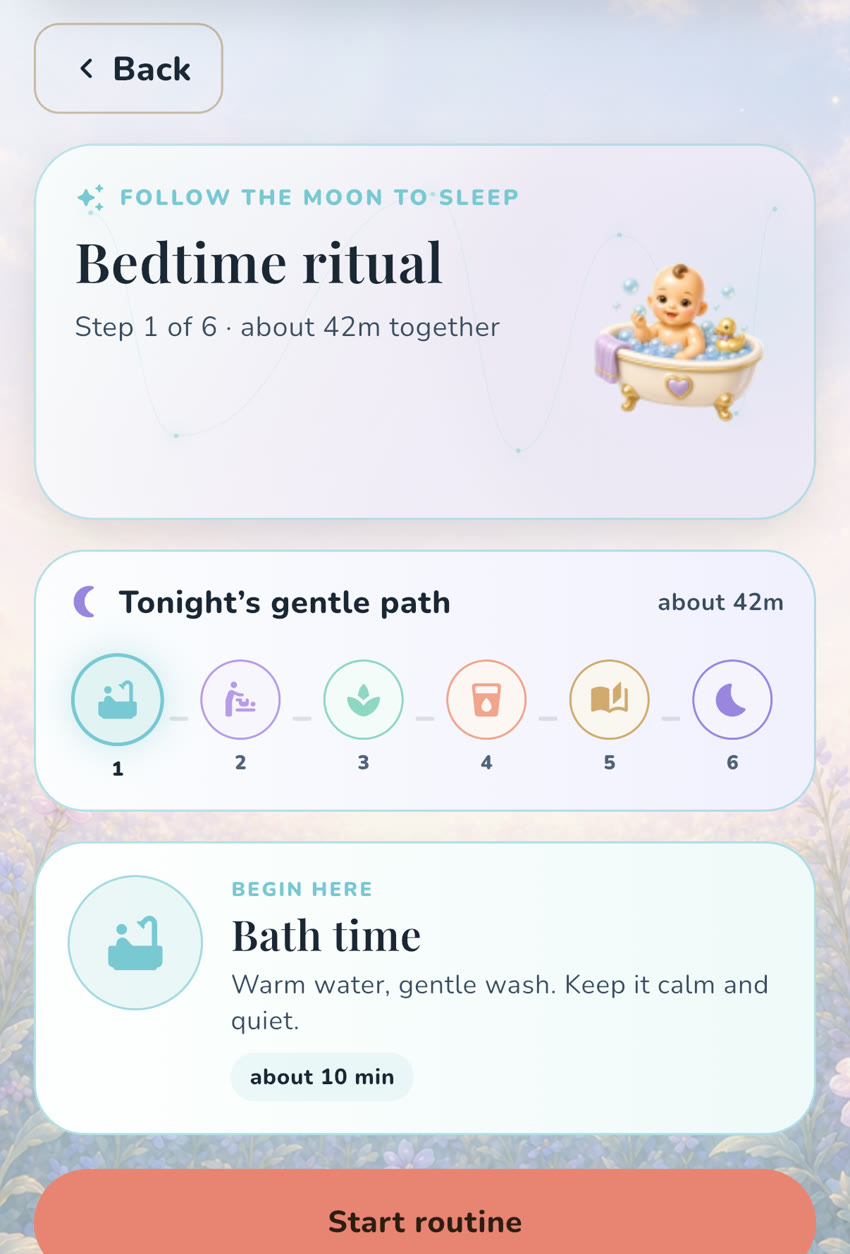
For New Year's Eve, keep the steps the baby recognises and remove anything that creates extra stimulation. The app's default example is not a clinical prescription: babies do not all need a bath, massage, a particular feed size or to be put down in one particular way.
Give sound one bounded job
Open Care → Sound Machine. The current app contains nine generated soundscapes: white, pink, brown, ocean, womb, heartbeat, rain, fan and shush. It supports pause, resume, stop, a volume slider and sleep timers of 15, 30, 45 or 60 minutes.
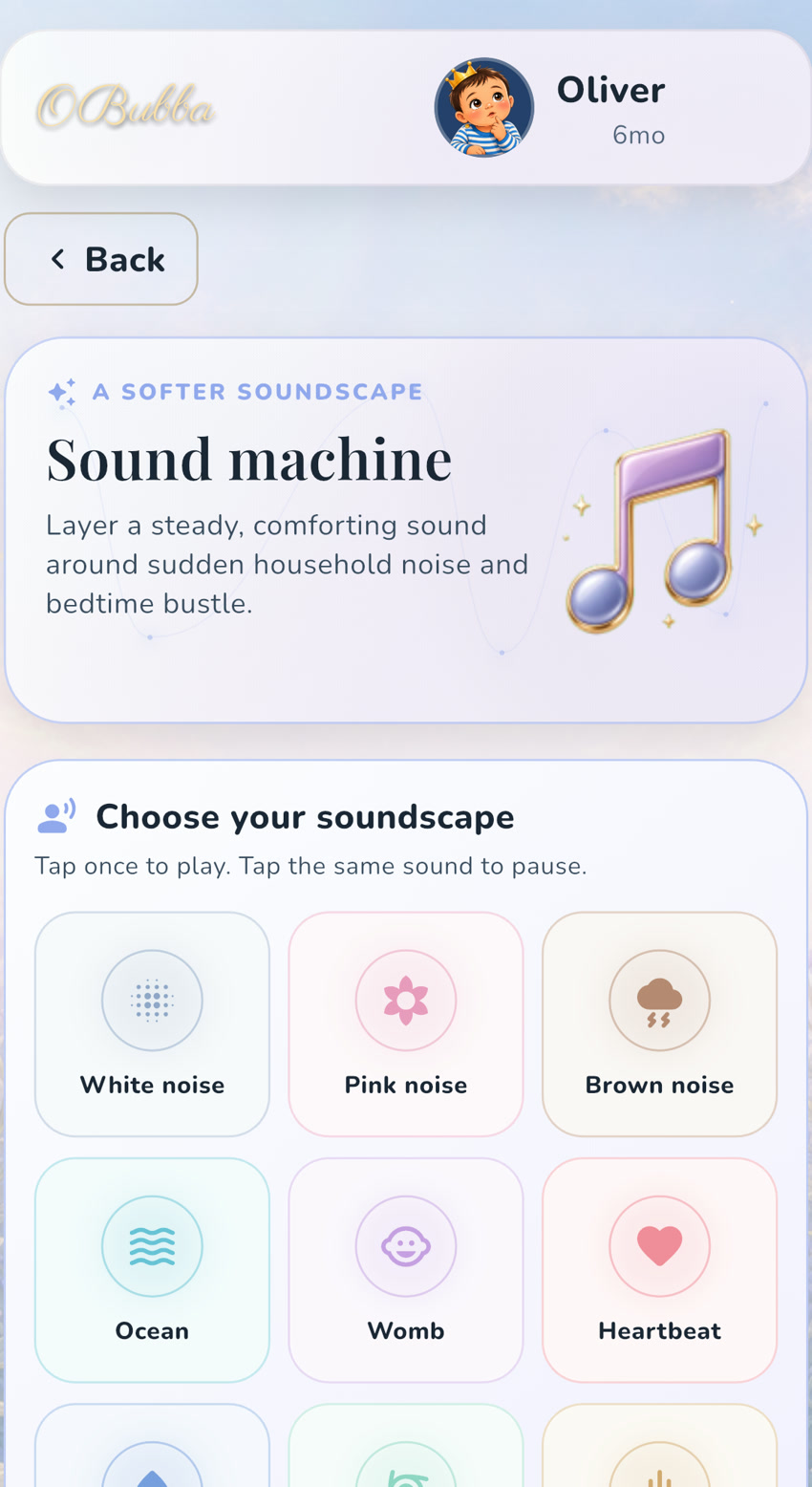
Choose one low steady sound only if it helps mask distant intermittent noise. Set a timer that matches the likely local fireworks window rather than turning the speaker up. The Sound Machine is optional and does not reduce SIDS risk.
Make a one-night adjustment without changing normal
In Track → Adjust Schedule, parents can change preferred wake time, bedtime or nap count and choose Just today, Gradually or Every day. A one-off early gathering may justify Just today; it expires rather than becoming the permanent family preference.
If sleep already happened, the app does not rewrite it. A Just today change only steers what remains ahead. Leaving the schedule on Auto and logging real sleep is equally valid.
Let tonight use today's evidence
Tonight's Guidance uses the sleep actually recorded today and only adds a learned awake-window estimate after enough personal samples. It cannot see tired cues, hear fireworks or assess the room.
That makes its role appropriately small: help the parent interpret this baby's day, not declare that every baby should stay awake for New Year.
Try OBubba free → — keep the real day, editable bedtime ritual, optional sound, night wakes and shared care together without turning a family celebration into a second sleep app.
Newborn, older baby and toddler differences
Newborn
Do not engineer a midnight wake. Feed responsively, keep night care quiet, follow any weight or feeding plan and use the usual safer-sleep space. If visitors are present, protect the baby from passing between many tired adults.
Older baby
Use their recognisable nap and bedtime ranges without treating them as deadlines. An early family moment and ordinary bedtime usually work better than a long final awake stretch.
Toddler
Explain simply that there may be bangs outside. Close the curtains, keep the routine familiar and offer calm reassurance if they wake. Avoid repeatedly checking the window after every sound, which can make the noise the most interesting event of the night.
Quick answers
Should I wake my baby at midnight on New Year's Eve?
No. There is no need to wake a sleeping baby for the countdown. Take a photo or mark the occasion before bedtime.
Can my baby watch fireworks through the window?
An older awake baby may briefly notice distant fireworks from well inside a closed home, but they do not need the experience. Keep them away from the glass and cords, avoid close displays and end the viewing if they appear distressed or tired.
Will fireworks damage my baby's hearing from inside the house?
Risk depends on the actual sound level, distance, building and duration, so a webpage cannot certify the exposure. Close windows, increase distance and keep the baby away from launch sites. Seek hearing advice if you are concerned after a loud exposure.
Should I turn white noise up when fireworks start?
No. Use the lowest effective setting and keep the source far from the baby. White noise can soften the contrast of distant bangs; louder playback cannot make nearby fireworks safe.
What if my baby sleeps through fireworks?
Let them sleep. Do not wake them to check whether they heard the display. Continue normal safer-sleep supervision and respond to the baby, monitor or alarm signals you would ordinarily act on.
Can I drink if my baby is asleep?
Plan a sober responsible adult and the baby's own safe sleep space before drinking. Do not co-sleep after alcohol, and never risk falling asleep with the baby on a sofa or armchair. Nobody who has been drinking should drive the baby.
Will one late night ruin my baby's routine?
Usually not. One variable evening is information, not a new permanent pattern. Return to morning light, responsive feeds, nap opportunities and the familiar bedtime routine the next day.
OBubba supports parent-entered organisation and sleep-pattern awareness. It cannot monitor sound exposure, assess hearing, supervise a baby, verify sobriety, inspect a sleep space or replace advice from a health visitor, audiologist, pharmacist, GP, NHS 111 or emergency service.
Ready to try OBubba?
Use OBubba to track feeds, sleep, naps, nappies, growth, milestones and family handovers in one calm baby tracker app.