The appointment is tomorrow. You know there were two difficult nights, feeding has felt different and one nappy worried you—but the exact times have dissolved into the week. So you arrive with 146 tracker entries and no idea where to begin.
You do not need to remember everything, and your health professional does not need every tap.
Take the Red Book, appointment details, medicines or a medicine list, feeding essentials, spare clothes and nappies—and a one-page summary of what changed, when it started and the questions you want answered. A short, honest pattern is usually more useful than a perfect-looking chart or an unfiltered data dump.
The five-minute appointment checklist
| Bring | Why it helps | |---|---| | Red Book / Personal Child Health Record | Holds professionally recorded growth, vaccinations and other child-health information | | Appointment letter or message | Confirms the time, place, purpose and any preparation requested | | Medicines, packaging or a current list | Gives the clinician the exact name, strength and dose rather than a remembered approximation | | Milk, feeding equipment and comfort item | Keeps the baby comfortable if the appointment or journey runs long | | Nappies, wipes and a change of clothes | Covers ordinary baby timing—and makes undressing for an examination easier | | Your top three questions | Protects the concerns most likely to vanish when the conversation starts | | One short log summary | Shows dates, frequencies and changes without asking anyone to decode every entry |
The NHS advises taking your baby's Personal Child Health Record—usually called the Red Book in England—to baby clinic and GP visits. It is used to record weight and height, vaccinations and other important information. An app summary can sit beside it; it does not replace it.
First, know what kind of appointment this is
Preparation changes with the purpose of the visit.
A routine health and development review
The NHS says baby reviews are a chance to discuss health, development and anything that concerns you. The new-baby review is usually offered at 10 to 14 days. At 6 to 8 weeks, a baby is invited for a physical examination, and the conversation may include vaccinations and how the parent is feeling emotionally and physically.
Later reviews may cover movement, communication, hearing and vision, growth, eating, behaviour, sleep, safety and dental care. For the 9-to-12-month and 2-to-2-and-a-half-year reviews, your health-visiting team may send an Ages and Stages Questionnaire in advance.
Bring the questionnaire if one was sent. Do not panic if every answer is not complete; NHS guidance says a health visitor can help you finish it.
A GP appointment about one concern
Lead with the problem, not the whole baby diary:
> “Since Saturday, feeds have become shorter, wet nappies are down from our usual pattern and she seems sleepier. The highest temperature I recorded was 38.1°C at 14:20 yesterday.”
That opening gives the change, start date, comparison and most important measurement. The clinician can then ask for detail.
A feeding or growth review
Bring the Red Book and any plan your maternity, neonatal, health-visiting or feeding team already gave you. A useful recent summary may include feeding method, approximate frequency, bottle volumes actually taken where known, pumping kept separate from intake, wet and dirty nappies, vomiting or discomfort, and professionally recorded growth.
Do not create a new feeding target from an app average. If your baby was born prematurely, has a medical condition or follows an individual plan, that clinical plan remains in charge.
A vaccination appointment
Check the invitation because arrangements differ. Take the Red Book, dress the baby in clothes that are easy to remove and tell the clinic if somebody else is bringing them. Our separate baby vaccination appointment checklist covers preparation and aftercare in detail.
What to write down before you go
Use one page. Put the reason for the visit at the top, then answer only the questions that matter.
1. What changed?
“Sleep is bad” is real, but hard to investigate. Make it observable:
- wakes rose from the family's usual one or two to five or six
- feeds became shorter or the baby began refusing one side
- wet nappies are noticeably drier or less frequent than usual
- vomiting changed in frequency, force, colour or timing
- crying now happens during feeds rather than mainly in the evening
- a rash, cough, temperature or stool change started on a known day
The comparison should be against your baby's usual pattern, not another baby's schedule.
2. When did it start?
Write the first day you noticed the change and whether it is constant, intermittent or tied to an event such as feeding, lying down, a medicine dose or starting a new food.
For a symptom that comes and goes, a clear photo or short video may help if it is safe and appropriate to capture. Do not delay urgent care to collect evidence.
3. What has the baby actually had?
For feeding questions, separate different events:
- breastfeeds and any observed swallowing or attachment concern
- bottles offered and amounts taken where known
- pump sessions, which record milk removed from the parent—not milk drunk by the baby
- solid foods and possible allergen exposure
- medicines with exact name, strength, dose and time
This avoids double-counting expressed milk once when pumped and again when it is fed. Our guide to cluster feeding versus low milk supply explains how to place feeding frequency inside the wider picture.
4. What came out?
Nappies provide useful context, especially when feeding has changed. Note wet nappies, bowel movements and what is genuinely different from usual. A log cannot diagnose dehydration, constipation, allergy or infection, but it can make the timeline clearer.
If nappies are drier than usual and the baby is not feeding normally, seems unusually sleepy or otherwise seems unwell, seek clinical help rather than waiting to finish a seven-day record. The NHS lists drier nappies and feeding changes among signs that need attention.
5. What do you want decided today?
Turn worry into a question the appointment can answer:
- “Does this feeding pattern need somebody to observe a feed?”
- “Does the Red Book growth pattern need follow-up?”
- “Which symptoms should make us seek same-day or emergency help?”
- “Should we continue this medicine, and what exact dose applies?”
- “Is this development within the expected range, and when should it be reviewed?”
- “What should we track—and what can we stop tracking—before the follow-up?”
Choose three. Put the one that matters most first.
A useful report is honest about missing data
A tracker report should never turn “not logged” into “zero”. If a family recorded bottles and nappies but no sleep, a clinic summary must not say the baby had zero naps or zero night wakes. That would convert absence of data into a clinical-looking claim.
Use these rules:
- include the number of days actually logged
- label averages clearly
- leave out categories you did not track consistently
- keep unusual events as dated notes rather than burying them in an average
- distinguish parent observations from professional measurements
- avoid app-generated diagnoses or conclusions
Averages can smooth away the very day you want to discuss. Bring the summary and be ready to open the original dated entries if the clinician asks.
What not to bring as your opening explanation
Avoid leading with:
- a screenshot of a single “bad” night without the surrounding week
- a growth centile from unverified home measurements presented as fact
- a list of every feed when the question is about a sudden change yesterday
- an AI interpretation without the underlying observations
- a normal-range comparison copied from another baby
- a confident diagnosis generated from symptoms
The goal is not to prove a theory. It is to help a qualified professional understand what happened and decide what comes next.
How Reports works in OBubba's actual app
Open Care → Reports. The current app builds its overview from two real seven-day windows, so week-to-week comparisons are based on like-for-like periods rather than decorative trend arrows. It can show a weekly overview, night-sleep trend, recent nap rhythm, latest logged weight and a plain-English digest where enough data exists.
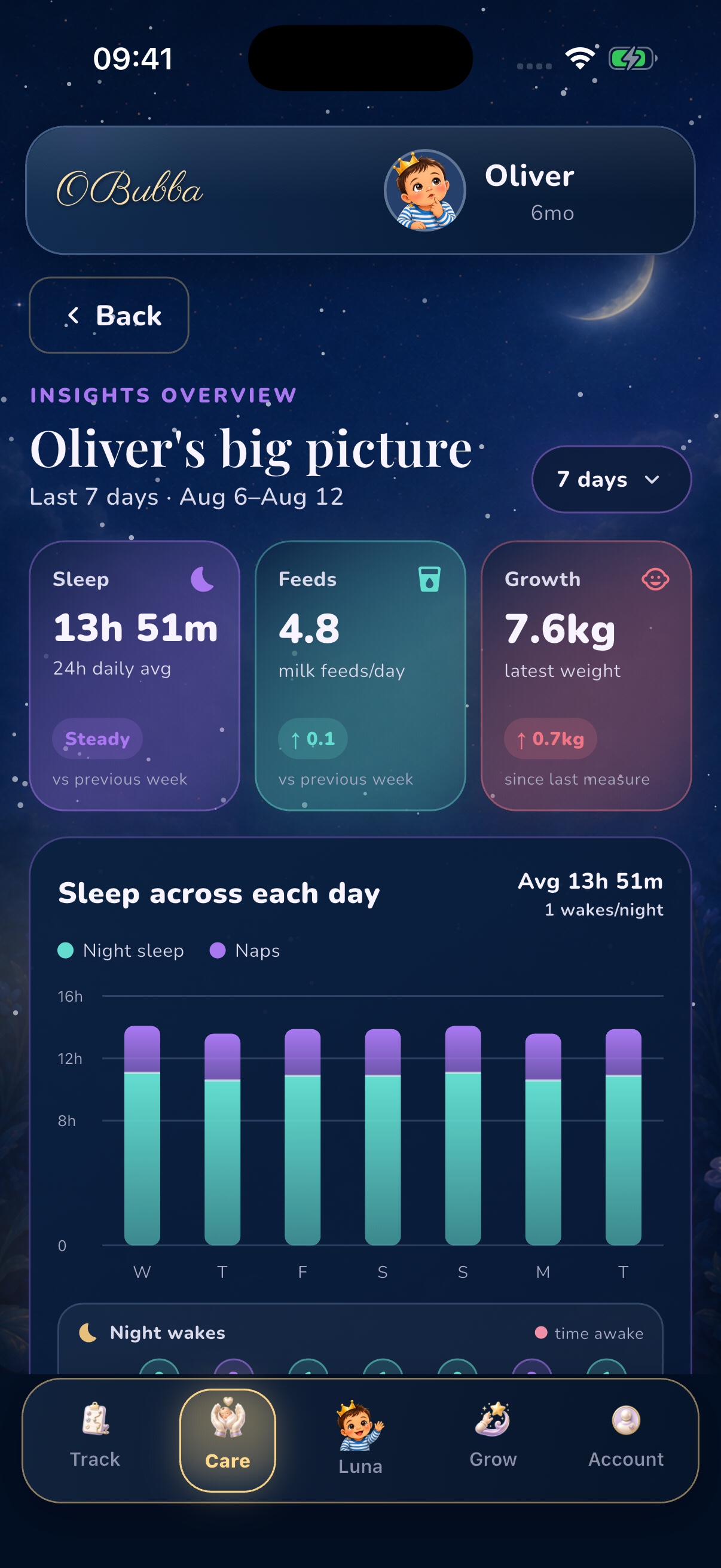
Expand More reports & handovers for three appointment-friendly options:
- Copy report for your GP / health visitor creates a shareable seven-day text summary.
- 4-week summary PDF (for clinic) creates a printable summary covering sleep, feeds, nappies and the latest logged growth. Where the required information is available, growth lines can include a WHO centile.
- Prep sheet for a doctor visit puts recent health-related flags first, then includes plausible temperature readings, latest logged weight and available feeding or sleep averages.
The underlying code deliberately omits nap or night-wake lines when those categories were not logged. It also labels the output as a parent-logged summary, not a medical record. Implausible temperature entries are filtered from visit prep so an accidental “380” is not presented as 380°C.
OBubba's 4-week PDF uses recent parent logs and can be shared through the phone's share sheet. It does not verify an entry, confirm a medicine dose, replace the Red Book, make a diagnosis or tell a clinician what decision to make.
For a short appointment, the best workflow is:
- open the Reports screen the day before
- choose the seven-day share for a recent change or the four-week PDF for a broader pattern
- add your three questions separately
- check the original entries for any unusual day
- take the Red Book as the clinical record
Try OBubba free → — keep feeds, nappies, sleep, temperature, growth and questions together, then turn the useful parts into a calm appointment summary.
When a routine appointment should not wait
Do not wait for a scheduled review or spend time perfecting a report if your baby may be seriously ill.
Current NHS guidance says to call 999 or go to A&E for signs including serious breathing difficulty, blue, grey, pale or blotchy skin, a rash that does not fade when pressed, a baby who is difficult to wake, a seizure, no pee for 12 hours, a temperature of 38°C or higher under 3 months, 39°C or higher at 3 to 6 months, or a temperature below 36°C. Call NHS 111 if you are worried about any symptom or do not know what to do.
Trust your instincts. A tracker is for recall and patterns; it is never a reason to postpone care.
Quick answers
Do I need to track for a full week before a health visitor appointment?
No. Bring what you genuinely have. For a new or urgent change, the start time and a few accurate observations can be more useful than waiting for a complete week.
Should I print my baby's whole log?
Usually start with one page: the concern, when it began, key changes, relevant measurements or frequencies, medicines and three questions. Keep the detailed log available in case the clinician wants it.
Can a baby tracker replace the Red Book?
No. The Red Book is the Personal Child Health Record used for professionally recorded growth, vaccinations and other important information. A tracker can add recent family observations beside it.
What if I forgot the Red Book?
Still attend unless the service tells you otherwise. Explain that you do not have it and follow the team's instructions about updating the record later.
Should I show an app's diagnosis or score?
Show the observations underneath it. Dates, feed changes, temperatures, nappies, sleep and behaviour are more useful than presenting an automated label as a conclusion.
What if I have ten questions?
Write all ten, circle the top three and ask what follow-up route to use for the rest. That protects the most important concern without relying on memory.
Related guides
- How often should you weigh your baby?
- Newborn feeding and nappy log: what is worth tracking
- What to track when your baby wakes at night
- Baby reflux and colic diary: what to track
- Why is my baby crying? A calm checklist
- Baby care handover template for grandparents and nursery
Sources and further reading
- NHS: Your baby's health and development reviews
- NHS Best Start in Life: Vaccinations and newborn screening tests
- NHS: When to get urgent medical help for babies and children under 5
- NHS: Vaccination tips for parents
OBubba supports organisation, parent-entered tracking and health conversations. It is not a medical record or medical device, cannot verify observations, diagnose illness or replace the Red Book, health visitor, GP, paediatric team, NHS 111 or emergency services.
Ready to try OBubba?
Use OBubba to track feeds, sleep, naps, nappies, growth, milestones and family handovers in one calm baby tracker app.