You offered the first spoonful. Then somebody else's six-month-old appeared online eating breakfast, lunch, dinner and a snack from a tiny divided plate.
Suddenly one taste of broccoli can feel behind schedule.
When your baby first starts solids at around six months, one small meal opportunity a day is enough. Add a second when the first feels manageable. From about seven to nine months, move gradually towards breakfast, lunch and tea alongside usual milk feeds. By 10 to 12 months, three meals a day is the general direction. Babies under 12 months do not need snacks; offer extra breast milk or first infant formula if they are hungry between meals.
That is a progression, not a deadline. A meal counts as an opportunity to practise even when most of it reaches the bib.
The short guide by age
| Stage | A useful direction | Milk and snacks | | --- | --- | --- | | Around 6 months, just starting | Begin with 1 small meal opportunity at a calm time | Continue usual breastfeeds or first infant formula; no snacks needed | | Around 6–7 months, gaining confidence | Add a second meal when sitting, swallowing and preparation feel manageable | Milk remains the main drink; do not drop a feed simply because a meal was offered | | Around 7–9 months | Gradually work towards 3 meals: breakfast, lunch and tea | Continue usual milk feeds; offer extra milk rather than snacks between meals | | Around 10–12 months | Usually 3 meals each day with increasing variety and texture | Continue breast milk or first infant formula; babies under 1 still do not need snacks |
The NHS first-solid-foods guidance says a baby who has just started does not need three meals a day. It recommends small amounts—just a few pieces or teaspoons—at a time when neither of you is rushed and baby is not too tired.
For 7 to 9 months, the NHS describes a gradual move towards three meals alongside usual milk feeds. By 10 to 12 months, breakfast, lunch and tea should feel established for many babies.
“Gradually” is doing important work. You do not have to serve three complete meals on the day your baby turns seven months.
What counts as a meal for a new eater?
A meal is a safe, supervised opportunity to explore food. It does not need several courses or a minimum number of swallowed grams.
At the beginning, a meal might be:
- two very soft broccoli florets
- a few teaspoons of thick lentil and vegetable mash
- one strip of well-cooked omelette
- a soft pear wedge and a preloaded spoon of plain full-fat yoghurt
- a little iron-fortified porridge
Sit baby upright, stay with them and let them decide whether and how much to eat. Offer a texture they can manage and avoid hard, round, sticky or otherwise unsafe shapes.
Touching, squashing, licking, gagging noisily, bringing food to the mouth and dropping it are all part of learning. The amount swallowed will vary wildly from one meal to the next.
The NHS advises looking at intake over a week rather than judging one meal or one day. A rejected lunch is not evidence that you need to add a replacement snack or pressure more food at tea.
When should I add the second meal?
Add another meal opportunity when one meal no longer consumes the whole day's energy—yours or the baby's.
Useful signs include:
- baby is ready to sit safely for another short meal
- they are swallowing at least some food, even if the amount is tiny
- you can prepare and supervise another opportunity without rushing
- the first meal is not repeatedly replacing an important milk feed
- baby shows interest at another family mealtime
- you can offer variety across the week without making every plate new
There is no required number of days on one meal first. Some families add breakfast after a week; others stay with lunch for several weeks. Work, nursery, milk feeds, naps, fatigue and the baby's temperament all shape what is realistic.
A practical sequence is:
- start with lunch, when baby is alert and you have time
- add breakfast, which is often simple and repeatable
- add tea when the late afternoon is no longer too tired or chaotic
You may prefer breakfast first because it fits your household. The names matter less than choosing a calm, supervised time.
When should I move to three meals?
From about seven months, begin moving in that direction. “Towards three” may look like:
- three meals on calm home days and two on a travel day
- breakfast offered but barely touched after an early milk feed
- lunch and tea established while breakfast is still occasional
- a small family-food component at each meal rather than a separate baby menu
By 10 to 12 months, aim for breakfast, lunch and tea on most days. The goal is a reliable rhythm and growing range of food skills—not three identical portion sizes.
At this stage, meals can include foods from several groups:
- starchy food: potato, oats, rice, bread, pasta or another grain
- vegetables and fruit: varied colours and less-sweet vegetables too
- iron-rich protein: meat, fish, egg, beans, lentils, chickpeas or tofu
- full-fat dairy or an appropriate alternative: yoghurt or pasteurised cheese
Not every plate needs every group. Balance the week.
Our simple weekly weaning plan shows how to choose a small set of repeatable ideas instead of inventing 21 different meals.
How do meals fit around milk feeds?
Milk does not disappear when the high chair arrives. Breast milk or first infant formula remains the main drink throughout the first year.
When solids first begin, the NHS suggests offering food before the usual milk feed—when baby is interested but not desperately hungry. Continue to feed responsively. As food intake grows, some babies naturally take less at a milk feed or eventually drop one; that change does not need to be forced from the calendar.
A beginner's day might look like:
| Part of day | Example rhythm—not a prescription | | --- | --- | | Morning | usual milk feeds following cues | | Late morning or lunch | one short solids opportunity + sips of water | | Afternoon and evening | usual milk feeds following cues | | Night | milk as needed for age, feeding pattern and individual needs |
An older weaning baby's day may include breakfast, lunch and tea between responsive milk feeds. Exact spacing depends on wake time, naps, appetite and whether feeding is breast, bottle or mixed.
Do not keep a hungry baby waiting for the “correct” meal slot. Equally, a baby who has just taken a full milk feed may have little interest in porridge five minutes later. Use the routine to create opportunities, not override cues.
Our milk-while-starting-solids guide covers the whole transition without treating formula figures as universal targets or trying to measure breastfeeds in millilitres.
Does my baby need snacks?
No—not before 12 months.
The NHS says babies under one do not need snacks. If they seem hungry between meals, offer an extra milk feed. This keeps milk available while their portions are small and their eating skills are still developing.
“Baby snack” packaging does not create a nutritional requirement. Rusks, puffs and pouches can also fill the gaps where a milk feed or shared meal would be more useful.
From 12 months, many toddlers move to three meals and may need two healthy snacks. That is a new stage, not something a nine-month-old has to practise early.
A calm 1 → 2 → 3 meal progression
One meal: build the skill
Choose one calm family mealtime. Offer:
- one iron-rich food across the day
- one safe texture opportunity
- sips of water from an open or free-flow cup
- plenty of time without pressure
Repeat foods. One successful lentil mash does not have to be replaced by a new recipe tomorrow.
Two meals: build the rhythm
Keep one dependable meal and add a second easy anchor. For example:
- breakfast: porridge with mashed pear
- lunch: soft lentil, tomato and vegetable mash
Across the week, introduce common allergens one at a time in small amounts following current guidance, then keep tolerated allergens in the diet regularly. If your baby has severe eczema or a known food allergy, ask a health professional about introducing egg or peanut.
Three meals: build the range
Let breakfast, lunch and tea borrow from family food:
- breakfast: eggy toast fingers with soft fruit
- lunch: bean spread on toast with soft-cooked vegetables
- tea: family tomato pasta with lentils, prepared without added salt and served in a safe texture
Reusing ingredients is efficient, not boring. A batch of lentil tomato sauce can become mash, pasta sauce and a toast topping across several days.
What if three meals are not happening yet?
First ask what is making the third opportunity hard.
Baby is too tired at tea
Move the opportunity earlier, make it smaller or let lunch carry more of the variety. An exhausted baby does not learn more because the plate was served at the traditional time.
Breakfast follows a large milk feed
Keep breakfast low-pressure. Join the family, offer a few pieces and let milk remain important. Appetite may shift gradually as the wider pattern changes.
Work or nursery makes the rhythm inconsistent
Agree what counts as breakfast, lunch and tea across both settings. Share allergens, textures, reactions and milk context rather than relying on “ate well.” OBubba's babysitter and carer handover guide explains the difference between a static note, temporary care link and ongoing family access.
Baby refuses most meals
Keep portions tiny, sit together and remove pressure. Check timing, constipation, teething, illness and texture. If refusal is persistent, baby coughs or chokes, seems in pain, cannot progress through textures, has fewer wet nappies or growth is a concern, speak to your health visitor or GP.
Use our no-pressure solids reset when meals have become a battle.
How the actual OBubba app handles meal rhythm
We inspected the current implementation rather than describing a generic meal planner.
The Track-page meal heads-up
OBubba has an age-staged solids readiness signal. It remains silent before about 22 weeks and remains silent until at least one solids meal exists in recent logs. That prevents a baby who has not started solids from receiving breakfast reminders.
Its standard default slots are deliberately simple:
- before 30 weeks: one lunch opportunity
- 30 to 38 weeks: breakfast and lunch
- from 39 weeks: breakfast, lunch and tea
These are product defaults, not clinical deadlines. They approximate a 1 → 2 → 3 meal progression and should always sit beneath readiness, professional advice for premature or medically complex babies, and the family's actual day.
The heads-up appears only when a slot is within two hours ahead or up to 45 minutes past. If a solids meal was logged within the previous two and a half hours, it stays quiet. A meal near the slot also counts as covering that opportunity.
What the current engine does not do is equally important:
- it does not measure how much food was swallowed
- it does not infer hunger
- it does not automatically fit meals between today's milk feeds or naps
- it does not replace readiness signs or a health professional's plan
- it does not treat a missed slot as a nutrition failure
The Weaning progress view
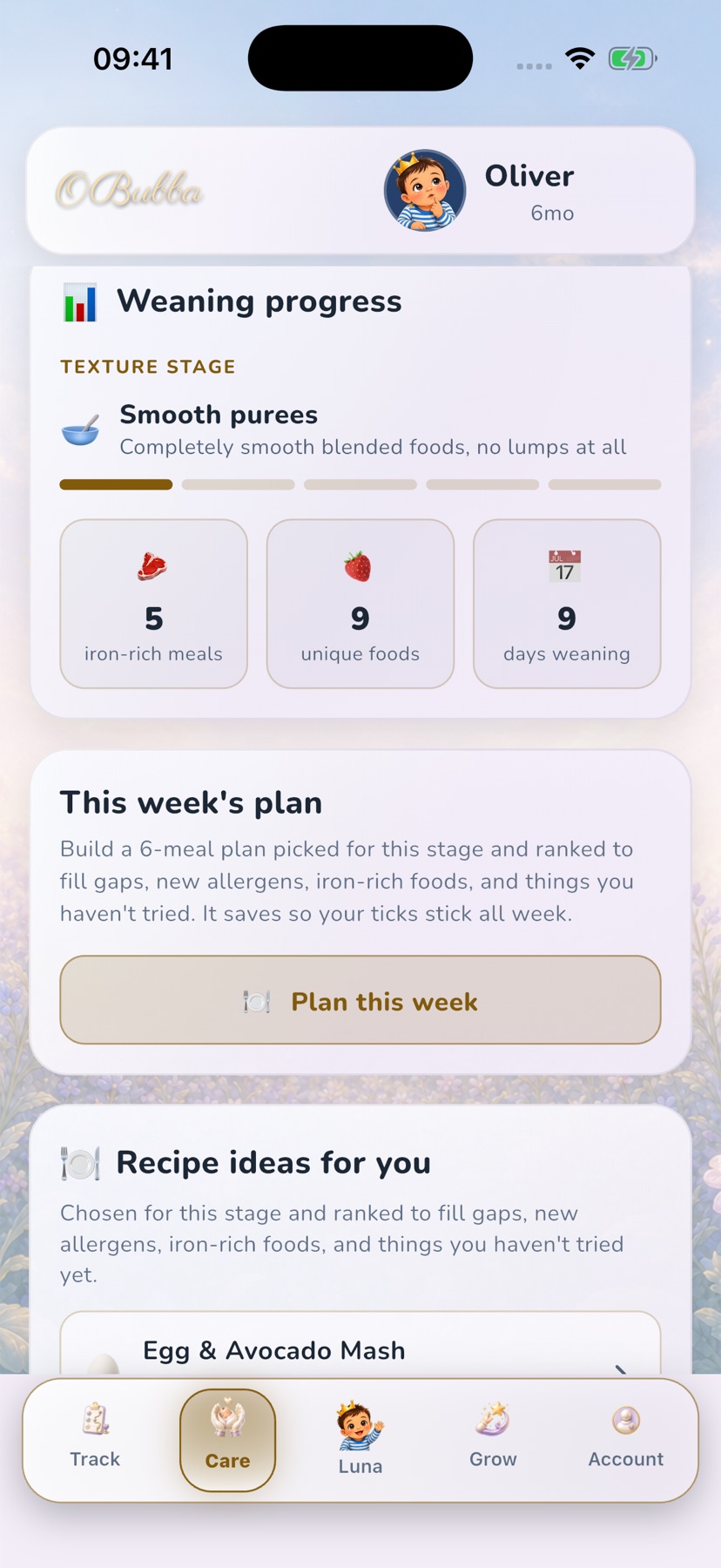
Food logs feed a wider picture: current texture stage, days since solids began, unique food descriptions and iron-rich meal count. Allergens recognised in logged foods join the allergen journey; any recorded reaction remains excluded from future suggestions even after the original day moves out of the recent active window.
The weekly planner then selects age-appropriate recipes from the baby's history, marks iron-rich choices, carries detected allergens and builds a deduplicated shopping list. It is six useful meal ideas by default—not a demand for six different days or a complete nutrition prescription.
That separation matters:
| OBubba can organise | The parent and baby still decide | | --- | --- | | whether breakfast, lunch or tea is roughly due | whether baby is hungry and comfortable now | | which meals and textures were logged | how much was actually eaten | | recent food variety and iron-rich meal count | whether today's portion should be larger or smaller | | known allergen history and recorded reactions | what an allergy clinician advises for this baby | | a practical weekly recipe shortlist and shopping list | which meal fits real family life today |
Try OBubba free to keep milk feeds, meals, allergens, reactions, textures and weekly ideas in one timeline—without turning the high chair into another place to chase a perfect score.
The rule worth remembering
Start with one opportunity. Add the second when it feels manageable. Move gradually towards three meals from around seven months, and aim for breakfast, lunch and tea by 10 to 12 months.
Keep milk responsive. Skip snacks before one. Serve tiny amounts safely, stay close and let your baby decide what happens to the food.
The rhythm matters because it creates chances to learn. It is not proof of how well your baby ate—or how well you parented.
This article provides general information for UK families. It does not replace individual feeding, allergy or medical advice. Ask your health visitor, GP, paediatric dietitian or relevant specialist if your baby was premature, has a feeding difficulty, allergy, medical condition or growth concern.
Frequently asked questions
How many meals should a six-month-old have?
Begin with one small meal opportunity a day. A few pieces or teaspoons are enough. Add a second when the first feels manageable; a six-month-old does not need three meals immediately.
How many meals should a seven- or eight-month-old have?
Gradually move towards three meals—breakfast, lunch and tea—alongside usual milk feeds. Some days may still have two opportunities, especially early in that transition.
How many meals should a nine-month-old have?
Three meals is a useful direction, but appetite and routine vary. Keep breast milk or first infant formula responsive, offer safe texture and iron-rich foods, and judge the pattern over a week rather than one plate.
Does a baby under one need snacks between meals?
No. NHS guidance says babies under 12 months do not need snacks. Offer an extra breastfeed or first infant formula if they are hungry between meals.
Should solids come before or after milk?
When solids first begin, the NHS suggests offering food before the usual milk feed, when baby is interested but not desperately hungry. Continue milk responsively and do not force a feed to disappear because a meal was offered.
Does three meals mean three full bowls?
No. A meal is an opportunity, not a portion target. One may be a few teaspoons, another two finger-food pieces and another mostly exploration. Follow fullness cues and consider variety across the week.
Ready to try OBubba?
Use OBubba to track feeds, sleep, naps, nappies, growth, milestones and family handovers in one calm baby tracker app.