Your baby took four naps yesterday, three today and appears determined to make tomorrow a surprise. The internet chart says “three naps”. Nursery calls the pushchair doze a nap. A 12-minute feed snooze may have moved the afternoon without looking like a proper sleep at all.
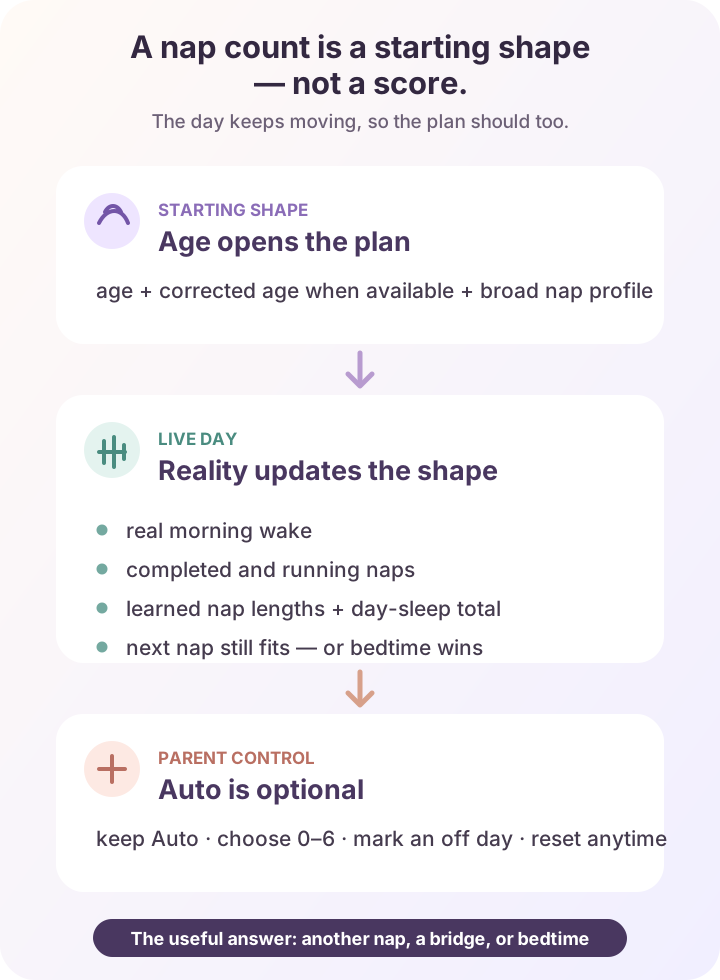
There is no single correct nap count for every baby of the same age. Age gives you a useful starting shape; the better answer comes from the whole 24 hours, your baby's mood and feeding, how naps actually unfold, and whether bedtime still works.
Newborn sleep is especially irregular and should not be forced into a clock-led plan. Older babies often move from several naps towards three, then two and eventually one—but transition days naturally contain both the old and new count.
A practical nap-count guide
Use this as a description of common day shapes, not a target to manufacture.
| Approximate age | A common nap shape | What matters more than the number | |---|---:|---| | Birth to 3 months | many short and long sleep periods; no reliable count | responsive feeds, alertness, growth, safer sleep and following any newborn feeding plan | | 3 to 5 months | often 3–4 naps | whether the last nap is a short bridge and whether the day remains manageable | | 5 to 8 months | often 3, moving towards 2 | repeated ability to manage longer awake periods without becoming exhausted | | 8 to 14 months | often 2 | two useful naps that still leave a workable bedtime | | Around 14 to 18 months | 2 or 1 during the transition | repeated nap refusal plus a sustainable one-nap day—not age alone | | Around 18 months onward | often 1 | enough total sleep, a workable bedtime and a child who is coping well |
These bands deliberately overlap. A seven-month-old may still need three naps after short sleeps; another may have settled into two. A 15-month-old may manage one nap at nursery and need two on a tired home day.
Local NHS guidance describes babies approaching six months as commonly having two to three daytime naps, and babies from six to 12 months as often having two. It also says there is no single rule for daytime sleep because the child's age, individual need and total sleep across 24 hours all matter.
Why a nap count cannot answer the whole question
Two babies can both take two naps and have completely different days.
One may sleep 90 minutes twice and reach bedtime calmly. Another may take two 25-minute naps, become frantic by late afternoon and need a bridge nap or earlier bedtime. Counting “two” hides the difference.
The broader total matters too. The American Academy of Sleep Medicine recommends 12–16 hours across 24 hours for healthy infants aged four to 12 months, including naps, and 11–14 hours for children aged one to two. Those are broad consensus ranges—not a prescribed split between night and day. The panel made no duration recommendation under four months because normal variation and the supporting evidence were too wide.
The NHS similarly stresses that some babies need more sleep and some less. It describes newborn sleep as short or long bursts and gives very broad totals. That is why a newborn “six-nap schedule” should be read as six possible planning slots, not six appointments a parent must produce.
Signs the current nap shape fits
The count is probably serviceable when, across ordinary days:
- your baby usually settles without every nap becoming a prolonged battle
- most awake periods are comfortable rather than consistently frantic or glassy-eyed
- naps leave enough room for a workable bedtime
- your baby feeds, interacts and wakes in their usual way
- total sleep sits within a plausible range for this baby
- the family can follow the rhythm without spending the whole day rescuing a timetable
One difficult day proves very little. Illness, teething, travel, visitors, nursery, a growth change, a new skill and an unexpectedly short nap can all produce an extra sleep or remove one.
Signs the count may be changing
A nap transition is a pattern, not one refusal.
Look for the same evidence across at least a week or two of reasonably ordinary days:
- the same nap is repeatedly refused despite a calm, age-plausible opportunity
- settling takes much longer for that nap while the baby remains content and alert
- keeping every nap repeatedly pushes bedtime too late
- the last nap becomes a tiny bridge or disappears without the evening collapsing
- awake periods lengthen naturally rather than through forced distraction
- the new day shape produces similar or better mood, bedtime settling and overnight sleep
Our detailed nap-transition guide separates a real pattern from a few disrupted days.
Extra naps are not regression
During a 3-to-2 or 2-to-1 transition, the old count often returns after a short first nap, an early morning or a rough night. That does not reset progress. It is the flexible part of a transition.
Think in terms of a weekly shape. If four days work with two naps and three days need a small third bridge, the honest answer is “between two and three”—not “failing at two”.
What if my baby took a tiny accidental nap?
A brief car, carrier, pram or feed doze can reduce sleep pressure even if it did not look like a planned nap. Do not pretend it did not happen, but do not automatically give it the same role as a full restorative nap either.
Record the real duration. Then watch the next transition. Your baby may need a later nap, a shorter wake period after a poor-quality doze or no further nap if bedtime is close. The app should recalculate from the sleep that happened, not insist on finishing a numbered list.
If the doze happened in a car seat, use the seat only for travel and move the baby to a suitable flat sleep space when you arrive. For every nap, follow current safer-sleep guidance.
What if naps are very short?
Short naps are common, particularly while sleep is maturing. They do not automatically mean the count should drop.
If every nap is brief, the day may still need more nap opportunities because little sleep was banked. Dropping a nap solely because an age chart changed can create a very long final awake stretch.
Check the whole pattern:
- Was the nap offered after a reasonable awake period for this baby?
- Did a hidden doze move sleep pressure?
- Was the environment safe and workable?
- Did the baby wake content or distressed?
- Can the next sleep or bedtime move earlier without forcing it?
The article on why a baby's next nap time changed explains why the prediction should move after the day changes.
Should I rescue a short nap?
You can. A contact, pram or carrier rescue can protect sleep when used safely. Keep it as one nap if the baby briefly stirs and continues sleeping; in OBubba, add the moved-to location rather than inventing a second nap and a three-minute wake window.
If you are holding a sleeping baby, stay awake and attentive. Move the baby to a clear, flat, firm sleep surface if you might fall asleep; sofas and armchairs are especially dangerous places to doze with a baby.
How the current OBubba plan chooses a nap count
OBubba begins with an age-based nap profile. In the current code, that planning prior moves from multiple newborn sleep slots through roughly three to four naps in early infancy, three then two across later infancy, and one as the toddler pattern settles. Corrected age is used when it is available for a baby born prematurely.
That is only the cold start. The live plan then uses what has actually happened today:
- the real morning wake
- completed and currently running naps
- the total daytime sleep already logged
- the likely next awake interval
- whether another nap still fits before bedtime
- teething, illness or another marked disruption
- any nap-count choice the parent has made
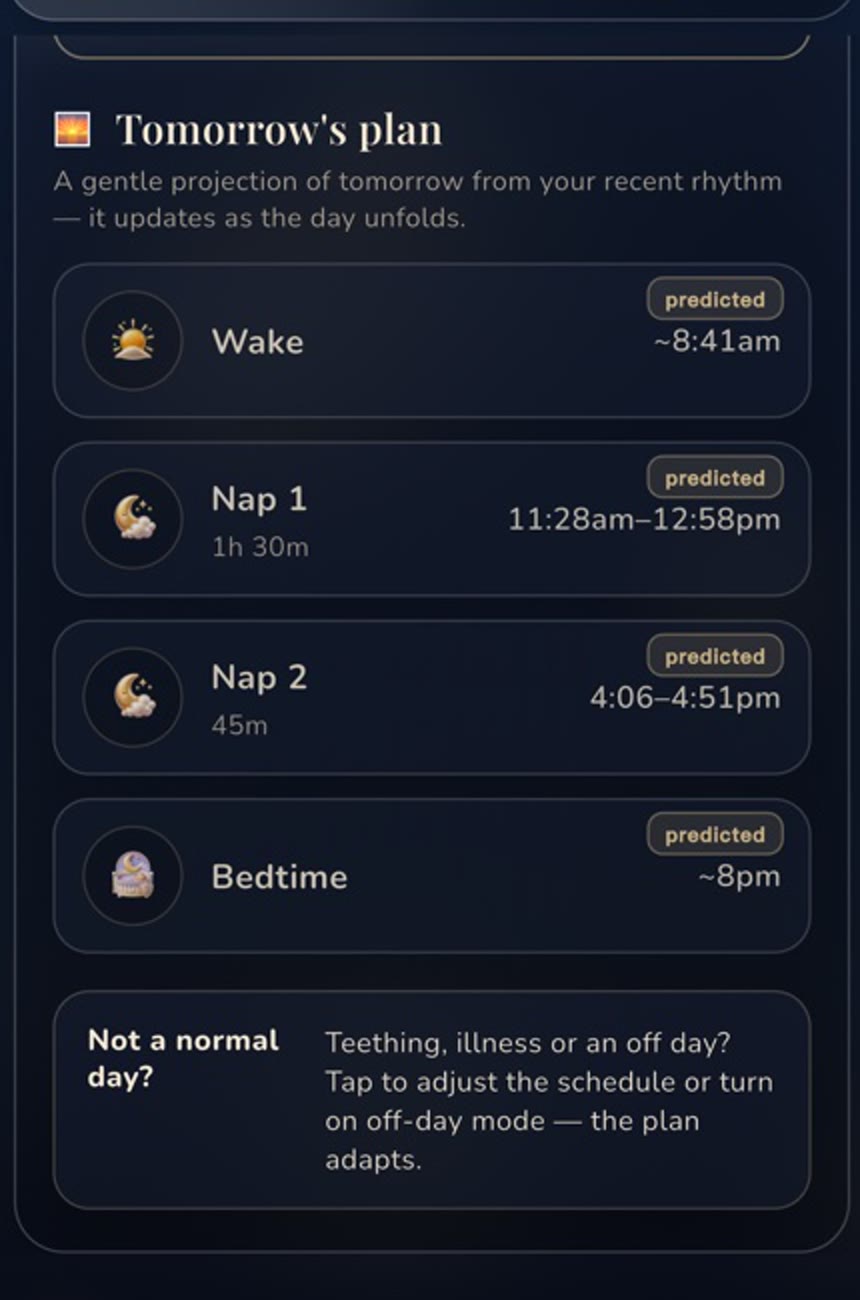
The clock and Today's plan use the same prediction engine. That matters: the page should not display another nap while the clock counts down to bedtime. When the plan simulates the rest of the day, it predicts one sleep, adds its estimated end, then asks again whether another still fits.
Nap length becomes personal with enough history. For each nap position, OBubba looks across the previous two weeks and uses the baby's median length after at least three valid examples. Until then, it falls back to the age profile. A late possible sleep is treated as a short bridge rather than projecting a two-hour nap into the evening.
After a long first nap has already covered much of the day's usual sleep, the plan can reduce the remaining count. It is guarded from collapsing a young two-nap baby straight to one nap, and teething can preserve the higher count. These are product guardrails, not biological truths.
You can override the app
In Track → Today's plan → Adjust, nap count can stay on Auto or be set from zero to six. Zero matters for a toddler who has genuinely stopped napping; six allows the picker to describe a very young newborn's fragmented day.
One current-app detail is worth knowing: a manual nap-count choice is treated as structural and stays active until you return it to Auto or reset the schedule. Wake-time and bedtime adjustments have separate one-day, gradual and ongoing options. If the plan suddenly seems to ignore a new pattern, check whether an older nap-count override is still active.
For illness, teething, travel or an off day, the disruption control temporarily tells the prediction system not to treat the unusual day as ordinary baseline evidence.
Try OBubba's adaptive nap tracker free → — see the next likely sleep, the rest of today's shape and bedtime update from the naps that really happened.
What OBubba cannot know
The app cannot see tired cues, confirm an unlogged car doze, judge whether a baby is unusually difficult to wake, or decide that a sleep pattern is healthy. It cannot turn a chart into a diagnosis.
A prediction is particularly uncertain when:
- the date of birth or corrected age is missing
- naps are frequently unlogged or left running
- nursery and home record sleep differently
- the baby is ill or recovering
- the family has just travelled across time zones
- the baby is in the middle of a nap transition
Correct the record instead of forcing the child to match it. A good tracker should become quieter when the evidence is weak.
Safer sleep applies to every nap
The nap number never changes the safety basics. The Lullaby Trust advises placing a baby on their back in their own clear, flat, firm sleep space. For at least the first six months, that space should be in the same room as a parent or carer for sleep, day and night.
Keep pillows, duvets, bumpers, pods, positioners, toys and loose items out of the cot or Moses basket. No schedule benefit justifies unsafe sleep or an exhausted adult trying to stay awake on a sofa with a sleeping baby.
If a baby is unusually sleepy or hard to wake, feeding poorly, producing fewer wet nappies, breathing differently, feverish or otherwise seems unwell, stop adjusting naps and seek medical advice. Follow any individual waking or feeding plan from your neonatal, maternity or community team.
Frequently asked questions
How many naps should a 6-month-old take?
Many six-month-olds take two or three naps. The more useful question is whether the sleep adds up to a workable day: short naps may need a third opportunity, while two longer naps may be enough. Do not force a drop because another baby is on two.
How many naps should an 8-month-old take?
Two is common, but some eight-month-olds still use a short third bridge nap during the transition. Look for a stable pattern across several days rather than judging one afternoon.
How many naps should a 12-month-old take?
Two naps are still normal at 12 months. Some children begin moving towards one, especially around nursery changes, but age alone is not a reason to drop a nap. Repeated refusal and a sustainable one-nap day are stronger evidence.
When do babies move from three naps to two?
Often in the later part of the first year, but there is no birthday deadline. The transition usually looks mixed: two naps after long sleeps, three after short naps or an early start.
When do toddlers move from two naps to one?
Many move during the second year, with one nap common by around 18 months. Some transition earlier or later. Give the pattern time and protect an earlier bedtime when the one-nap day is still new.
Does a 10-minute car nap count?
It counts as sleep and may shift the next nap, but it may not replace a full restorative nap. Record the honest duration and follow the next cues.
Should I wake my baby to protect the nap count?
Usually the goal is not to preserve a number. A repeated long or late nap may justify a small, cautious experiment when it consistently disrupts bedtime. Newborn feeding plans, illness and individual clinical advice come first. Read when to wake a baby from a nap before making the change.
Reliable sources
- NHS Best Start in Life: Your baby's sleep patterns
- Black Country NHS: Sleep and daytime naps
- American Academy of Sleep Medicine: Paediatric sleep-duration consensus
- The Lullaby Trust: Room sharing and safer sleep
- Healthier Together: Healthy sleep for children aged 1–5
This article gives general information for UK families. It is not a medical, developmental or individual sleep assessment, and OBubba is not a medical device. Follow your child's cues, safer-sleep guidance and advice from their own healthcare team.
Ready to try OBubba?
Use OBubba to track feeds, sleep, naps, nappies, growth, milestones and family handovers in one calm baby tracker app.