Both parents wake for every cry. One feeds while the other watches. By morning, nobody knows who changed the nappy, whether the 3am bottle was 60ml or 90ml, or which person is now too tired to safely hold the baby.
A useful newborn night shift gives one adult clear responsibility while the other gets a protected block of rest. It must still preserve responsive feeding, your individual breastfeeding or medical plan and safer sleep. Before swapping, hand over only the facts that change the next decision: last effective feed, nappy, sleep state, medicine, anything unusual and who is now on duty.
The goal is not an equal number of wakes. It is two adults who can function safely and a baby whose needs remain central.
Choose the shift shape that matches feeding
| Night-shift pattern | Can work well when | Important limitation | |---|---|---| | Early shift / late shift | One adult sleeps early while the other handles the evening, then they swap | A breastfeeding parent may still need to feed or express during their protected block | | Alternate complete wakes | Either adult can safely provide the planned feed and resettle | Both adults may keep waking unless rooms and responsibilities are genuinely separate | | Feeding parent + support parent | Breastfeeding is being established and baby feeds directly | The support parent owns lifting, changing, winding, settling, water and logging, not passive supervision | | One overnight adult + early-morning relief | One parent copes better at night and the other can start early | The overnight adult still needs a defined recovery block later | | Friend or relative daytime shift | A single parent or couple needs sleep but feeding limits overnight cover | The helper must receive safer-sleep, feeding, medicine and emergency instructions |
There is no universal 9pm-to-2am schedule. A premature baby, newborn under a feeding plan, baby with jaundice or slow weight gain, or parent establishing milk supply may need feeds or expressing at intervals set by their clinical team. Build shifts around that plan rather than stretching feeds to protect the timetable.
Newborn wakes are not a scheduling failure
The NHS says newborn babies wake repeatedly during the first few months and need to feed little and often. Their sleep comes in short bursts and does not yet fit adult night and day.
A night shift should therefore change which adult is responsible, not force the baby to wait until the next adult's alarm. Feed responsively and follow early cues such as stirring, rooting, hands to mouth or increasing alertness. Crying is a later cue.
Keep night interactions low-key: dim light, quiet voices, no play and a return to the baby's safer sleep space after feeding and changing. The on-duty adult is not trying to teach a newborn to sleep through; they are meeting needs without waking the whole household.
If you are breastfeeding
In the early days, feeding frequently, including at night, supports milk production. The NHS notes that night breastfeeding is particularly important while supply is becoming established. A plan in which the breastfeeding parent simply skips several needed feeds may affect comfort, supply and the baby's intake.
That does not make the other adult irrelevant. A support shift can own everything around the feed:
- notice the early cue and bring the baby
- check whether a nappy change is actually needed
- pass water, pillows or practical support
- wind or hold the baby after the feed when appropriate
- settle baby back into their cot or Moses basket
- record the feed and nappy if the feeding parent wants to return straight to sleep
Once breastfeeding feels established, some families choose an occasional bottle of expressed milk. NHS guidance says this is a personal choice; expressing regularly may be needed when time apart would otherwise reduce milk removal. Ask a midwife, health visitor or breastfeeding specialist for a plan that fits your supply, baby's growth and feeding effectiveness.
Do not introduce top-ups or stretch intervals solely to make a shift chart work.
If you formula-feed or combination-feed
Partners may be able to take whole feeding shifts, but the handover still needs precision:
- which milk is being used
- when the last feed began or ended, using one household convention
- amount offered and amount taken
- any vomiting, coughing, difficulty feeding or unusual sleepiness
- the next step in an individual feeding plan
Prepare formula safely according to NHS instructions; do not pre-mix a night of bottles outside that guidance. Discard leftover milk according to the preparation advice. The off-duty adult should not be woken simply to confirm routine information that the on-duty adult can see and record.
The 30-second handover
At the swap, use this order:
- Baby now: asleep in the cot, feeding, awake and settled, or needs a response.
- Last feed: type, actual time and useful amount or breast detail.
- Last nappy: only if it changes what the next adult needs to know.
- Open event: sleep, feed or night-wake timer still running.
- Safety-critical detail: medicine actually given, temperature, allergy or clinical instruction.
- Exception: one sentence such as “coughed through that bottle” or “would not settle flat, please reassess if it repeats”.
- Ownership: “You are on duty now; wake me if X happens.”
Do not recite the whole day. A long handover keeps both adults awake and makes the urgent line easier to miss.
Use closed-loop language
“I think I gave paracetamol” is not a handover. Neither is “baby needs feeding soon.”
Prefer:
> “The last bottle started at 1:40am; 70ml was taken. Wet nappy at 2:05. No medicine. Sleep restarted at 2:18 and the timer is running. You are on duty until 6.”
For medicine, the receiving adult repeats the product, actual dose and time back. If the record and spoken handover disagree, stop and resolve it before giving anything. Use our medicine handover guide; no app should calculate or authorise a dose.
A safer-sleep plan belongs inside the shift
For at least the first six months, NHS guidance says the baby should sleep in the same room as a parent or carer, in their own clear cot or Moses basket. Put baby on their back on a firm, flat mattress and keep pillows, duvets, nests, pods, bumpers, toys and loose bedding out.
During each care block:
- the on-duty adult remains responsible and able to respond
- the baby returns to the safer sleep space after care
- the off-duty adult can sleep in another room if the on-duty adult is sharing the baby's room
- nobody sleeps with the baby on a sofa or armchair
- if the on-duty adult may doze while holding or feeding, they put the baby down and wake the other adult
The point of shifts is to reduce dangerous exhaustion, not to create a heroic solo stretch beyond what one adult can safely manage.
Three plans families can adapt tonight
Plan A: breastfeeding support shift
- First adult: feeds responsively when baby cues.
- Second adult: brings baby, changes if needed, resettles and logs.
- Protected rest: after the early-morning feed, the second adult takes baby for settling and ordinary care while the feeding parent returns to sleep.
This preserves direct feeds while making the work around them visible and owned.
Plan B: complete care blocks
- 8pm–1am: Adult A is responsible for feeds under the agreed plan, nappies and settling; Adult B sleeps.
- 1am onward: a factual handover, then Adult B takes over and Adult A sleeps.
Times are illustrative. Move the boundary to match work, milk expression, older children and each person's natural sleep.
Plan C: one adult household
Create shifts across the 24-hour day rather than pretending nighttime must be handled alone. A friend or relative can take a post-feed morning block, walk an awake baby, prepare food, wash equipment or sit beside the cot while the parent sleeps nearby. Share the exact care boundaries and emergency contacts.
If exhaustion is becoming unmanageable, ask the health visitor, GP, family or trusted friends for help. If you cannot sleep even when the baby is safely cared for, or your mood, thoughts or ability to cope are concerning you, read our postpartum insomnia guide and seek professional support.
How the current OBubba app supports a real night shift
OBubba uses two different sharing tools because a live co-parent and a temporary helper do not need the same access.
One shared timeline for regular partners
With Family sharing, the second parent enters the baby's sync code and chooses Connect: live sync. Both phones then read and write the same child record rather than maintaining two diaries.
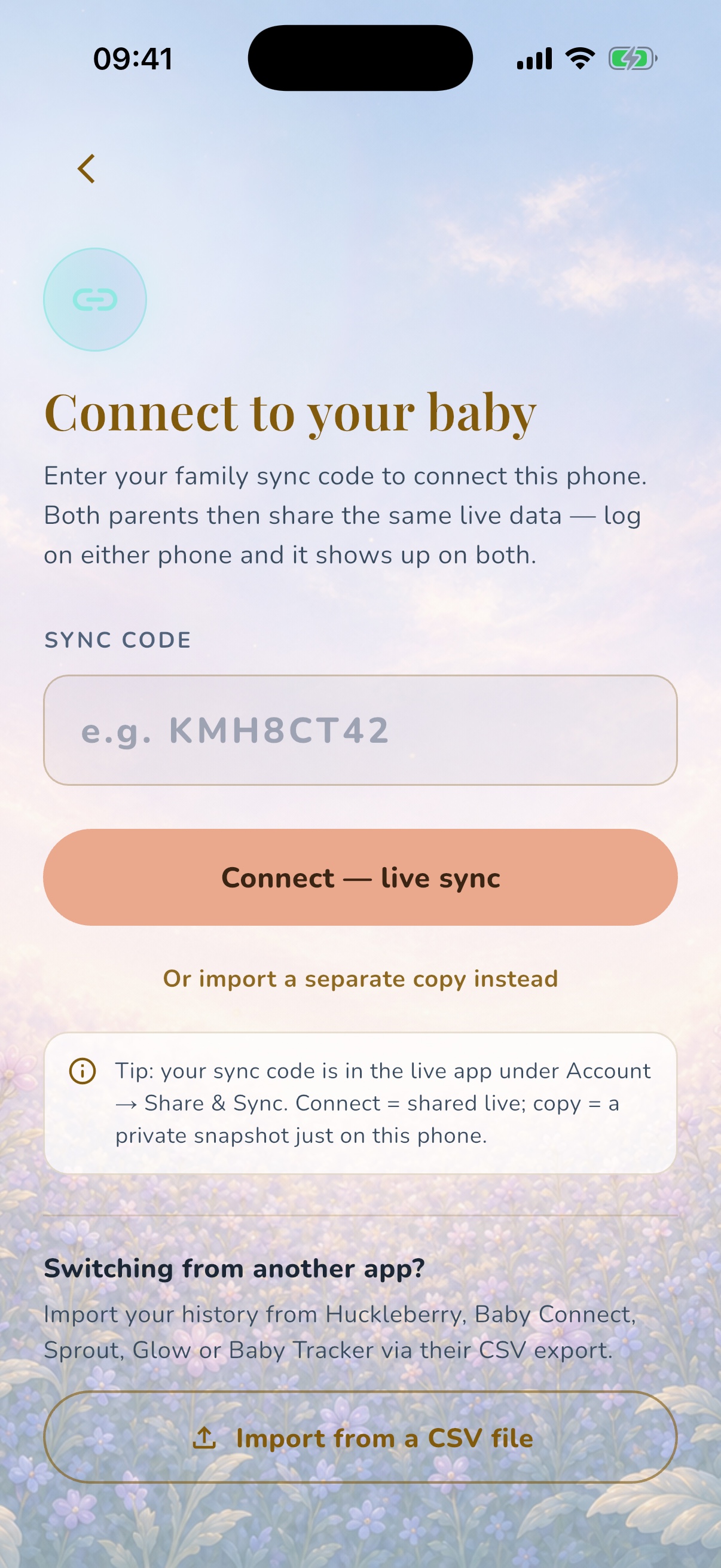
The adult who performs a feed, change or settle records it. At handover, the receiving adult checks the existing timeline instead of recreating the event. This matters because OBubba can deduplicate the same synced entry by its stable ID, but it cannot safely assume two separately created 2am bottles describe one physical feed.
Open sleep timers also travel with the shared child record. The timer logic recognises a genuine bedtime carried across midnight, an active night-wake pause and the latest valid open sleep. It also rejects stale abandoned timers so yesterday's forgotten nap does not remain “live” forever.
A compact briefing for the next carer
After at least two logged days, Bubba Care → Hand-off briefing can assemble a copyable page with:
- likely next nap and bedtime from the current day plan
- a short summary of last night
- the settling approaches most often recorded as helpful
- recorded conditions and lifetime food-reaction warnings
- names of medicines logged today or yesterday
- current developmental phase and one useful non-wellbeing insight
The briefing deliberately does not replace the exact timeline. It does not list a medicine dose or administration time, and it does not currently provide the last feed or nappy as a verified handover field. Those details must come from the live log and the adults' closed-loop check.
That limitation is important: “Recent medicine: paracetamol” is a warning to verify, not permission to give another dose.
| OBubba can help with | The adults still must confirm | |---|---| | One live feed, sleep and nappy timeline across phones | Whether a real-world event was entered correctly | | Preserving a valid overnight timer and pause | Whether baby is currently asleep and safely positioned | | Learning commonly recorded settling methods | What this wake needs tonight | | Carrying older recorded food reactions into the Watch list | The current allergy action plan and safe foods | | Showing names of medicines used recently | Product, dose, exact time and whether another dose is due | | Copying a concise carer briefing | Emergency contacts and individual clinical instructions |
Access is per child. A partner joining one baby's code does not automatically receive every child on the owner's account. When access should end, replacing the sync code disconnects everyone on the old code; trusted carers who still need access must be re-invited.
Read the full two-parent live-sync setup before the first night rather than troubleshooting at 2am.
Start tracking the night together →
Use one shared overnight timeline for a calmer handover and fewer moments when both exhausted adults are asking what already happened.
Morning review: improve the system, not the score
Spend two minutes on three questions:
- Did each adult get a genuinely protected block, or were both still half-on-duty?
- Did any handover detail cause uncertainty or duplicate logging?
- Was anyone too sleepy to feed, hold or settle safely?
Change one thing for the next night: move the boundary, make the off-duty room quieter, clarify who logs, prepare safe supplies or ask for an extra daytime support block. Do not optimise the baby's feeds around the adults' spreadsheet.
Frequently asked questions
How long should a newborn night shift be?
There is no universal length. It must fit feeding needs, milk supply, parental health and safe alertness. Even a two-hour protected block can be valuable if the other adult truly owns the care.
Can my partner do every other breastfeed with a bottle?
Not automatically. Introducing expressed milk and missing breastfeeds can affect feeding and supply, especially early on. Ask a midwife, health visitor or breastfeeding specialist for individual guidance.
Should both parents wake for every newborn feed?
Usually both do not need to remain fully awake for every routine feed. The support parent can take specific surrounding tasks, or one adult can own a care block when the feeding plan allows. Safety and the family's circumstances decide.
What should we log overnight?
The essentials are feed, meaningful nappy, proper night wake and any medicine or unusual symptom. Our low-effort night-wake log keeps the record manageable.
Sources and further reading
- NHS: Helping your baby to sleep
- NHS: Sleep and tiredness after having a baby
- NHS: Breastfeeding, the first few days
- NHS: Milk supply
- NHS: How to make up baby formula
- UNICEF UK Baby Friendly Initiative: Caring for your baby at night
- The Lullaby Trust: Safer sleep for babies
OBubba supports organisation, tracking and family handovers. It does not verify feeds, assess milk transfer or supply, supervise sleep, calculate medicine doses, diagnose illness or replace a midwife, health visitor, breastfeeding specialist, pharmacist, GP, NHS 111 or emergency care.
Ready to try OBubba?
Use OBubba to track feeds, sleep, naps, nappies, growth, milestones and family handovers in one calm baby tracker app.