Your baby has been asleep since 7:30pm. You are finally ready for bed at 10:30pm—and you know there is a good chance they will wake hungry just after you fall asleep. Should you gently offer milk now and try to move that first wake later?
That planned feed is commonly called a dream feed. For some families it moves a substantial feed closer to the parent's bedtime and creates a more useful stretch of shared sleep. For others it wakes the baby, adds milk without removing any later feeds or leaves everyone no better rested.
Dream feeding is optional, not a sleep requirement. Evidence for the feed by itself is limited. If your baby is healthy, growing well and still needs night milk, you can try it responsively for several comparable nights—but never force a sleepy baby to feed, and stop if it disrupts sleep or does not improve the part of the night that matters to your family.
What exactly is a dream feed?
A dream feed is a parent-initiated milk feed after bedtime, usually before the parent goes to sleep, when the baby has not woken and called for it.
In everyday use, the definition varies:
- some parents lift a sleeping baby and feed without a full wake
- some gently rouse a drowsy baby enough to latch or accept a bottle
- some use “dream feed” for any scheduled late-evening feed
- others incorrectly use it for the first feed after the baby wakes
That last event is an ordinary night feed, not a dream feed. The distinction matters when you are testing whether the planned feed prevented a later wake. If the baby was already awake and hungry, the feed did not pre-empt that wake.
OBubba uses a precise definition: a feed given during ongoing night sleep without a full wake. It stays in the feeding history, but it is not counted as a wake-driven night feed.
The quick decision guide
| Your situation | Dream feed worth trying? | Why | |---|---|---| | Healthy, growing baby has a reliable first hungry wake soon after you go to bed | Possibly | Moving a needed feed nearer your bedtime may improve your first sleep stretch | | Baby already sleeps a long first stretch and the family is coping | Probably unnecessary | There is no problem to solve, and the feed could interrupt settled sleep | | Newborn has an individual feeding plan or needs waking for weight, jaundice or prematurity | Follow the clinical plan, not a sleep experiment | Scheduled medical feeding and dream feeding are not the same thing | | Baby refuses, coughs, chokes, arches or is hard to rouse | No—seek advice | A sleepy feed should not bypass a feeding or health concern | | Dream feed happens, but the same later feeds and wakes continue | Stop and compare | It may be adding a feed rather than replacing or delaying one | | Parent is so tired they may fall asleep in a chair or on a sofa | Prioritise immediate safety | A planned feed is not worth increasing the risk of accidental sleep |
Do not start because a schedule says every baby needs a 10pm top-up. Start only if you can name the outcome you hope to improve.
Does dream feeding actually work?
There is no strong evidence that a dream feed alone reliably makes all babies sleep longer.
Dream feeding has appeared inside multi-part responsive-parenting sleep programmes. For example, a secondary analysis of the Sleep SAAF randomised trial found that families receiving the intervention used dream feeds more often. But they also received bedtime-routine, settling and safer-sleep guidance. The study cannot tell us that the dream feed alone caused the sleep outcome.
Another responsive-parenting trial reported more dream feeding in the intervention group, while night waking and feeding at night were similar between groups at some follow-ups. Again, dream feeding was one component rather than a clean isolated treatment.
The practical conclusion is simple: dream feeding may help a particular baby on a particular rhythm, but the research does not justify promising it will make a baby “sleep through”.
It also depends on what “work” means. Imagine two outcomes:
- Without a dream feed: baby wakes at 1am and 4am.
- With a 10:30pm dream feed: baby wakes at 3am and 5:30am.
The baby still wakes twice, but the parent may get a longer first stretch after going to bed. That can be a meaningful win.
Now imagine the baby still wakes at 1am and 4am after the 10:30pm feed. Wake count, timing and parental sleep did not improve. The feed did not achieve its purpose even if the baby took milk.
Who might benefit from a short trial?
A dream-feed experiment is most plausible when:
- the baby is healthy and feeding and growing well
- the baby already has an identifiable first part of the night
- a substantial first feed commonly lands soon after the parent goes to bed
- the baby accepts milk calmly without needing to be fully woken
- the parent can remain awake and feed safely
- the family wants to test one change without removing needed night milk
The goal is alignment, not calorie manipulation: move a feed the baby appears to need toward a time that may allow parent and baby to share more sleep.
Night feeds remain normal for many babies. The NHS says babies generally need fewer night feeds as they grow, but not all babies follow the same timetable. For some babies aged six to twelve months, night feeds may no longer be necessary; “some” is not an instruction for every six-month-old.
If readiness to remove milk is the real question, use the night-weaning checklist. Adding a scheduled feed and reducing a genuinely requested feed are different experiments.
When a dream feed is unlikely to help
Your baby already has a useful first stretch
If bedtime to the first wake is the best sleep of the night, interrupting it may move the family backwards. A dream feed cannot improve a problem that is not present.
The first wake is not hunger-led
A baby may wake from discomfort, temperature, noise, a false start, a difficult transfer or an overtired bedtime. Adding milk may settle the baby without addressing the reason the wake began.
If the baby falls asleep at bedtime and wakes 20–60 minutes later, start with the false-start guide. A 10:30pm feed will not correct a 7:45pm false start caused by mistimed sleep.
The feed fully wakes your baby
Some babies feed and return to the cot smoothly. Others need a nappy change, become alert, take a long time to resettle or treat the interruption as morning. If the intervention creates thirty minutes of wakefulness, any later gain has to outweigh that cost.
The later wakes do not move
A dream feed sometimes becomes one additional feed. Do not keep it for weeks because it “ought” to work. Compare the actual night.
Daytime intake is the underlying issue
If an older baby repeatedly takes small daytime feeds and much fuller feeds overnight, work first on calm daytime opportunities. The reverse-cycling guide explains why night milk should change after—not before—daytime feeding becomes easier.
Feeding is clinically complicated
Speak to a health professional before experimenting if your baby was premature, has faltering growth, a feeding plan, swallowing concerns, significant reflux, respiratory or neurological needs, or has been advised to use a particular position or feed interval.
How to offer a dream feed responsively
There is no medically proven perfect time. Choose a point near your own bedtime and before the baby's usual first hungry wake, rather than chasing a universal 10pm rule.
1. Prepare while fully awake
Wash your hands and prepare milk safely. Keep the room dim but bright enough to see the baby's colour, breathing and feeding cues. Put away loose blankets and pillows. If you are already fighting sleep, do not sit on a sofa or armchair with the baby.
2. Lift and support the baby
Pick the baby up rather than feeding them flat in the cot. Support the head and neck and hold them in the safe position you normally use. A bottle should never be propped or left in a baby's mouth.
3. Invite—do not insert or force
Touch the breast or bottle teat to the lips and wait for rooting, opening and active sucking. A sleeping mouth is not consent to push a teat in. If the baby does not engage, stop.
For a bottle, keep it nearly horizontal and allow pauses. The NHS responsive bottle-feeding advice says to follow hunger and fullness cues and never force a baby to finish.
4. Watch for active feeding
Look and listen for a suck-swallow-breathe rhythm. Milk pooling, coughing, spluttering, colour change, noisy breathing or repeated choking means stop and seek appropriate advice. Do not use sleepiness to push through a difficult feed.
5. Finish when the baby finishes
Turning away, releasing the teat, relaxed hands, slowing or no longer swallowing can signal a pause or finish. A dream feed is not a target bottle. A larger volume does not guarantee a longer sleep.
6. Return to safer sleep
Hold upright or wind only as your baby normally needs, then place them on their back in their own firm, flat, clear sleep space. The Lullaby Trust recommends placing babies on their back for every sleep.
Do not add a wedge, pillow or sleep positioner after a feed. Do not leave a bottle in the cot. If the baby is fully awake, respond and settle them rather than treating remaining asleep as a pass-or-fail test.
Breastfeeding and dream feeds
A breastfed baby may latch without fully waking, but the same responsive principles apply. Allow the baby to attach and transfer milk actively; do not hold the breast in an unresponsive sleeping mouth.
In the early weeks, night breastfeeding supports milk production. The NHS notes that prolactin levels are higher at night, and responsive feeding helps establish supply. Do not replace your newborn's cues or individual feeding plan with a rigid dream-feed schedule.
If a planned late feed lets you sleep through breast fullness or changes how often milk is removed, monitor comfort and supply. Ask a midwife, health visitor or qualified breastfeeding specialist for individual help when supply, latch, pain or weight gain is uncertain.
Pump output cannot tell you how much a baby takes at the breast. Do not judge whether a dream feed is “big enough” by comparing active breast minutes with bottle millilitres.
A fair eight-night experiment
One night is easily distorted by a short nap, vaccination, visitors, teething or chance. OBubba's comparison needs at least four dream-feed nights and four nights without one, so a simple trial can mirror that minimum.
Use eight reasonably ordinary nights:
- Keep bedtime and the final daytime feed broadly similar.
- Use a dream feed on four nights and no planned feed on four nights.
- Do not withhold milk if the baby wakes and shows hunger on any night.
- Log whether the feed happened before a wake or in response to one.
- Mark illness, travel, teething peaks and unusual nap days.
Compare outcomes the family actually feels:
- first wake after the parent's bedtime
- longest stretch the parent could sleep
- number of genuine wakes
- number of wake-driven feeds
- whether the baby woke fully during the dream feed
- resettling time
- total night milk where it is genuinely measurable
- how rested and safe the parent felt
Avoid judging only by total wake count. A later first wake can help even if the count stays the same. Equally, fewer recorded wakes do not help if the parent stayed awake an extra hour to give the feed.
This is not a randomised clinical experiment. Nap timing, development and the order of nights can still influence the result. Treat it as a practical family comparison, not proof that the feed caused every difference.
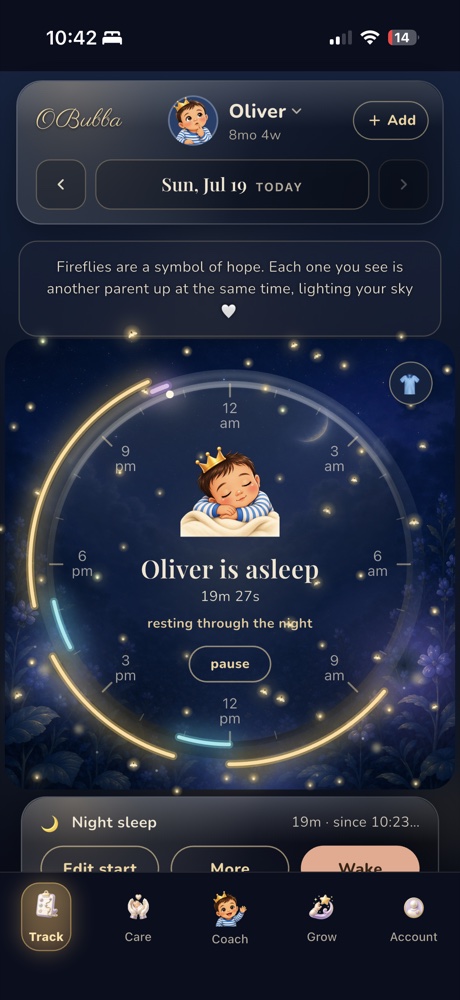
How the current OBubba app handles dream feeds
While a night sleep is running, OBubba's More actions separate Night wake from Dream feed. Choosing Dream feed records a night bottle feed with the explicit dream-feed flag and leaves the sleep timer running. A night wake instead uses the pause-and-resume flow.
That distinction changes several parts of the app:
- a dream feed does not add a false night wake
- it is excluded from the baseline used for genuine wake-driven night-weaning plans
- it does not inflate daytime feed counts or anchor a daytime feed reminder
- it is excluded from reverse-cycling volume comparisons
- it survives CSV export and re-import as a distinct feed type
OBubba then checks whether dream feeds appear to help this baby. The current insight:
- only runs from 14 weeks corrected age
- looks across up to 21 recent nights
- requires at least four nights with a dream feed and four without
- uses the app's deduplicated genuine-wake count, so a wake and its linked feed are not counted twice
- needs a difference of at least 0.5 wakes per night before saying anything
If dream-feed nights have fewer wakes, the card shows both averages and the sample size. If they have more wakes, it can suggest a five-night trial without the feed. If the difference is smaller, the app stays quiet.
This is useful pattern detection, not causal proof. Families may choose dream feeds on already difficult days, or only on calm ones. OBubba cannot know whether the baby transferred milk effectively, whether the parent slept longer or whether teething changed the comparison. That is why the article's eight-night review includes parent sleep and feed quality alongside wake count.
Dream-feed logging in Track is free. The personalised dream-feed comparison in Guidance is a Premium feature. OBubba unlocks Premium during pregnancy and through the first two corrected-age months; plan options follow after that early-free period.
Find out whether the dream feed earns its place →
Record the planned feed without ending the sleep timer, keep genuine wakes separate and compare repeated nights instead of trusting a universal promise.
How and when to stop a dream feed
You do not need to preserve a planned feed forever. Consider stopping the experiment when:
- the baby regularly refuses it
- the feed wakes the baby fully
- the same later wakes continue
- the baby has started sleeping through the planned time
- daytime milk and solids have changed with age
- it no longer improves parental sleep
- the family simply dislikes doing it
For a healthy, growing older baby who has no clinical feeding plan, a parent-initiated feed can often be removed and the baby's cues followed. If breastfeeding, supply is a concern or the feed contains a meaningful part of daily intake, get individual advice before making a large change.
Do not remove the dream feed and a wake-driven night feed on the same night. Change one thing so hunger cues remain clear and you can tell what happened.
Safer nights matter more than the experiment
The most important risk is not whether a dream feed “creates a habit”. It is an exhausted adult falling asleep with a baby in an unsafe place.
UNICEF UK's Caring for your baby at night brings feeding, rest and safer sleep together. Plan for the possibility that you may be more tired than expected.
- Never sleep with a baby on a sofa or armchair.
- Never prop a bottle or leave a baby feeding alone.
- Keep the cot or Moses basket clear, firm and flat.
- Place the baby on their back at the start of sleep.
- Keep the sleep space in the parent's room for the first six months.
- Avoid feeding after alcohol, sedating drugs or medication if you may not remain alert; get help from another sober adult.
If the experiment makes the night less safe, it has failed regardless of the sleep graph.
Frequently asked questions
What time should I dream feed my baby?
There is no evidence-based universal time. Parents often try near their own bedtime and before the baby's usual first hungry wake. A feed at 10pm is not automatically better than 9pm or 11pm; it needs to fit the baby's existing night.
Should I change my baby's nappy first?
Not routinely if it is only wet, not leaking and the skin is comfortable; changing may wake the baby fully. Change a soiled, leaking or clinically necessary nappy. Keep light and interaction calm.
What if my baby will not wake enough to feed?
Do not force it. If there is no clinical requirement to feed, return the baby to their safe sleep space. If your baby is unusually difficult to rouse, feeding poorly or seems unwell, seek medical advice.
Can a dream feed cause more waking?
It can disturb some babies or simply add a feed without moving later wakes. That is why the no-dream-feed comparison matters. OBubba only surfaces a difference after repeated nights in both groups.
Does a dream feed count as a night feed?
It is milk taken at night, but it is not a wake-driven night feed. OBubba stores it as a distinct feed and excludes it from genuine night-feed baselines so a scheduled 10pm feed does not make the baby look less ready for night weaning.
Can I dream feed a newborn?
Newborns need responsive frequent feeding and may have an individual plan requiring waking. Do not substitute a parent-selected late feed for cue-led feeds or clinician-directed intervals. Ask your midwife or health visitor if you are unsure.
Will a bigger dream feed make my baby sleep longer?
Not reliably. Follow fullness cues and never force a bottle. Taking more milk than the baby wants can cause distress and does not guarantee a longer sleep stretch.
Is dream feeding the same as feeding to sleep?
No. Feeding to sleep describes the way a baby falls asleep at bedtime or after a wake. A dream feed begins after sleep is already underway and is initiated by the parent. Read Is feeding to sleep a bad habit? if the bedtime association is your concern.
The gentle bottom line
A dream feed is a tool, not a milestone. It may shift a needed feed into a more useful part of the night, do nothing or disturb sleep.
Try it only when feeding and growth are reassuring, the parent can remain safely awake and there is a specific outcome to test. Offer responsively, never force, and return the baby to a clear cot on their back. Compare several dream-feed and non-dream-feed nights, including the sleep the parent actually got.
If it helps, you can keep it while it remains useful. If it does not, dropping the experiment is not giving up—it is listening to your baby and your data.
This article provides general information and is not medical advice. Follow your baby's individual feeding plan and seek professional support for concerns about intake, growth, swallowing, breathing, unusual sleepiness or safe night care.
Ready to try OBubba?
Use OBubba to track feeds, sleep, naps, nappies, growth, milestones and family handovers in one calm baby tracker app.