Your baby slept from 7:30pm until 2am, fed, then slept until 6:15. Did they sleep through the night?
One friend says yes because the first stretch was longer than six hours. Another says no because you got up. A sleep chart says eight hours. Your own body says it definitely was not a full night.
Nobody is necessarily using the phrase incorrectly. “Sleeping through the night” has several definitions, and they answer different questions.
For researchers, it may mean one uninterrupted block of six or eight hours. For a family, it often means bedtime to morning without a feed or a parent needing to resettle. For OBubba's current sleep-milestone logic, it means a completed logged night with no recorded wakes and at least one six-hour unbroken block.
Those definitions should never become a deadline. A long stretch is worth noticing. It is not proof that a baby no longer needs night feeds, that every future night will match it or that a baby who still wakes is behind.
The short answer: six hours can count, but define what you mean
Use the phrase with a qualifier:
| What you mean | A clear way to say it | |---|---| | One long block | “Baby slept for 6 hours without signalling.” | | No feed | “There was no night feed between bedtime and morning.” | | No parent help | “Baby did not need us overnight.” | | Full family night | “Baby slept from bedtime until our morning start.” | | OBubba milestone | “The complete log shows no wakes and at least a 6-hour stretch.” |
That extra sentence removes most of the confusion. It also lets a health visitor understand the night without having to guess what “through” meant.
Why the definition changes the answer
Infant-sleep studies have used several thresholds. A study of 388 babies assessed both six-hour and eight-hour uninterrupted blocks at six and 12 months; depending on age and definition, 27.9% to 57% had not reached the threshold. The authors did not find that failing to sleep through by those definitions was associated with poorer mental or psychomotor development. You can read the study abstract on PubMed.
Another study followed 44 six-month-old babies across 13 nights. On average, parents reported a six-hour block on about five nights and an eight-hour block on about three. Most babies varied from night to night; only three achieved six uninterrupted hours every night. The researchers described consolidation as a changing process rather than a one-time switch. See the original Sleep Medicine study.
These are useful observations, not predictions for an individual baby. The samples, methods and definitions differ, and parent diaries cannot capture every brief waking. The important message is gentler: one long night does not create a permanent sleeper, and one waking night does not erase progress.
A baby can wake without waking you
All people move between sleep states. A baby may stir, open their eyes, reposition, make a small sound and return to sleep without signalling for help. Unless you were watching continuously, you would never log it.
So “no wakes” in a parent-held tracker really means no wakes that were noticed and recorded. It does not mean the baby's brain remained in one unbroken sleep stage for six hours.
That distinction is healthy. The aim is not surveillance. What usually matters to family life is whether the baby needed feeding, comfort, a nappy change or extended help—and whether the parent had to become fully awake.
What is a longest sleep stretch?
The longest stretch is the biggest continuous block between night sleep beginning, a meaningful wake and the final morning wake.
Suppose the night looks like this:
| Event | Time | Stretch that just ended | |---|---|---| | Asleep for the night | 7:40pm | — | | Wake and feed | 1:55am | 6h 15m | | Back asleep | 2:20am | — | | Morning wake | 6:30am | 4h 10m |
The longest stretch is 6h 15m. Under a six-hour research definition, that baby achieved a six-hour uninterrupted block. Under a bedtime-to-morning family definition, the baby did not sleep through because there was a feed and parental help.
Both descriptions are true. The first stretch may still be an encouraging sign of consolidation, especially if it has grown from three or four hours.
Does a night feed mean baby did not sleep through?
It depends on the definition, but the feeding need matters more than the label.
The NHS says newborns wake repeatedly because they need feeding. At three to six months, some babies may sleep for five to eight hours or longer, but not all. From six to 12 months, some babies may no longer need night feeds, while hunger or teething can still wake others.
Do not use a six-hour stretch as automatic permission to drop a feed. Age alone is not enough either. Follow an individual neonatal, feeding, growth or medical plan. If you are unsure about night feeding, milk intake or weight gain, speak to your health visitor, GP, midwife or feeding team.
If night weaning is the actual question, use a readiness assessment rather than a sleep label. Our night-weaning readiness guide separates age, daytime nourishment, growth, recent night feeds and family preference.
When should a baby sleep through the night?
There is no date that every healthy baby should meet.
The NHS describes wide variation: some babies sleep for long periods, others in short bursts, some sleep through relatively soon and others do not for a long time. Sleep patterns change with development, growth spurts, teething and illness.
That means these statements can all be normal:
- a newborn wakes frequently for feeds
- a four-month-old gives one five-hour stretch, then returns to shorter ones
- a seven-month-old sometimes sleeps eight hours and sometimes feeds twice
- an older baby wakes more during illness, separation or a new skill
- a baby sleeps through before a sibling did—or much later
Talk to a health visitor if sleep is causing concern, the baby seems uncomfortable, feeding or growth is affected, breathing is noisy or interrupted, or exhaustion is making it hard to care safely.
What OBubba counts in the actual app
OBubba uses a deliberately specific product definition so it does not turn missing data into a celebration.
A wake-free night needs three things
For the current milestone, count and streak logic, the night needs:
- a recorded bedtime or night-sleep start
- a recorded morning wake, proving the night is complete
- zero logged night wakes and a longest unbroken stretch of at least six hours
A bedtime with no morning wake is not enough. Zero wake entries on an unfinished night mean absence of data, not evidence that the baby slept through.
“First ever” has a higher honesty bar
Before showing First all-night sleep!, the milestone detector needs the latest night plus at least ten prior nights with logged bedtimes. The latest night must be complete and recent, and every complete earlier night must include a wake.
There is another quiet safeguard: if older history has already moved into archived storage, the detector stays silent rather than claiming “first ever” from only the recent slice. It cannot verify a lifetime first without the full history in view.
That restraint is intentional. A celebration is only delightful if it is true.
A personal record is not the same milestone
A baby can set a new sleep record and still wake once.
OBubba's current record-stretch card requires:
- a complete recent night
- a longest unbroken stretch of at least five hours
- an improvement of at least 30 minutes over every earlier complete night in the available history
So a move from 4h 20m to 6h is a personal best even if a 2am feed follows it. The app can celebrate consolidation without pretending the night was wake-free.
Streaks use complete nights, not perfect app use
The slept-through streak reads backwards across complete logged nights. A complete night with a wake resets the run. An incomplete or forgotten night is skipped rather than treated as a failure or a success.
At seven wake-free nights in a row, the current Track experience can celebrate the run. If a later wake resets it, the seven-night celebration can re-arm for a future streak.
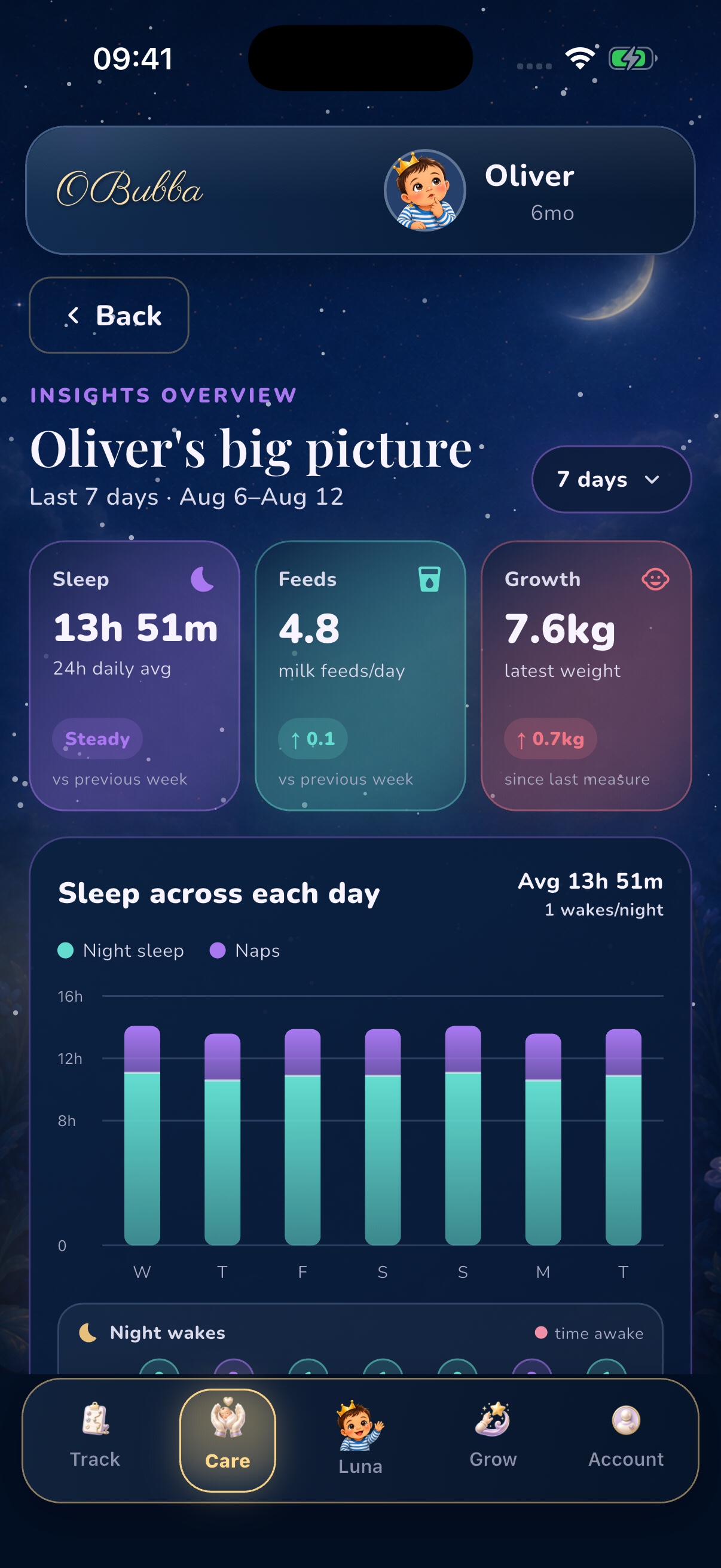
How to log a night so the answer is trustworthy
You only need a few anchors:
- night sleep began: actual sleep, not the start of bath or the moment you entered the bedroom
- meaningful wake: when the baby signalled and needed a feed, comfort, change or extended resettling
- back to sleep: when known, especially after a long awake period
- morning wake: the point the day genuinely began
If you realise the sleep timer was left running, edit the end rather than deleting the whole night. If you missed a brief wake time, an honest note is better than invented precision.
Our guide to what time counts as bedtime separates routine start, into-bed time and sleep onset. For a difficult night, track only the details that can change the next decision.
One night, three different useful wins
| Night result | What is worth noticing | What it does not prove | |---|---|---| | 6h 20m first stretch, then a feed | the longest block is growing | night feeds are no longer needed | | Bedtime to morning, no logged wakes | a genuine wake-free complete night | every future night will repeat it | | Two wakes, both settled quickly | less time awake and less parental effort | the baby “should” have had zero wakes | | Same wakes, later morning | the night may be shifting later | total sleep automatically increased | | Fewer wakes, two-hour split night | the wake count fell | the night became more restorative |
This is why OBubba keeps longest stretch, wake count, time awake and total sleep as different signals. A single score cannot tell the whole story.
Sleeping through does not replace safer sleep
A longer stretch changes nothing about the sleep-space basics. The NHS says the safest place for the first six months is a cot or Moses basket in the same room as you, with baby placed on their back. Use a firm, flat mattress and keep the space clear of pillows, cot bumpers and loose objects.
Do not add a weighted product, positioner, nest or extra bedding to chase a longer night. If you bring the baby into bed for feeding or comfort, plan for tiredness and return them to their safer sleep space before you sleep. Never fall asleep with a baby on a sofa or chair.
What if the baby sleeps six hours but the parent does not?
A 7pm-to-1am baby stretch may meet a six-hour research threshold while the parent gets two hours after washing bottles, expressing milk, tidying and trying to unwind.
Your rest is its own outcome. Consider:
- going to bed during the baby's most reliable first stretch
- sharing the first response or early morning where feeding allows
- preparing the night station before bedtime
- treating a wake-free baby night as good news, not a demand to clear the whole to-do list
If you cannot sleep even when the baby sleeps, or you feel persistently low, anxious, unable to cope or frighteningly exhausted, seek support. The problem is real even when the baby's graph looks good.
Frequently asked questions
Does six hours officially count as sleeping through the night?
Six uninterrupted hours is one common research definition, while other studies use eight hours or a particular clock window. There is no single universal family definition. State the duration and whether feeds or parental help occurred.
My baby woke briefly but settled alone. Did they sleep through?
Many parents would say yes because no help was needed; a strict uninterrupted-sleep definition would say no. A parent-held log usually cannot detect every brief arousal, so record wakes that were noticed and meaningful rather than trying to monitor continuously.
Does a dream feed break “sleeping through”?
Under a no-feed definition, yes. Under a no-signalled-wake definition, some families count a parent-initiated dream feed separately because the baby did not wake and ask. Say “one scheduled dream feed, no signalled wakes” for clarity. See our guide to whether a dream feed is helping.
Why does OBubba need a morning wake?
Without it, the app cannot know the night ended or calculate the final stretch. A bedtime-only log with no wakes could mean a wonderful night, an unfinished night or forgotten logging. OBubba's milestone logic keeps those possibilities unresolved.
Why did OBubba celebrate a record when the baby still woke?
The personal-record milestone is about the longest continuous block, not zero wakes. A baby can lengthen their best stretch substantially and still need a feed or resettling later.
Is sleeping through a sign that development is better?
No single night is a developmental grade. The 2018 study linked above found no association between not achieving six- or eight-hour blocks and later mental or psychomotor development in its cohort. Development and sleep both vary; discuss specific concerns with a health professional.
Celebrate the stretch, not a standard
If your baby gives you six uninterrupted hours tonight, celebrate what it is: a longer block, some rest, a new possibility.
You do not need to turn it into a deadline for tomorrow. You do not need to compare it with another baby. And you do not need to call it “sleeping through” without explaining what happened.
Try OBubba free → — record bedtime, meaningful wakes and morning once, then let the app distinguish a long stretch, a personal best and a complete wake-free night without treating missing logs as perfection.
OBubba supports parent-held tracking and pattern awareness. It cannot observe unlogged wakes, assess feeding or growth, confirm that a sleep space is safe, diagnose a sleep problem or replace advice from a health visitor, GP or other qualified professional.
Ready to try OBubba?
Use OBubba to track feeds, sleep, naps, nappies, growth, milestones and family handovers in one calm baby tracker app.