A meal plan can make starting solids feel possible, but most plans ask too much of a brand-new eater. A six-month-old does not need three polished meals, snacks and a colour-coded freezer on day one.
If your baby is around six months and showing all three readiness signs, begin with one small, calm food opportunity each day. Offer a few teaspoons, a few soft pieces or both. Keep normal breastfeeds or first infant formula feeds responsive, because milk is still doing most of the nutritional work at the beginning.
This seven-day starter menu introduces variety without changing everything at once. It includes iron-rich choices, vegetables, safe finger foods and three common allergens on separate days. If your baby already manages one meal comfortably, there is a flexible two-meal version further down.
The plan is a set of options, not a prescription. Swap ingredients for foods your family eats, repeat familiar foods and follow your baby's appetite.
Before using the plan: is baby ready?
The NHS recommends introducing solid food at around six months, once all three developmental signs appear together:
- Baby can stay sitting and hold their head steady.
- They can coordinate eyes, hands and mouth to look at food, pick it up and bring it towards their mouth.
- They can swallow food rather than repeatedly pushing it out.
Night waking, fist chewing and wanting extra milk do not prove readiness. Starting solids is not a treatment for disrupted sleep. Use our three-sign solids-readiness guide before planning the menu if you are uncertain.
At every meal, seat baby upright in a stable highchair with the harness fastened. Stay within arm's reach. Finger food should be soft enough to squash between your thumb and finger, and round foods need changing into a safer shape.
A calm seven-day meal plan for a six-month-old
This version assumes baby has just started. Pick a time when they are alert, you are not rushing and they are neither completely full nor frantic for milk. The meal labels are optional: “lunch” can happen at 10am if that is when your household is calm.
| Day | One small food opportunity | Preparation and purpose | |---|---|---| | 1 | Soft broccoli floret with sweet-potato mash | Steam the broccoli until squashable, leaving a long stalk to hold. Offer a little mash on a preloaded spoon. This introduces savoury and less-sweet flavours. | | 2 | Red-lentil and sweet-potato mash | Cook lentils until completely soft and combine with sweet potato. Lentils add iron and protein; keep the texture thick enough to stay on a spoon. | | 3 | Egg and avocado | Offer a small amount of mashed egg or a soft omelette strip with ripe avocado. Egg is a common allergen, so make it the only new allergen in this meal. | | 4 | Repeat tolerated egg with broccoli | Repetition matters. If egg was tolerated, offer it again with a familiar vegetable. If there was a possible reaction, do not re-offer it; seek advice. | | 5 | Smooth peanut butter thinned into familiar sweet-potato or pear mash | Start with a very small amount. Thin it thoroughly; never give whole nuts or a sticky spoonful of nut butter. Peanut is today's only new allergen. | | 6 | Tender chicken and courgette | Cook chicken through and shred or mince it finely into a moist mash. Steam courgette until very soft. This adds another iron-rich savoury option. | | 7 | Plain full-fat yoghurt with mashed pear | Use pasteurised, unsweetened yoghurt. Cow's milk is today's new allergen; it can be used in food from around six months but not as the main drink before one year. |
If baby eats nothing on a day, do not push or double the next portion. Touching, licking, squashing and dropping food are all part of learning. The NHS notes that a food may need to be offered ten times or more before it becomes familiar.
If your baby has eczema, a diagnosed allergy or a strong family history of allergy, speak to your GP or health visitor about allergen introduction before following the example.
What “a portion” means in the first week
There is no target bowl to finish. The NHS advises starting with just a few teaspoons or pieces. Let baby control the pace and amount.
Useful fullness cues include:
- closing the mouth when food approaches
- turning the head or body away
- pushing the spoon or food aside
- slowing down and losing interest
- becoming tired or upset
Stop at those cues. Distracting baby into eating, scraping the spoon on the upper lip or repeatedly asking for one more bite can turn a low-pressure lesson into a struggle.
Similarly, avoid measuring success by how clean the bowl looks. An adult may load a spoon and place it within reach, but baby can decide whether to bring it to their mouth. For finger food, offer one or two manageable pieces at a time rather than covering the tray.
Where meals fit around milk and naps
There is no universal six-month timetable. A useful food window is often after baby has woken, had time to become alert and taken enough milk not to be frantic, but before the next nap makes them tired. A baby who normally sleeps at noon does not need “lunch at 12” simply because an adult meal plan says so.
Try one window for several days before moving everything around. If baby rubs their eyes, arches away or becomes upset, finish the meal and protect the nap; tiredness is not a feeding problem to solve with persistence. If they wake unusually at night, do not automatically add a larger evening meal. The NHS states that starting solids does not make a baby more likely to sleep through. Look at milk intake, naps, comfort and illness as well as food.
This is where a flexible plan earns its place: it remembers the next idea without requiring an exact clock time. The food can move; safe posture, supervision and responsiveness cannot.
Milk, water and the meal plan
Breast milk or first infant formula remains the main drink throughout the first year. Early solid-food portions do not need to replace a milk feed. Continue breastfeeding responsively or offering usual formula feeds, then let the balance change gradually as eating skills and quantities grow.
The NHS suggests offering food before the usual milk feed when baby may be interested, without waiting until they are desperately hungry. Some families find a small milk feed first produces a calmer experiment. Follow the baby in front of you rather than forcing one sequence.
From around six months, offer sips of water with meals in an open cup or free-flow cup without a valve. Water is for cup practice and thirst alongside food, not a substitute for milk. See our water when starting solids guide.
Babies under 12 months do not need snacks. If baby seems hungry between meals, offer an extra milk feed rather than filling the day with rusks, puffs or fruit pouches.
If your baby is ready for two meals a day
Once one meal feels familiar, add another opportunity on days when it suits your baby. There is no prize for reaching two meals in a particular week. From about seven months, babies gradually move towards three meals alongside milk, but development and appetite vary.
This example assumes each named allergen has already been introduced without a reaction. If it has not, substitute a familiar food and introduce only one new allergen at a time.
| Day | First opportunity | Second opportunity | |---|---|---| | Monday | Unsweetened oat porridge with mashed pear | Lentil and sweet-potato mash with soft broccoli | | Tuesday | Egg and avocado on a preloaded spoon | Tender shredded chicken with courgette and potato | | Wednesday | Plain full-fat yoghurt with mashed strawberry | Salmon, pea and potato mash, checked carefully for bones | | Thursday | Toast fingers with a very thin spread of smooth peanut butter | Red-lentil tomato sauce with very soft pasta | | Friday | Banana and avocado mash | Beef and vegetable mash with a soft broccoli floret | | Saturday | Repeat egg with soft-cooked tomato | Chickpea mash with roasted squash and thinned tahini | | Sunday | Plain yoghurt with soft pear | Family roast adapted before salt: shredded chicken, soft potato and squashable vegetables |
This is not nutritionally “perfect” in isolation. It illustrates a useful rhythm: familiar food plus gradual variety, regular iron-rich choices, vegetables across the week and tolerated allergens kept in rotation.
How to introduce allergens inside a meal plan
Planning helps only when it makes reactions easier, not harder, to interpret. The NHS advises introducing foods that can trigger allergy one at a time and in very small amounts, so you can spot a reaction.
Common allergens include egg, peanut and tree nuts, cow's milk, wheat and other gluten-containing cereals, fish, shellfish, sesame and soya. Offer them in a safe form earlier in the day, when baby is well and you can observe them. Once introduced and tolerated, keep offering them as part of the usual diet.
Do not introduce peanut for the first time in porridge if wheat or gluten is also new. Thin peanut into a food baby already knows. Do not introduce dairy, fish and wheat together in a first fish pie. A plan should separate unknowns until they are known.
Possible allergy symptoms include hives, swelling, vomiting, cough or wheeze. Sudden swelling of the lips, mouth, throat or tongue, breathing difficulty, sudden floppiness or collapse can be a severe reaction: call 999. For a possible non-emergency reaction, stop the food and seek medical advice rather than testing it again yourself. Our baby-allergen introduction guide explains what to record.
Build each meal from three simple questions
You do not need a nutrition spreadsheet. When choosing what comes next, ask:
1. Is there an iron-rich food?
From around six months, include iron-containing foods regularly: tender meat, fish, egg, lentils, beans, tofu, dark green vegetables or an iron-fortified cereal. Plant iron is helped by vitamin C, so lentils with broccoli or strawberries with porridge are useful pairings.
See our iron-rich foods for babies guide for preparation ideas.
2. Is the texture appropriate today?
Purées are not a mandatory first stage, and finger food is not a contest. Offer mashed, lumpy and finger-food textures as baby can manage them. A preloaded spoon can sit beside a soft graspable piece.
Progress is not perfectly linear. A tired baby may prefer a familiar mash even if they managed a soft finger food yesterday. Keep offering texture opportunities without forcing them. Our purées-to-lumps guide helps when the transition feels stuck.
3. Is anything in this meal new or unsafe in this form?
Identify new allergens before combining ingredients. Then check shape and preparation: hard raw apple remains hazardous even though apple is nutritious; whole nuts remain hazardous even though nuts provide useful nutrients.
The one-week shopping list
Buying for six tiny portions can create waste. Choose ingredients that overlap with family meals and freeze suitable leftovers in labelled baby-sized portions.
For the starter week above, a compact list is enough:
- one small sweet potato
- one head of broccoli
- red lentils
- one ripe avocado
- eggs
- smooth unsalted peanut butter with no added sugar
- one courgette
- a small portion of chicken
- plain pasteurised full-fat yoghurt
- two ripe pears
- baby's usual breast milk or first infant formula for thinning where appropriate
You do not need specialist baby stock, sweetened yoghurt or separate desserts. Cook without added salt, stock cubes, gravy or sugar. Take baby's portion from a family meal before adult seasoning.
For batch cooking, cool food promptly, refrigerate or freeze it safely, label it with the date and reheat until steaming hot before cooling it to a safe serving temperature. Do not reheat food repeatedly, and discard food left in baby's bowl after eating. The NHS children's food-safety guidance covers preparation, storage and reheating.
Safety rules the menu cannot replace
Healthy ingredients still need safe preparation. Keep these rules beside the plan:
- sit baby upright in a highchair with a securely fitted harness
- supervise every bite; do not feed in a car seat, pushchair or while moving around
- cook hard vegetables and fruit until soft; grate or cook apple
- quarter grapes and cherry tomatoes lengthways; flatten blueberries
- remove every bone, stone, pip, tough skin and hard rind
- never give whole nuts under five or a sticky spoonful of nut butter
- do not give honey before 12 months
- do not add salt or sugar; avoid stock cubes, gravy and salty processed meat
- do not use cow's milk as the main drink before 12 months
- do not give rice drinks to children under five
Read the NHS foods-to-avoid guidance and learn infant first aid. Gagging can be noisy; choking may be quiet because airflow is blocked. Our gagging versus choking guide explains the difference but cannot replace practical training.
Vitamins at six months
NHS vitamin guidance recommends vitamin D from birth for breastfed babies and babies having less than 500ml of formula a day. From six months, daily vitamins A, C and D are recommended unless baby is having 500ml or more of first infant formula each day, because formula is already fortified.
Ask your health visitor, pharmacist or GP which product and dose are suitable, especially if your baby was premature, has a medical condition or uses specialist formula. A meal plan should not be used to guess supplement needs.
How OBubba builds a plan from the baby, not a generic calendar
The current OBubba app has a real weekly weaning planner and recipe engine. It does not simply show the same seven-day PDF to every family. It considers corrected age and the solid foods already logged, then ranks recipes to fill gaps: iron-rich meals, foods not yet tried and allergens that may still need introduction.
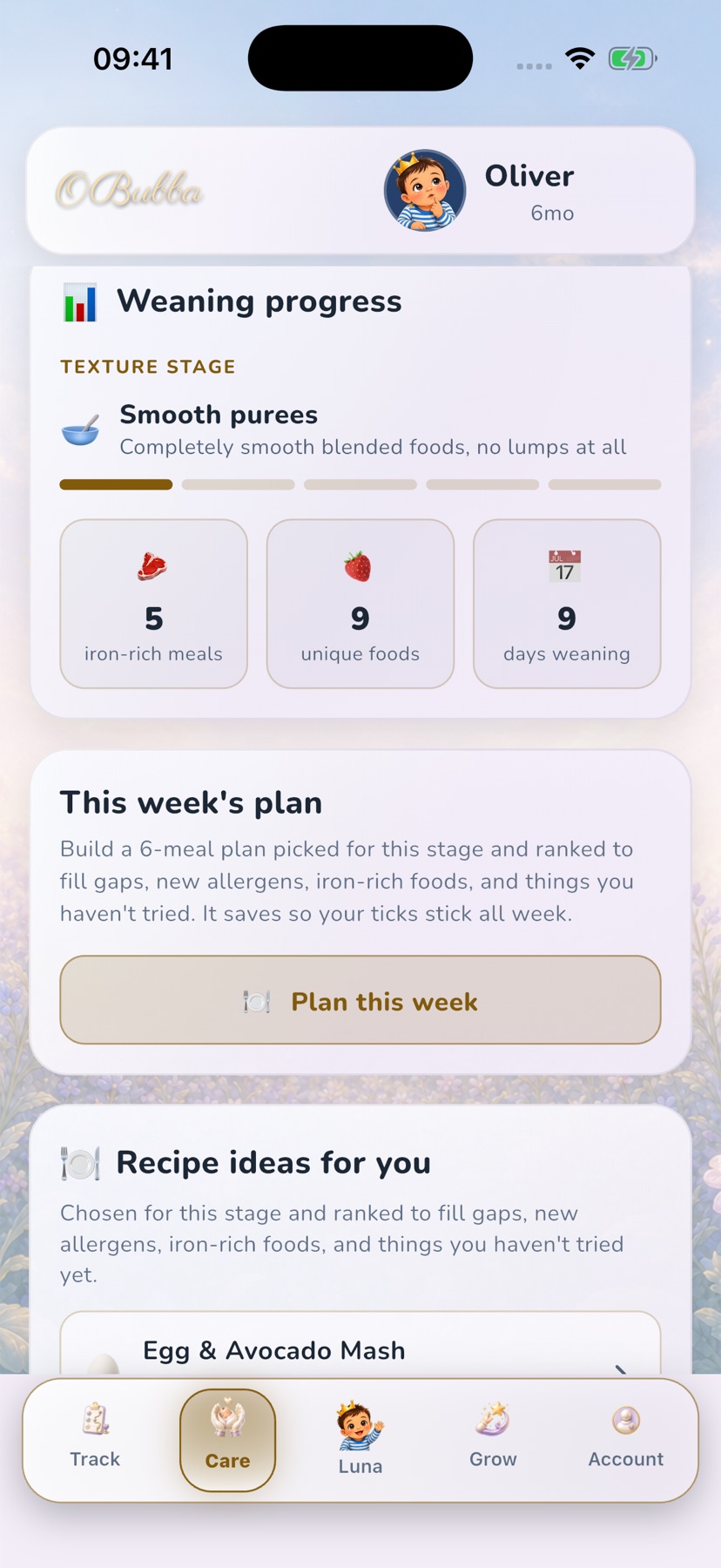
The generated plan contains six meals and persists for the week, so tried ticks remain checked. Allergen labels come from both the recipe data and OBubba's food recogniser. A recorded reaction keeps that allergen out of future suggestions rather than allowing an old event to disappear from the recommendation logic.
OBubba also derives a shopping list from the chosen recipes, remembers what is already in the basket and lets the parent copy the list. The progress view brings texture stage, iron-rich meals and unique foods into the same place, while meal logs connect with milk, nappies, growth and sleep.
The saved six-meal weekly plan and its shopping list are available in the free app. Free accounts see a smaller set of ranked cookbook ideas, while Premium unlocks the full 77-recipe garden.
That is decision support, not a diet prescription. The app cannot see whether a piece is soft enough, diagnose an allergy or decide that poor growth is harmless. It should reduce memory work so the parent has more attention for the baby at the table.
Build one manageable weaning week in OBubba.
A useful plan bends
A good six-month meal plan should make the week calmer, not make you feel behind. Keep the parts that help:
- one food opportunity a day can be enough at the beginning
- milk remains central while solids build gradually
- iron-rich foods deserve regular space
- new allergens are easier to interpret when introduced separately
- tolerated allergens stay in the usual rotation
- soft shape and upright supervision matter at every meal
- baby's “finished” cues end the meal
If Thursday's plan becomes Sunday's lunch, nothing is broken. If baby wants milk and ignores the lentils, offer milk. The purpose of planning is to remove one decision, not to remove responsiveness.
This article provides general information for UK families and does not replace advice from your health visitor, GP or dietitian. Seek individual guidance for prematurity, poor growth, swallowing problems, eczema, known allergy, a restricted diet or persistent feeding distress. Call 999 for breathing difficulty, tongue or throat swelling, sudden floppiness or collapse.
Ready to try OBubba?
Use OBubba to track feeds, sleep, naps, nappies, growth, milestones and family handovers in one calm baby tracker app.