Your baby watches every forkful you eat. They chew their fists, wake twice at night and seem hungry again after a milk feed. Is it time for solids?
Those behaviours are common, but they do not answer the question. The clearest guide is age plus development: most babies are ready to begin solid food at around six months, when they show all three readiness signs together.
- They can stay sitting and hold their head steady.
- They can coordinate their eyes, hands and mouth to look at food, pick it up and bring it to their mouth.
- They can swallow food rather than automatically pushing it back out with their tongue.
One sign by itself is not enough. A baby who grabs your toast but slumps sideways in a highchair is not yet showing the whole pattern. Nor should readiness be “tested” by putting food into the mouth of a baby who is too young or cannot sit steadily.
This guide turns the three signs into observations you can actually use, separates readiness from misleading behaviours, and gives you a calm first-taste plan for when the pieces come together.
Baby-ready-for-solids checklist
| Question | What you are looking for | What does not prove readiness | |---|---|---| | Can baby stay sitting? | An upright, stable position with steady head control throughout the taste | Briefly sitting before folding, leaning or losing head control | | Can baby reach accurately? | Looking at food, reaching, grasping and bringing it towards the mouth | Watching you eat or grabbing any nearby object | | Can baby swallow? | Managing a tiny, appropriate texture rather than repeatedly pushing everything out | Chewing fists, dribbling or making chewing movements without food | | Is baby around six months? | Age and all three developmental signs considered together | A jar labelled “from 4 months” or another baby's start date |
The NHS recommends introducing solid foods from around six months and names these same three signs. “Around” matters: there is no magic change at midnight on a half-birthday, and babies do not all acquire skills on the same morning. Look for a stable pattern, not one lucky reach.
Sign 1: baby can stay sitting and hold their head steady
Safe eating begins with posture. Your baby needs to remain upright enough to control their head and engage with food. In a highchair, their trunk should be supported, the harness secured and their head steady, not tipped back, dropping forwards or repeatedly falling to one side.
This does not mean every baby must be able to sit alone on the floor for a long time. The NHS wording is that baby can stay in a sitting position and hold their head steady. Appropriate highchair support can help, but it should not be doing all the work for a baby who is still floppy or unstable.
Try observing before food is involved:
- Does baby remain upright through a short spell in the highchair?
- Is their chin clear of their chest?
- Can they turn their head while staying controlled?
- Do they tire and collapse almost immediately?
If the position is not stable, wait and try again later. Feeding while reclined, in a bouncer or lying back is not a shortcut to readiness.
Sign 2: baby coordinates eyes, hands and mouth
This sign is a sequence, not simply enthusiasm. Baby should be able to notice food, reach towards it, grasp it and guide it towards their mouth. That coordination helps them take an active role whether you choose finger foods, a spoon or a mixture of both.
A baby may stare intently at your plate weeks before they can complete the sequence. They may also grab a napkin, your glasses and the table edge with equal excitement. Interest is encouraging; coordinated action is the developmental sign.
Offer an age-appropriate opportunity only when the other readiness signs are also present. A large, soft piece of food that is easy to hold can make the movement visible. The adult remains close, upright positioning stays non-negotiable and the baby, not an adult pushing food into the mouth, controls the reach.
Sign 3: baby swallows instead of pushing food back out
Young babies have a tongue-thrust response that helps push unfamiliar material out of the mouth. As oral skills mature, they become better able to move a tiny amount of suitable food backwards and swallow it.
At first, eating will still look messy. Some food may fall out. Baby may lick, squash or smear far more than they swallow. That is normal learning and does not mean the meal has failed.
Swallowing is also different from gagging. Gagging can be noisy and dramatic as a baby learns to manage texture; choking may be quiet because the airway is blocked. Read our gagging versus choking guide before the first meal, learn infant first aid and supervise every bite. If you are worried about your baby's swallowing, coughing during feeds, recurrent chest infections or growth, ask a health professional rather than relying on a home checklist.
What is not a sign that baby needs solids?
Several changes cluster around this age, which makes them easy to misread.
Chewing fists
Babies explore with their mouths and may chew hands because they are discovering their body or teething. It says little about whether they can sit, reach and swallow.
Waking more at night
Sleep changes for many reasons: development, discomfort, temperature, hunger, illness, nap changes or simply normal infant sleep. The NHS specifically says that waking in the night is not a readiness sign and that starting solids does not make a baby more likely to sleep through. If sleep has changed, use our starting-solids and baby-sleep guide to troubleshoot without treating food as a sleep intervention.
Wanting extra milk
Appetite can rise during a growth phase. Offer breast milk or formula responsively. Milk remains the main source of nutrition and the main drink throughout the first year while solid-food skills and variety build gradually.
Watching you eat
Social interest is lovely and shared meals help babies learn. But watching your spoon is not the same as completing the three-sign sequence.
Having teeth
Teeth are not required to begin. Babies can manage appropriately soft textures with their gums. Equally, an early tooth does not make a four-month-old developmentally ready.
A food packet says “from 4 months”
Marketing labels do not assess your individual baby's posture, coordination or swallowing. Follow current health guidance and your baby's development, not the earliest age printed on a product.
Why guidance says around six months
By around six months, babies are more likely to have the posture, hand-to-mouth coordination and oral skills needed to explore food. They also begin to need nutrients from a varied diet alongside milk, including iron.
Starting is not a switch from milk to meals. The first weeks are practice: tastes, textures, hand skills, shared routines and learning how food feels. Breast milk or first infant formula remains central, and you can continue offering it on demand.
Do not rush because a friend started earlier, and do not delay indefinitely once your baby is ready without discussing it with a professional. If your baby was born prematurely, ask your health visitor, GP, dietitian or neonatal team when to begin. Corrected age may be part of that conversation, but readiness and medical history need individual judgement.
If all three signs are there: a calm first-taste plan
You do not need a cupboard full of special products or a perfect menu. Choose a normal day and keep the experiment small.
- Pick a calm time. Baby should be awake and alert, not exhausted or frantic with hunger. A little milk beforehand may take the edge off.
- Seat baby upright. Use a stable highchair and its harness. Stay within arm's reach.
- Offer one small opportunity. Try a little smooth mashed food on a spoon, a large soft finger-food piece, or both. Baby can lead the pace.
- Expect exploration. Touching, smelling, licking, dropping and spitting are all information-gathering.
- Stop when baby says stop. Turning away, closing the mouth, pushing away or becoming upset are cues to finish, not reasons to distract or pressure.
- Continue normal milk feeds. The goal is familiarity, not replacing a bottle or breastfeed on day one.
Once a day is enough at first. Gradually expand the range and texture as confidence grows. The choice between baby-led weaning and spoon-feeding is not a contest; our baby-led versus spoon-feeding comparison explains how both can be responsive.
Good first foods are soft, varied and useful
There is no single mandatory first food. Useful options include:
- soft-cooked broccoli, cauliflower or courgette in a graspable shape
- mashed or soft-cooked lentils and beans
- well-cooked egg in a suitable texture
- plain full-fat yoghurt
- soft strips of meat or flaked fish with bones removed
- smooth or mashed iron-fortified cereal
- ripe pear, avocado or banana
Include less-sweet vegetables early as well as fruit, and begin building in iron-rich choices. See our iron-rich foods for babies guide for practical combinations.
Texture must match skill. Finger food should be soft enough to squash easily, while round foods such as grapes and small tomatoes need lengthwise quartering. Avoid whole nuts and hard raw pieces. Honey is not suitable before 12 months, and babies do not need added salt or sugar.
Water, cups and milk
From around six months, offer sips of water with meals from an open cup or free-flow cup. This is cup practice, not a replacement for milk. See how much water a baby needs when starting solids for a fuller age-by-age explanation.
Keep breast milk or first infant formula as the main drink until 12 months. Cow's milk can be used in cooking from around six months but should not replace breast milk or formula as the main drink before the first birthday.
Allergens: readiness is the starting line, not a reason to panic
Once your baby is around six months and ready for solids, common allergenic foods can be introduced one at a time in suitable forms and small amounts. Examples include well-cooked egg and smooth peanut butter thinned into another food, never whole nuts or a sticky spoonful of nut butter.
Choose daytime when you can observe, keep the rest of the meal familiar and record what was offered. Once tolerated, include the food regularly as part of the diet. Babies with severe eczema, an existing food allergy or another clinical concern may need an individual plan; speak to a health professional before introduction. Our allergen introduction tracker guide gives a practical process and reaction warning signs.
What if baby refuses the first food?
Refusal does not erase readiness. A new taste can be surprising, and learning happens across repeated low-pressure exposures.
End the attempt calmly, continue milk as usual and offer another opportunity on a different day. Change only one variable: perhaps a slightly softer texture, a different time, or the chance to hold the spoon. Avoid scraping the spoon against closed lips, sneaking food in during distraction or chasing a target number of spoonfuls.
If your baby repeatedly coughs or chokes, seems in pain, vomits persistently, cannot manage any texture, has very few wet nappies, loses weight or you are otherwise concerned, seek medical advice.
Common readiness mistakes
- Counting two signs as close enough. All three work together to support a safer start.
- Using solids to fix sleep. Food is a developmental and nutritional step, not a treatment for waking.
- Replacing milk too quickly. Early tastes complement milk; they do not take over overnight.
- Comparing babies. Another child's age or portion is not evidence about yours.
- Testing in a reclined seat. Stable upright posture comes before the taste.
- Treating gagging as failure. Learn the difference between gagging and choking, then adapt texture without removing every lump indefinitely.
- Waiting for teeth. Soft food does not require a full set of teeth.
- Turning the checklist into a diagnosis. It supports observation; it cannot assess swallowing or medical risk.
How OBubba turns the signs into a usable plan
The current OBubba app does not just say “start at six months”. Its free Before first tastes screen combines the baby's corrected age with a three-sign checklist: sits steady, reaches, and swallows. Parents can mark a sign when they see it consistently. Those observations are saved on the device for the selected child, rather than being inferred or medically assessed by the app.
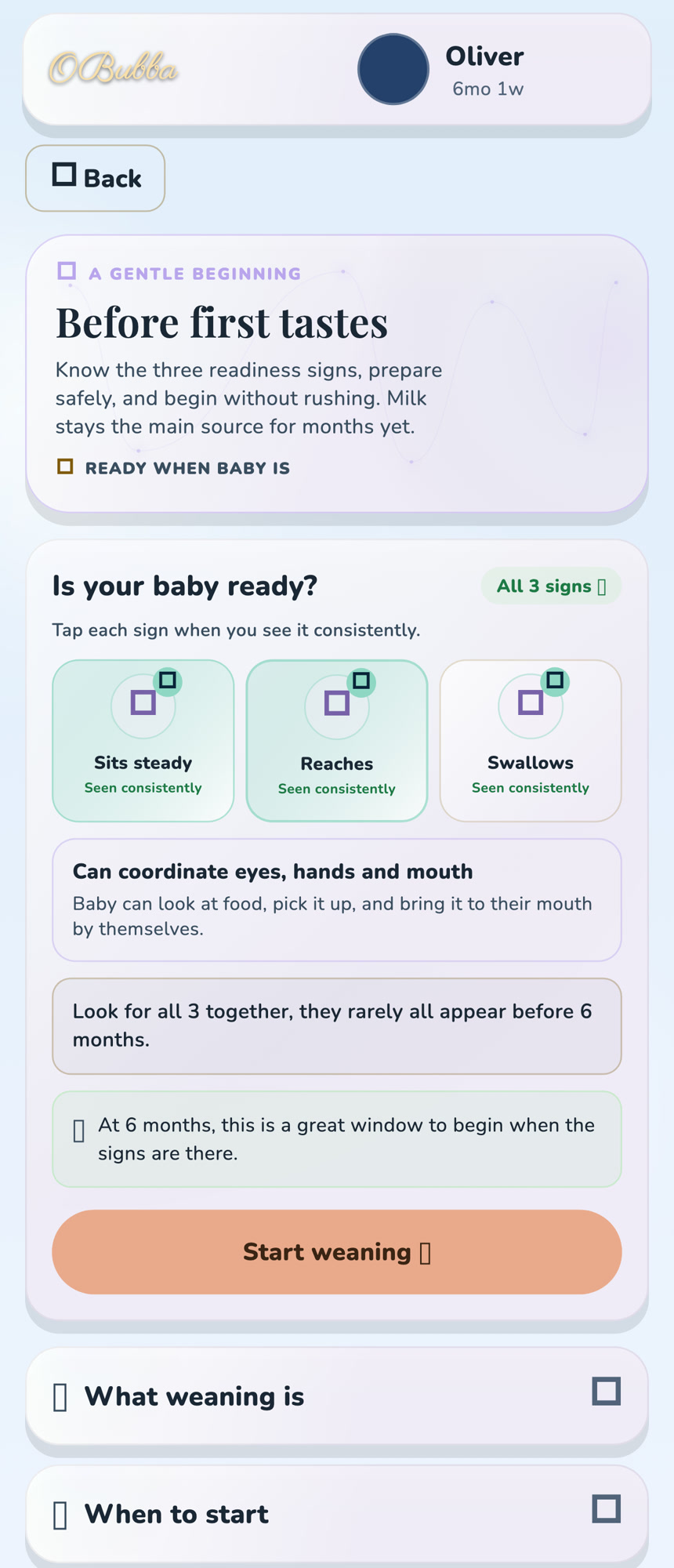
The same screen keeps practical preparation nearby: when to start, what is not a sign, ways to wean, equipment, gagging versus choking, foods to avoid, allergens, iron, water, and the changing balance between milk and food. It also changes its age framing for the selected child, including a more cautious route when a baby is early or was born prematurely.
That makes the checklist a bridge from “I think we may be close” to “I know what to prepare next”. It is still not a medical assessment and does not certify that swallowing is safe. A parent or carer records what they observe; a qualified professional handles clinical concerns.
OBubba's wider care tools let parents keep feeding, sleep and nappy information in one timeline rather than scattering the story across notes and screenshots. Premium adds deeper personalised sleep analysis and planning after the early-free period. The whole app is unlocked during pregnancy and through your baby's first two corrected-age months.
Keep the three readiness signs together →
The two-minute decision
Before offering a first taste, pause and ask:
- Is my baby around six months, or have we agreed a different plan with their health professional?
- Can they stay upright and hold their head steady?
- Can they look, reach, grasp and bring food towards their mouth?
- Are they able to swallow rather than automatically push everything out?
- Do I have a stable highchair, harness, appropriate texture and uninterrupted supervision?
- Do I know the difference between gagging and choking?
If the developmental answers are not all yes, waiting is not falling behind. Keep sharing family mealtimes, let baby watch and try the checklist again later. If they are all yes, begin gently: one safe seat, one small taste and no pressure to perform.
The aim is not to produce a full meal. It is to give a ready baby a safe, responsive first experience of food.
This article provides general information for families in the UK and does not replace advice from your health visitor, GP, dietitian, neonatal team or another qualified professional. Seek urgent medical help for choking, breathing difficulty, severe allergic symptoms or a baby who becomes floppy or unresponsive.
Ready to try OBubba?
Use OBubba to track feeds, sleep, naps, nappies, growth, milestones and family handovers in one calm baby tracker app.