Your baby sleeps for a solid first stretch, wakes at 1:40am and is still awake at 3am. They may be upset, quietly staring into the dark or behaving as if it is lunchtime. Then they eventually fall asleep again and complete a second block of sleep.
Parents often call this a split night because one night has broken into two sleeps with a long awake period between them. It is a useful description, not a medical diagnosis. One split night can follow hunger, discomfort, travel, illness or chance. A repeating pattern can also suggest that sleep timing needs a small adjustment.
Do not automatically cut naps or push bedtime later. First distinguish a true middle-of-the-night wake from a bedtime false start, check health and feeding, and compare the day that led into each long wake. High day sleep and low day sleep can both precede a split night, and they need opposite responses.
What counts as a split night?
There is no universally agreed clinical threshold for the parent term “split night”. In this guide, it means:
- the baby completed a meaningful first block of night sleep
- they were genuinely awake for roughly an hour or longer
- the wake happened in the middle of the night, not just after bedtime
- they then returned to sleep for another block
OBubba's current logic uses 60 minutes as a practical detection threshold and requires the long wake to begin more than 45 minutes after bedtime when the timing is known. Those are product rules designed to prevent mislabelling; they are not medical cut-offs.
| What happened | Better description | Why the distinction matters | |---|---|---| | Baby woke 20–45 minutes after bedtime | False start | Bedtime timing, transfer, hunger or discomfort may be more relevant than a split-night schedule change | | Baby woke briefly several times and resettled within minutes | Night waking or cycle-linked stirring | Short wakes are not the same pattern as one sustained awake interval | | Baby slept for hours, stayed awake for 60–120 minutes, then slept again | Split-night pattern | The whole 24-hour rhythm and the day before bedtime are worth comparing | | Baby woke at 4:30am and never returned to sleep | Early morning waking | Light, bedtime and body-clock timing may need a different plan | | A newborn fed, changed and stayed awake overnight | Newborn night waking | Immature day–night rhythm and feeding come before schedule correction |
The label should make the night easier to understand, not turn one difficult wake into a disorder.
Are split nights normal in babies?
Occasional long wakes can happen. Infant sleep changes rapidly, and waking itself is normal.
The NHS explains that babies have individual sleep patterns: some sleep in long periods, others in short bursts, and growth, teething and illness can change the pattern. Newcastle Hospitals notes that babies wake at the end of sleep cycles and that young babies do not begin life with an established body clock.
For newborns, being awake overnight is not strong evidence of a schedule problem. Feeding and the developing difference between day and night dominate. Keep daytime light and ordinary, nights dim and quiet, feed responsively and follow any individual clinical plan. Do not cut a newborn's sleep to manufacture more “sleep pressure”.
For older babies, a recurring long, alert wake can be worth investigating, especially when the pattern appears on otherwise healthy nights and follows similar nap or bedtime conditions.
The most useful clue: happy awake or distressed awake?
How the wake feels can point your investigation in a direction, though it cannot diagnose the cause.
Calm, chatty or ready to play
A baby who is contentedly rolling, babbling or watching the room may not feel sleepy enough at that moment. Look for:
- substantially more daytime sleep than is usual for this baby
- a last nap that ended unusually close to bedtime
- a final awake period that was shorter than usual
- bedtime moving earlier while morning wake stayed the same
- travel, a time-zone change or a large shift in the daily rhythm
This pattern can fit insufficient sleep pressure at bedtime or a body clock that is temporarily out of alignment. It does not prove that naps are excessive.
Crying, tense or hard to settle
A distressed long wake makes hunger, pain, illness, separation, temperature or overtiredness more important to check. Look for:
- active hunger cues and a substantial feed
- congestion, fever, cough, vomiting or altered nappies
- sore gums, eczema, reflux symptoms or constipation
- a very long final wake window, missed naps or a frantic bedtime
- a new motor skill or a period of increased separation anxiety
A baby can also start calm and become upset after being awake for an hour. Mood is one clue among several, not a pass–fail test.
Six possible reasons and the evidence each needs
1. The baby had less sleep pressure at bedtime
Sleep pressure is the biological drive that builds while we are awake and eases while we sleep. Developmental sleep research describes a “two-process” model in which this homeostatic drive interacts with the circadian body clock. Infant sleep is more complicated than a tank that is simply full or empty, but the idea helps explain why timing matters.
If a baby sleeps significantly more than their own norm in the day, or the last awake period is unusually short, they may begin the night before enough sleep pressure has built to sustain it. After a first sleep block, they can become fully alert.
Evidence that strengthens this explanation:
- the baby is calm and awake rather than obviously uncomfortable
- the same pattern follows several high-nap days
- the final wake window was consistently shorter than this baby's recent successful nights
- total sleep opportunity has expanded beyond what the baby actually uses
Do not compare one nap with an internet chart and declare it “too much”. The American Academy of Sleep Medicine recommends a broad 12–16 hours per 24 hours for babies aged 4–12 months, including naps, and does not prescribe a universal day/night split. Individual variation inside the range is real.
2. The baby was overtired
It sounds contradictory, but too little daytime rest or a very long final wake window can also precede a long night wake. An overtired baby may settle fast, then struggle to resettle when sleep is lighter later in the night.
This is more plausible when:
- daytime sleep was low rather than high
- naps were missed or unusually short
- bedtime was late or highly distressed
- long wakes cluster in the early hours
- the baby seems upset, wired or exhausted rather than cheerful
This is why “cap every nap” is unsafe as generic split-night advice. If the day was already short on sleep, cutting more can deepen the problem.
3. Hunger or uneven daytime intake
A long wake can begin because the baby needs milk. The timing alone cannot tell you.
Look for an eager latch or bottle, sustained sucking and swallowing, and a substantial feed rather than a few comfort sucks. Review whether daytime feeds were distracted, shortened or missed. For a young baby, night feeding remains expected; for an older baby, readiness to reduce night milk depends on growth, feeding and family context.
Feed responsively rather than withholding milk to preserve an experiment. If most intake has moved into the night, use the reverse-cycling guide. If you are considering reducing night feeds, start with the night-weaning readiness checklist.
4. Discomfort, illness or breathing difficulty
A sudden new long wake should move health higher up the list. Check temperature, breathing, colour, feeding, vomiting, nappies and your baby's usual responsiveness.
The current NHS urgent-help guidance says to call 999 or go to A&E for warning signs including difficulty breathing, blue or grey skin, being difficult to wake, no urine for 12 hours, a seizure or a rash that does not fade when pressed. It gives the same emergency direction for a temperature of 38°C or higher in a baby under three months, or 39°C or higher from three to six months. Call NHS 111 if you are worried or do not know what to do.
Regular loud snoring, gasping or pauses in breathing deserve medical assessment; these are not schedule problems. Pause sleep experiments when your baby is unwell and follow your GP, health visitor or NHS 111 advice.
5. Development, teething or separation
Learning to roll, sit, crawl, stand or communicate can coincide with more practice and awareness at night. Teething discomfort or separation anxiety can make resettling harder. The connection is context, not proof: a milestone date alone cannot explain a two-hour wake.
Give physical skills safe floor practice in the day. Keep bedtime familiar, respond with reassurance and avoid rebuilding the whole schedule around a temporary phase. For sore-gum nights, see Baby teething and sleep.
6. Environment or a changed routine
Travel, daylight-saving changes, dawn light, a warmer room, household noise or a parent returning to work can alter the sleep–wake rhythm. Sometimes the cause is as ordinary as a bright hallway turning a partial wake into playtime.
Keep night care low-key and the room appropriately dark. Correct the specific environmental change before cutting sleep.
The three-night split-night audit
One night can be chance. Record three representative nights, or all nights over a week if the pattern is intermittent.
For each night, note:
- Actual sleep onset, not the start of the routine.
- Long-wake start and end, including whether the duration was measured or estimated.
- Baby's mood, such as content, hungry, uncomfortable or frantic.
- What ended the wake: feed, cuddle, medicine advised for a known issue, nappy, or simply time.
- Every nap, with actual sleep rather than time offered in the cot.
- Final wake window, from the end of the last nap to sleep onset.
- Daytime milk context, especially missed or distracted feeds.
- Disruptors, including illness, teething, new food, travel, vaccination or a new skill.
- Morning wake, so you can see the complete 24-hour sleep opportunity.
Then compare each split-night day with a settled day. Ask:
- Was day sleep genuinely different?
- Was the final awake period shorter or longer?
- Did bedtime or morning move?
- Was the baby calm or distressed during the wake?
- Did they take a full feed?
- Is there a repeatable link, or only a story that fits one night?
The comparison protects you from the most common mistake: seeing a long wake after a long nap and assuming the nap caused it, without checking whether long naps also happened before good nights.
Choose the right direction, not a dramatic reset
| Repeated evidence | First experiment | Avoid | |---|---|---| | Day sleep clearly above this baby's recent norm; calm long wake | Trim 10–15 minutes from the final nap or move bedtime 10–15 minutes later | Cutting every nap at once | | Final wake window repeatedly too short; day sleep otherwise suitable | Lengthen only the final window by 10–15 minutes | Keeping an exhausted baby awake to hit a chart | | Day sleep low; bedtime frantic; long early-hours wake | Protect naps or move bedtime 10–15 minutes earlier | Trimming daytime sleep | | Full active feed ends the wake | Improve calm daytime milk opportunities and keep responsive night feeds | Removing milk based on age alone | | Pain, illness or breathing signs | Pause schedule work and seek appropriate advice | Calling it a regression or habit | | No repeatable evidence | Hold the routine steady and gather more nights | Guessing confidently from one wake |
Test one change for three to five comparable nights. Keep bedtime cues, feeding response and morning anchor broadly stable so you can interpret the result.
If the wake shortens and the baby remains well rested, continue gently. If bedtime becomes harder, daytime mood worsens or the wake moves earlier, undo the change. A good experiment is reversible.
What to do during a split night tonight
The long-term cause can wait until daylight. Overnight, aim for safe, boring and responsive:
- keep lights low and voices quiet
- feed if the baby shows hunger
- change a nappy when needed without turning on the full room
- offer the normal comfort your baby needs
- avoid screens, play and moving into a bright living room
- return the baby to their own clear, flat sleep space when ready
- trade shifts if another adult can safely take over
The Lullaby Trust says a baby's own clear, firm, flat sleep space is safest and warns never to fall asleep with a baby on a sofa or armchair. Exhaustion makes preparation important: clear the feeding area, know who can relieve you and return the baby to the cot as soon as you wake if you accidentally doze.
Do not treat keeping the night dark as ignoring the baby. You can cuddle, feed and reassure while preserving the message that this is still night.
Should I cap naps after a split night?
Not automatically.
Cap a small part of daytime sleep only when several nights show all of the following:
- the baby is healthy and beyond the newborn stage
- daytime sleep ran meaningfully above their own norm
- the long wake was calm and alert
- the final wake window was short or bedtime offered too much sleep opportunity
- low sleep is not already a concern
Start with 10–15 minutes at the edge of the final nap. Preserve restorative earlier naps. Never wake a baby merely to satisfy an app target or online schedule.
If day sleep was low, protect it. A slightly earlier bedtime may be the better experiment. The nap-waking decision guide helps separate a useful cap from unnecessary interference.
Is bedtime too early or too late?
Either is possible, and the observable day decides the direction.
Bedtime may be too early for the current rhythm when the baby had ordinary or high day sleep, took a late nap, went to bed after a very short awake period and spent the split night cheerful.
Bedtime may be too late when naps were poor, the final awake stretch ran long, settling was frantic and the baby woke distressed in the early hours.
Move bedtime in 10–15-minute steps, not an hour. Read overtired versus undertired at bedtime if both descriptions seem possible.
How long does a split-night pattern take to change?
A one-off needs no fix. A temporary illness or developmental disruption may settle as the context resolves. A timing pattern usually needs several consistent days before you can judge the experiment.
Use this review rule:
- after three nights: is the wake shorter, later or less frequent?
- after five to seven nights: is the direction consistently better without harming naps, bedtime or mood?
- after two weeks with no improvement: stop repeating the same lever and discuss the pattern with your health visitor or GP, especially if the family is struggling
Seek help sooner for health concerns, feeding problems, breathing symptoms or severe parental exhaustion.
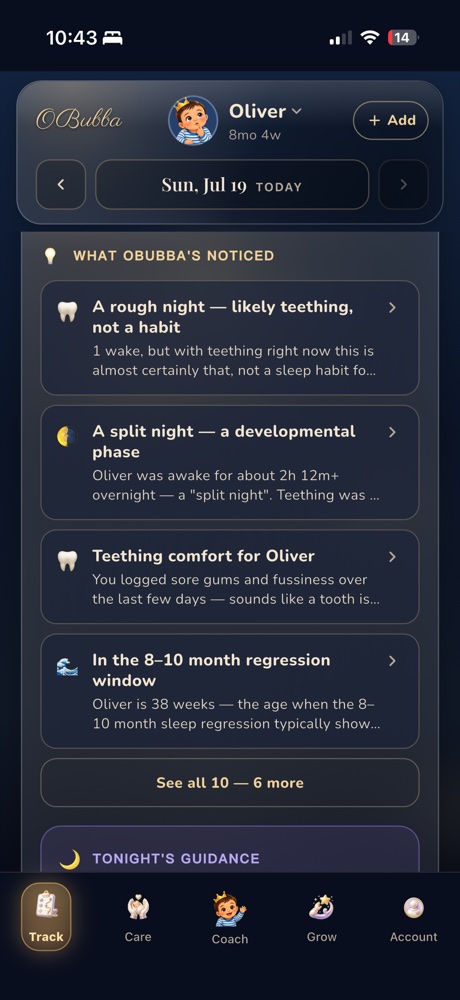
How the current OBubba app handles split nights
This guide reflects the app's actual night engine.
When a parent uses Night wake, the running night sleep pauses. On Resume, OBubba asks how the baby returned to sleep and stores the awake duration. That matters because an untimed wake is not evidence of a 90-minute wake.
The current safeguards include:
- a one-night split read needs either an explicitly timed wake of at least 60 minutes or a credible gap of at least 60 minutes between two sleep arcs
- when bedtime and wake position are available, the long wake must start more than 45 minutes after bedtime; a long wake near bedtime stays a false start
- an open pause or forgotten timer is not trusted as a multi-hour wake
- an inferred gap is ignored when another wake or feed was already logged inside it, which prevents the same wake being counted twice
- illness and other active disruptors can suppress schedule prescriptions
- wakes after midnight are reconstructed into the night they belong to, so the analysis does not lose the first sleep block at the date boundary
- the separate repeated-pattern insight needs at least two qualifying nights from up to seven observed nights and stays quiet below about 16 weeks
Once the wake is credible, the immediate night read checks the bedtime day's sleep, not the following day's naps. If day sleep was high, it may suggest trimming a little. If day sleep was low, it explicitly says do not cut it and protects rest. If the total is unknown or in range, it stays even-handed. Other OBubba views can place the final wake window, feeding, logged tummy discomfort, teething and development beside the sleep pattern as additional clues. They are not all inputs to the same split-night rule.
The screenshot shows the current app using fictional example data: a measured 2h12 overnight wake appears as a split night, while teething and developmental context remain visible as separate clues. Those cards are hypotheses from logged data, not diagnoses. The parent can open each explanation and decide whether it fits the baby they are holding.
Timing a night wake and seeing the immediate Track read are free. Deeper Guidance and Care → Sleep Consultant are Premium. The whole app is unlocked during pregnancy and through your baby's first two corrected-age months.
Make one long wake useful tomorrow →
A calm plan for the next 24 hours
If last night split in two:
- Do not punish today with a radically reduced nap schedule.
- Feed normally and check that your baby seems well.
- Record actual naps and the final awake period.
- Keep morning light and daytime activity ordinary for your baby's age.
- Choose bedtime from today's evidence, not last night's panic.
- Tonight, time the long wake only if it happens.
- After three representative nights, change one small lever.
A split night feels enormous while you are living through it. In the log, it becomes a specific interval with a before and after. That makes the useful question smaller: was this hunger, discomfort, a temporary disruption or a repeatable mismatch between sleep opportunity and this baby's current rhythm?
You do not need to solve the whole night at 2am. Keep it safe and responsive, then let daylight and several honest days of evidence choose the next move.
This article provides general information, not medical advice. Follow your baby's individual feeding and care plan and speak with a qualified health professional whenever sleep changes accompany feeding, growth, breathing, pain, fever or illness concerns.
Ready to try OBubba?
Use OBubba to track feeds, sleep, naps, nappies, growth, milestones and family handovers in one calm baby tracker app.