Once your baby is around six months and showing all three signs of readiness, they can explore a surprisingly wide range of ordinary family foods. There is no compulsory first food and no need to work through fruit before protein or purées before finger food.
The short answer is: a six-month-old can eat soft vegetables and fruit, iron-rich meat and pulses, cooked fish and egg, grains, and pasteurised full-fat dairy, prepared in a texture they can manage. Breast milk or first infant formula remains their main drink and still supplies most energy and nutrients at the beginning.
Start with a few teaspoons or pieces once a day, not three perfect meals. Include less-sweet vegetables and an iron-rich choice early, introduce common allergens one at a time in small amounts, and let your baby decide how much to eat.
This list gives you 34 practical possibilities, not a 34-item target.
Before food one: check readiness and posture
The NHS recommends starting solids at around six months, when these three signs appear together:
- Baby can stay sitting and hold their head steady.
- They can coordinate eyes, hands and mouth to look at food, pick it up and bring it to their mouth.
- They can swallow food rather than repeatedly pushing it back out.
Night waking, fist chewing, extra milk feeds and intense interest in your toast do not prove readiness. Starting solids is also not a reliable way to make a baby sleep through. Use our three-sign readiness checklist if you are unsure.
For every meal, sit baby upright in a stable highchair, fasten the harness and stay within arm's reach. A finger food should be soft enough to squash easily between your thumb and finger. Mashed food on a preloaded spoon, finger foods, or a responsive mixture of both are all valid; see our baby-led weaning versus spoon-feeding guide.
34 first foods for a six-month-old
These are the same 34 foods in OBubba's current app catalogue, grouped so you can build variety. Preparation matters more than the name of the food.
Nine vegetables
| Food | A safe early way to offer it | |---|---| | Sweet potato | Steam or roast until very soft; mash or offer a thick, adult-finger-sized wedge. | | Carrot | Cook until easily squashable; mash or offer a soft baton. Never offer a hard raw piece. | | Broccoli | Steam until soft; leave a long stalk as a handle for the floret. | | Parsnip | Steam or roast until soft; mash or cut into a thick baton. | | Butternut squash | Roast or steam; mash, purée or offer a soft wedge. | | Peas | Cook thoroughly and mash. Later, squash each pea rather than serving round peas whole. | | Courgette | Steam or sauté without salt until soft; offer a baton or mash. | | Avocado | Mash ripe flesh or offer a thick wedge; rolling it in a little ground oat can improve grip. | | Spinach | Cook well, chop or blend, then stir into another familiar food. |
Vegetables do not have to be disguised. Offering broccoli, spinach, courgette and other less-sweet flavours alongside sweeter choices helps baby meet a broader range of tastes.
Eight fruits
| Food | A safe early way to offer it | |---|---| | Banana | Mash, or offer a large ripe piece that baby can grip. | | Pear | Steam firm pear; very ripe, soft pear can be mashed or offered as a thick wedge. | | Apple | Stew or steam until soft, or finely grate it. Do not offer hard raw apple. | | Mango | Offer very ripe flesh mashed or as a large soft spear, with stone and tough skin removed. | | Blueberries | Cook into porridge or flatten each berry thoroughly. Never offer them round and whole. | | Strawberries | Mash, offer one large soft berry, or slice smaller berries lengthways. | | Peach | Use ripe soft flesh; remove the stone and any firm skin. | | Melon | Remove rind and seeds, then offer a large soft spear. |
Fruit is useful, but it need not dominate. Whole fruit is preferable to juice, which is sugary and unnecessary for a baby.
Eleven protein and iron-rich foods
| Food | A safe early way to offer it | |---|---| | Chicken | Cook through, then mince or shred finely into a mash; a large tender strip can be held and sucked. | | Beef | Slow-cook until tender, then mince, shred or blend with vegetables. | | Lentils | Cook until soft; red lentils make an easy thick dhal or mash without added salt. | | Salmon | Cook, flake finely and check meticulously for bones; fish is an allergen. | | Cod | Cook through, flake and check for bones; mash with potato or vegetables. | | Egg | Offer mashed boiled egg, soft scrambled egg or an omelette strip. Lion-stamped hen eggs may be lightly cooked; other eggs should be cooked through. | | Chickpeas | Cook until very soft and mash; use salt-free hummus only when sesame and any other ingredients are understood. | | Tofu | Mash silken tofu or offer a soft strip of firm tofu; soya is an allergen. | | Smooth peanut butter | Thin with warm water, milk or purée, or spread very thinly on toast. Never give a sticky spoonful. | | Turkey | Cook through and mince or shred finely into a moist mash. | | Sesame or tahini | Thin smooth tahini into yoghurt or purée, or spread it very thinly; sesame is an allergen. |
Iron-rich foods deserve regular space from around six months. Meat provides readily absorbed iron; lentils, chickpeas, tofu, peas and some fortified cereals contribute too. Pair plant sources with vitamin-C-rich broccoli, pepper, strawberry or fruit to support absorption. Our iron-rich first-food guide has more combinations.
Four grains
| Food | A safe early way to offer it | |---|---| | Baby porridge or oats | Cook until soft; offer on a preloaded spoon and gradually thicken the texture. Check labels for added sugar. | | Toast or bread fingers | Lightly toast and cut into wide fingers; choose a lower-salt bread. Wheat is an allergen. | | Pasta | Cook until very soft; large shapes are easy to hold, or mash smaller pasta into sauce. | | Rice | Cook until soft and combine with dhal or vegetables so it clumps onto a spoon. Cooked rice is fine; rice drink is not. |
Two full-fat dairy foods
| Food | A safe early way to offer it | |---|---| | Plain full-fat yoghurt | Offer unsweetened pasteurised yoghurt on a preloaded spoon or stir in fruit. Cow's milk is an allergen. | | Cheese | Grate pasteurised full-fat cheese or offer a soft strip; choose a lower-salt option. |
Cow's milk can be mixed into food from around six months, but it should not replace breast milk or first infant formula as the main drink before 12 months. Avoid unpasteurised milk and unpasteurised or mould-ripened soft cheeses because of food-poisoning risk.
How much should a six-month-old eat?
At first, a few teaspoons or a few pieces once a day is enough. The NHS emphasises that learning to eat matters more than quantity in the beginning. Some days baby may swallow several mouthfuls; on others they may lick, squash and drop everything.
Offer food when baby is awake and calm, not exhausted or frantic with hunger. Give enough time to explore. End the meal when they close their mouth, turn away, push food aside or become upset. Coaxing “one more spoon” overrides the useful skill of noticing fullness.
There is no need to replace a milk feed immediately. Continue breastfeeding responsively or offering usual first infant formula. From around six months, offer small sips of water with meals in an open cup or a free-flow cup without a valve. Our water-with-solids guide explains the balance.
A calm seven-day starting example
This is an example, not a meal plan or a race. Use foods your family eats, repeat tolerated tastes and move at your baby's pace.
| Day | Small tasting opportunity | Why it earns a place | |---|---|---| | 1 | Soft broccoli floret or sweet-potato wedge | One simple texture; a less-sweet vegetable is a useful start. | | 2 | Repeat the vegetable, plus soft lentil mash | Repetition plus an iron-rich food. | | 3 | A small amount of egg in a suitable texture | Introduces one common allergen when you can observe baby. | | 4 | Oat porridge with soft pear | A thicker spoon texture and a familiar fruit; note that oats may contain gluten. | | 5 | Smooth peanut butter thinned into a familiar purée | Introduces peanut safely, not whole nuts or a sticky spoonful. | | 6 | Tender minced beef or chicken with soft courgette | Another iron-rich option and savoury flavour. | | 7 | Plain full-fat yoghurt with mashed strawberry | Introduces dairy if it has not already been offered. |
Do not introduce egg, peanut and dairy together for the first time. If your baby misses a day or eats none of it, nothing has failed. Once an allergen has been introduced and tolerated, include it regularly as part of the usual diet rather than treating one taste as a completed checkbox.
Introducing allergens without panic
From around six months, allergenic foods can be introduced alongside other foods. The NHS advises introducing them one at a time so a reaction is easier to identify. Start with a small amount in an age-appropriate form, earlier in the day when your baby is well, and watch them.
Common allergens include egg, peanut and tree nuts, cow's milk, wheat and other gluten-containing cereals, fish, shellfish, sesame and soya. Whole nuts are not safe for young children; use finely ground nuts or smooth nut butter spread thinly or thinned into food.
If baby has diagnosed food allergy, eczema or a strong family history of allergy, speak to your GP or health visitor before introduction. Do not rub food on skin as an allergy “test”, and do not deliberately re-offer a food after a suspected reaction without professional advice.
Possible reactions can include hives, swelling, vomiting, cough, wheeze or worsening eczema. Swelling of the lips, face, tongue or throat, breathing difficulty, sudden floppiness or collapse can indicate a severe reaction: call 999. For symptoms that are not an emergency, stop the new food and seek medical advice. Our step-by-step allergen guide explains what to record.
Choking hazards: change the shape, not just the menu
Many nutritious foods become hazardous in the wrong form. The NHS advises avoiding hard foods such as whole nuts and raw carrot or apple, removing pips, stones and bones, and cutting small round foods such as grapes and cherry tomatoes into quarters.
Use these practical checks:
- cook hard vegetables and fruit until squashably soft
- flatten blueberries; quarter grapes and cherry tomatoes lengthways
- shred or mince tough meat and remove every fish bone
- spread nut butter thinly or dilute it; never give a sticky spoonful
- remove stones, hard pips, rind and tough skin
- keep baby sitting upright, supervised and still while eating
- learn infant first aid and know that gagging is different from choking
Gagging may be noisy, with retching and a tongue pushed forwards. Choking can be quiet because airflow is blocked. Read our gagging versus choking guide before the first meal; an article is not a substitute for practical first-aid training.
Foods and drinks to avoid or modify
The NHS foods-to-avoid guidance is a useful kitchen reference. At six months:
- no honey before 12 months, because of the risk of infant botulism
- no added salt or sugar; avoid stock cubes, gravy and very salty processed foods
- no whole nuts under five and no thick spoonfuls of nut butter
- no cow's milk as the main drink before 12 months, although it can be used in cooking
- no rice drinks under five; this is different from cooked rice
- no raw shellfish, shark, swordfish or marlin
- avoid unpasteurised milk and unsuitable soft cheeses
- avoid hard, round, sticky or tough pieces that have not been made safe
Juice, tea, coffee, herbal “baby drinks” and sugary drinks are unnecessary. Milk remains the main drink, with water sips at meals.
Make first foods from the meal you already cook
Weaning does not need a separate miniature menu. Before adding salt, stock or a sugary sauce, take out a small portion of the family meal and adapt its texture.
- A roast dinner can become shredded chicken, squashable broccoli and a soft potato wedge.
- A lentil dhal can be cooked without salt, then mashed or loaded onto a spoon.
- Porridge can be made soft and thick enough to stay on a preloaded spoon, with fruit mashed through it.
- Pasta can be cooked very soft and coated in a simple vegetable sauce.
- A jacket sweet potato can be scooped and mashed with chickpeas or plain yoghurt once those ingredients are tolerated.
Batch-cooking is useful, but label and cool food promptly, freeze in small portions, and reheat only what you need until steaming hot before cooling it to a safe temperature. Follow package storage instructions, pay particular attention to cooked rice, and discard food left in the bowl after baby's spoon or hands have been in it rather than saving it for later.
The aim is not culinary variety at every sitting. Repetition helps. A familiar broccoli floret alongside a new lentil mash can make the meal feel manageable for baby and gives you a clearer record than changing every ingredient at once.
Common first-food questions
Does my baby need teeth?
No. Gums can manage suitably soft foods. The squash test and baby's posture, coordination and swallowing skills matter more than the number of teeth.
Must I offer only one food for three days?
Ordinary non-allergenic foods do not need a rigid three-day wait. You can build variety gradually. Introduce a common allergen one at a time so any reaction is easier to trace, and avoid stacking several brand-new allergens into one meal.
Are pouches and jars bad?
They can be convenient, but they need not set the texture or flavour of every meal. Check the age, ingredients and sugar and salt information; squeeze a pouch into a bowl and use a spoon rather than letting baby routinely suck from the spout. Include ordinary home foods and progress beyond smooth textures as baby can manage them.
What if my baby refuses everything?
Refusal at one meal is not evidence that baby dislikes a food forever. Keep the portion tiny, eat together, allow touch and smell, and offer it again another day without pressure. The NHS notes that acceptance can take repeated exposure. If baby persistently coughs, chokes, seems in pain, cannot progress through textures, or growth is a concern, ask your health visitor or GP rather than trying to push through.
How OBubba turns the list into a usable next step
The real OBubba app includes a searchable First foods garden rather than a generic note page. It currently contains these 34 ideas and lets a parent search by food, standout nutrient or allergen, then filter vegetables, fruit, protein, grains, and dairy and eggs.
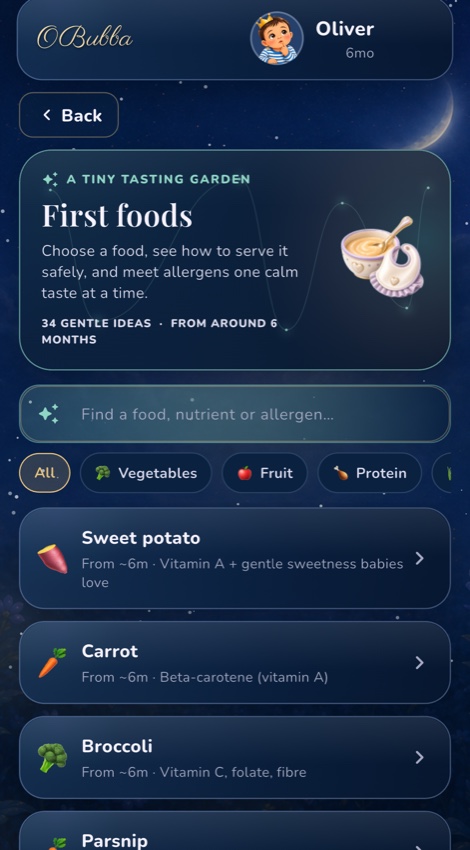
Open a food to see preparation guidance, a key nutrient, allergen information and live safety cross-checks. OBubba can also use foods already logged and allergens already introduced to suggest a varied next taste, interleaving new allergens with gentler familiar options and prioritising iron-rich ideas. Foods linked to a recorded reaction are not suggested.
That is planning support, not medical clearance. The app cannot assess swallowing, diagnose an allergy, verify that a piece is soft enough or replace your health visitor. Its job is to reduce the mental load: what was offered, what was tolerated, what needs care and what could come next, all alongside milk, water, nappies and sleep.
Choose a safe next taste with OBubba and keep the useful pattern without turning every taste into homework.
The simplest useful rule
You do not need a perfect schedule. Think soft, varied, iron-aware and responsive:
- start when baby is around six months and developmentally ready
- offer a few pieces or spoonfuls while milk remains central
- include vegetables, fruit, grains, full-fat dairy and iron-rich protein over time
- prepare every food for baby's current skill, not its healthy reputation
- introduce allergens one at a time in small amounts, then keep tolerated foods in rotation
- stop when baby shows they are finished
Thirty-four foods are possibilities, not pressure. One calm taste, repeated often enough to become familiar, is a good beginning.
This article provides general information for UK families and does not replace individual medical advice. Ask your health visitor, GP or dietitian about prematurity, growth, swallowing difficulty, eczema, known allergy or a restricted diet. Call 999 for breathing difficulty, tongue or throat swelling, sudden floppiness or collapse.
Ready to try OBubba?
Use OBubba to track feeds, sleep, naps, nappies, growth, milestones and family handovers in one calm baby tracker app.