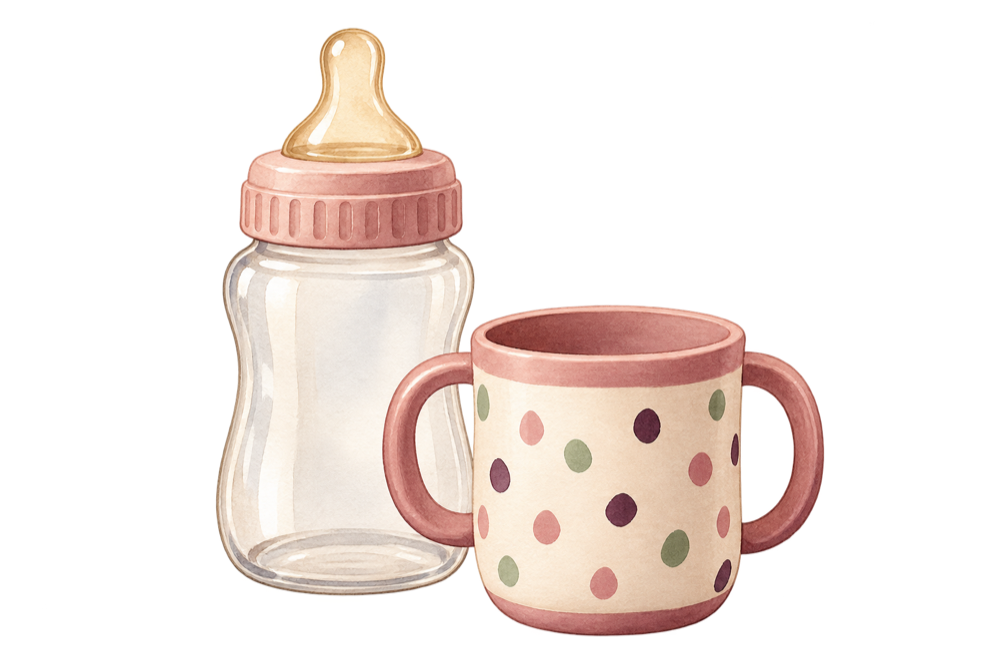
Your child is nearly one, but the bottle still works. Do you have to take it away on their birthday? No sudden switch is needed. The NHS recommends introducing an open or non-valved free-flow cup from around six months and discourages bottle feeding once a child is one. That is a direction to work towards, not a reason to withhold milk or turn a comforting feed into a battle.
The easiest place to begin is usually a relaxed daytime drink, not the bottle everyone relies on at bedtime. Keep offering a familiar drink and give your child time to learn what the cup does. Spills count as practice.
Change the container before you change everything else
Offer a small amount of your child's usual milk in an open cup or a free-flow cup without a non-spill valve. Sit with them while they drink and let them help hold it. You can model a sip from your own cup. If they turn away, stop and try another ordinary mealtime; do not make finishing the cup a condition of getting a drink.
Try that with one predictable daytime drink for a few days. When it feels familiar, offer another drink in a cup. You do not need to follow a seven-day timetable. If intake worries you, or your child is unwell, ask your health visitor or GP rather than persisting with a home-made deadline.
If your child has not started solids yet or is younger than 12 months, breast milk or first infant formula remains their main drink. Cow's milk is not a main drink before one. For a baby already starting solids, our water-and-first-cup guide covers those earlier months separately.
What goes in the cup after the first birthday?
From 12 months, the NHS says pasteurised whole or semi-skimmed cow's milk can be a main drink, alongside water. Breastfeeding can continue for as long as it works for you and your child. The NHS says first infant formula, follow-on formula and toddler milks are not needed after one; it does not say that breastfeeding must stop.
Milk choice may need individual advice if your child has a diagnosed allergy, uses a prescribed formula, follows a special diet, or has feeding or growth concerns. Do not swap a prescribed feed for cow's milk based on a general blog post. Your clinician or dietitian can help plan that change.
This is also a food transition. Your child may eat family meals in smaller, suitable pieces, with milk and water as their everyday drinks. The NHS over-12-month guide is a useful next read; our family-meal guide helps with the practical side.
If bedtime is the bottle that feels hardest
Keep the familiar parts of bedtime—same cuddle, book, song or quiet room—while you change one thing. You might offer milk in a cup earlier in the routine, then brush teeth, read the book and settle together. If your child has teeth, the NHS recommends brushing last thing at night and once more during the day.
Do not put a bottle in the cot for your child to drink alone or add cereal, sugar or sweet drinks to make a change feel easier. A cup switch is not a sleep-training method, and it cannot promise fewer night wakes. If your child still needs help with bedtime, you can work on the drink and the settling routine separately.
A tiny handover that helps
If two adults offer drinks, agree on just three facts: which cup you are trying, which daytime drink is the practice one, and what to do if it is refused. That keeps a gentle plan from becoming mixed messages.
In the current OBubba app, Care → Weaning & First Foods → Before you start → Water shows the cup guidance beside the wider milk-and-solids information. It is a reference to open together, not a cup-transition timer or a target for how much water your child must drink. If you still use bottles, Track → Feed → Bottle can keep the feeds you actually gave in the shared record; it does not claim to measure how well your child learned to use a cup.
If your child repeatedly coughs or struggles when drinking, is taking much less fluid than usual, has fewer wet nappies, or you are worried about growth, contact your health visitor or GP. Seek urgent medical advice if they seem dehydrated or seriously unwell. This article is general information, not an individual feeding plan.
A cup can become ordinary one calm drink at a time. If one shared place for feeds and first-food notes would make the handover lighter, explore OBubba. There is no need to make your child's birthday a pass-or-fail test.
Ready to try OBubba?
Use OBubba to track feeds, sleep, naps, nappies, growth, milestones and family handovers in one calm baby tracker app.