Yesterday you could put the washing away while your baby played. Today, one step towards the door brings a howl. Bedtime now includes a hand gripping your sleeve, and every night wake seems to ask the same question: Are you still there?
Sudden clinginess can be separation anxiety—a common developmental stage in which babies and toddlers become more aware of who makes them feel safe and protest when that person leaves. The NHS says it is common from around 6 months to 3 years, though it can appear outside that range or return during stress and change.
It is not proof that you have “made them dependent”, and responding warmly does not damage independence. But clinginess is not always developmental. Before blaming a leap, check ordinary needs such as illness, pain, hunger, teething, overtiredness and a disrupted routine.
What separation anxiety can look like
It may show up differently by day and night.
| During the day | Around sleep | |---|---| | Cries when you leave the room | Protests as the bedtime routine reaches goodbye | | Reaches to be picked up more often | Settles with one familiar person but not another | | Is wary of unfamiliar people | Wakes and becomes distressed when you are not immediately visible | | Follows you from room to room | Resettles with contact, then protests when put down | | Finds nursery or handover harder | Naps become harder away from home or with a different carer |
These signs can fit separation anxiety, but none is a diagnosis. A baby who cries when laid down may also be uncomfortable, hungry, unwell or simply not ready to sleep.
Why does it happen so suddenly?
Your baby is not going backwards. Their understanding of people, distance and absence is changing.
The NHS explains that separation anxiety appears as babies realise they are separate from the people who care for them and become more aware of how dependent they are on those familiar adults. As babies get older, they also become better able to understand that people and objects still exist when out of view.
That is why a previously easy goodbye can become emotionally loud. Your baby can care more clearly that you have gone before they can fully understand when you will return.
This is often described using the term object permanence, but development is not an on/off switch that flips on a particular week. Do not use a leap calendar as a countdown or assume every baby will become clingy at 8 months. Separation anxiety can come and go, intensify after illness or a change of carer, and look different across settings.
Why can separation anxiety disturb sleep?
Night waking is normal. Separation anxiety does not create every wake; it can change what happens after a baby surfaces between sleep cycles.
A baby who previously glanced around and resettled may now register your absence, call for you and become fully alert. At bedtime, the final step of the routine—the parent leaving—may become the hardest cue. During a nursery transition or family change, a baby may also seek extra connection at home.
Look for the whole pattern rather than assuming “more wakes equals separation anxiety”:
- the baby is also clingier or more watchful during the day
- protests cluster around goodbyes, put-downs or a parent moving away
- they settle when the familiar adult returns
- feeding, nappies and general wellbeing otherwise look usual
- no clear pain, illness or severe sleep-debt signal is present
If the only change is night waking, keep the list of possible causes open.
Rule out the ordinary things first
Before changing bedtime, ask five questions.
1. Could the baby be unwell or in pain?
Check for fever, breathing difficulty, unusual sleepiness, a different cry, feeding changes, drier nappies, vomiting, rash or other symptoms. Trust your instincts and seek medical help when something feels wrong.
Teething can overlap with this age, but do not use “teething” or “a leap” to explain away a baby who seems genuinely unwell.
2. Are they hungry?
Separation anxiety does not mean a young baby has stopped needing milk at night. Age, growth, daytime intake, feeding method and health all matter. Offer feeds responsively and do not begin night weaning simply because wakes increased during a clingy phase.
If night feeds are the question, use our night-weaning readiness checklist and speak to a health visitor, GP or feeding professional when intake or growth is uncertain.
3. Has day sleep collapsed?
An overtired baby may become more distressed at separation and wake more frequently. Compare recent naps with the baby's own usual pattern. A missed nursery nap, very long final wake window or repeated short naps may be a more practical explanation than development.
4. Has anything changed?
Think about starting nursery, a parent returning to work, travel, illness, moving rooms, a new carer or a run of unusual bedtimes. Normal separation anxiety can feel stronger when the world has recently become less predictable.
5. Is this happening only with one person or place?
A baby may be relaxed with a familiar grandparent but distressed at a new nursery, or happy at home and unsettled only at bedtime. That context tells you which transition needs more support.
A gentle daytime plan
The goal is not to stop your baby caring when you leave. It is to give them repeated, manageable experiences of separation followed by reunion.
Play “gone and back” games
Peek-a-boo, hiding a toy under a cloth and reappearing from behind a door turn absence and return into a safe game. Keep it playful; stop if the baby is overwhelmed.
Practise very short separations
Leave the baby with somebody they know well while you step away briefly, then return calmly. Build up gradually. The NHS is explicit that leaving a baby with another caregiver does not damage them.
Narrate small departures
Say what is happening in a simple, repeatable phrase: “I’m getting your cup. I’ll come back.” Letting a mobile baby follow when it is safe may also help them understand where you went.
Make goodbyes clear
Sneaking away can avoid the first cry, but it also removes the chance to learn the goodbye-and-return pattern. Use a short, warm goodbye and let the familiar carer take over.
Protect connection before separation
Five focused minutes can work better than 30 distracted ones. Get down on the floor, put the phone away, share a book or sing, then make the next transition.
A bedtime plan for the clingy phase
You do not need to redesign the entire routine. Keep the familiar anchors and change only the amount of support around the goodbye.
Step 1: Fill the connection cup before lights out
Add a few calm minutes of cuddling, a familiar story or a quiet song before the final sleep step. Keep this inside the routine so it feels predictable rather than an endless delay.
Step 2: Use the same short goodbye phrase
Choose something you can repeat without negotiating: “You are safe. It is sleep time. I love you. I’ll see you in the morning.” A younger baby will not understand every word, but the sound, order and return pattern become familiar.
Step 3: Choose a response you can repeat
Possible gentle options include:
- pausing briefly to see whether a small fuss settles
- returning for a calm voice and touch
- picking up to calm, then trying the cot again
- sitting nearby and gradually reducing your presence
There is no single correct method for every family. Choose the level of support that feels appropriate for your baby's age, temperament and feeding needs, then keep the response boringly predictable for several nights before judging it.
Step 4: Keep night interactions calm
Use low light, a quiet voice and minimal stimulation. Check the need, feed or comfort as appropriate, and return to the same sleep cue.
Step 5: Keep safer sleep rules unchanged
Clinginess is not a reason to add pillows, cot bumpers, loose blankets, soft toys or positioners to an infant's sleep space. The NHS advises that babies sleep in the same room as a parent for at least the first 6 months, day and night. Always follow current safer-sleep guidance for the baby's age and circumstances.
What to do when only one parent will do
The preferred parent does not need to disappear, and the other caregiver does not need to “win” a crying contest.
Try a bridge:
- both carers do the pleasant first half of the routine
- the preferred carer gives the usual cuddle and goodbye
- the other carer completes one small, predictable step
- repeat that division for several nights before adding another step
During the day, let the less-preferred caregiver own enjoyable, low-pressure routines—bath, breakfast, a walk or a particular song. Familiarity grows through ordinary repetitions, not one dramatic handover.
What is worth tracking—and what is not
You do not need to log every protest. Track enough to answer one question: is the problem mainly separation, sleep pressure, discomfort or a wider change?
For five to seven days, note:
- when clinginess happens: room exit, handover, bedtime or every setting
- nap end and bedtime, so you can see the final wake window
- night-wake time and whether the baby seemed distressed, hungry or ready to play
- what helped: voice, touch, pick-up, feed or another caregiver
- new symptoms, teething, medicines or temperature readings
- major changes such as nursery, travel or illness
- a newly practised skill such as crawling or pulling to stand
Skip a detailed entry when nothing new happened. “Cried when Mum left; settled with Dad after the usual song” is more useful than six taps describing the same five minutes.
How OBubba's actual app reads a clingy stretch
Open Grow, tap the development wave card, then choose Why right now?
The current screen is called Behaviour Explained. It does not ask you to select a prewritten diagnosis. Instead, it reads the family's existing context and may show one possible thread when the evidence fits.
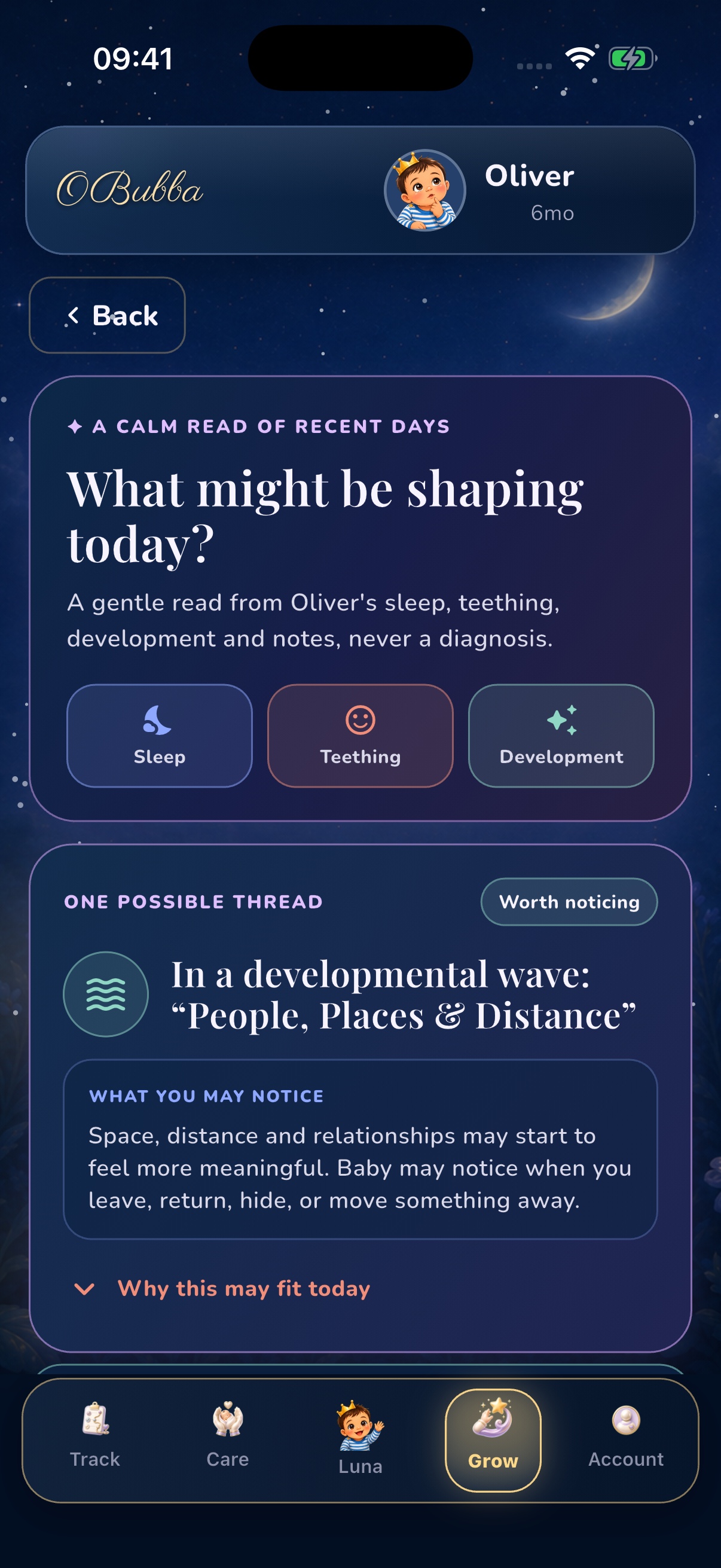
For a separation-anxiety possibility, the development engine looks for a relevant corrected-age window alongside either a recent night-wake increase or notes such as “clingy”, “cries when I leave” or “follows me”. It then shows the human evidence behind the suggestion—such as age, extra wakes and the parent's note—rather than hiding the reasoning.
The safeguards matter more than the label:
- a recent teething signal suppresses the separation interpretation
- very low recent day sleep can point to overtiredness instead
- an age window alone is not enough for the stronger separation card
- a wake is called “happy” only if the parent explicitly logged that mood
- broader disruption causes appear only after nights are genuinely disrupted
- the screen says “one possible thread” and “never a diagnosis”
OBubba can help you notice that clinginess, a changed night pattern and a developmental window overlap. It cannot see the baby, assess attachment, diagnose anxiety, confirm pain or promise the phase will end on a particular date.
Try OBubba free → — connect sleep, notes, teething, milestones and family context without turning a normal developmental wobble into a verdict.
When to ask for help
Speak to a health visitor if separation anxiety is causing a lot of distress, the child remains upset for a long time after you leave, it prevents them taking part in ordinary experiences such as nursery, or it continues intensely for more than a few weeks. Ask for help sooner whenever you are worried.
Seek prompt medical advice if the change comes with signs of illness, feeding problems, drier nappies, breathing concerns, unusual difficulty waking, persistent pain or another concerning symptom. A developmental explanation should never delay medical care.
Your wellbeing matters too. If repeated nights are making it hard to cope safely, ask somebody you trust to share the load and contact your health visitor or GP for support.
Quick answers
Does picking up a clingy baby make separation anxiety worse?
Comfort does not spoil a baby. You can respond warmly while still practising predictable, age-appropriate separations and allowing other familiar caregivers to build their own relationship.
Is separation anxiety the same as the 8-month sleep regression?
No. They can overlap, but “8-month regression” is a broad label for a period when separation, teething, motor skills, feeds and schedule changes may all affect sleep. Check the actual pattern rather than treating age as the answer.
Should I stop nursery until it passes?
Not automatically. The NHS says leaving a baby with another caregiver does not damage them. Use gradual familiarisation where possible, a clear goodbye and consistent communication with the key person. Seek advice if distress remains severe or prolonged.
How long does separation anxiety last?
There is no reliable countdown for one baby. It may come in waves across months or reappear around stress and change. NHS guidance describes it as common between 6 months and 3 years, although it can last longer.
Should I start sleep training during a clingy phase?
First rule out illness, pain, hunger and severe overtiredness. If the baby is well and the family wants to change settling support, choose a gradual, consistent method that fits the baby's age and your values. You do not have to make a major change during a difficult week.
Can separation anxiety cause more night feeds?
It can increase waking and the desire for contact, but a feed may still be genuine hunger. Do not remove feeds based on an anxiety theory alone.
Related guides
- A simple baby bedtime routine you can actually repeat
- What to track when your baby wakes at night
- Baby naps at nursery: a calm bedtime plan
- Why is my baby crying? A calm checklist
- Is my baby ready to drop a nap?
- Baby milestones by age: a calm first-year guide
Sources and further reading
- NHS: Separation anxiety
- NHS: Helping your baby to sleep
- NHS: Sleep and young children
- NHS Best Start in Life: Understanding your baby
- The Lullaby Trust: Keeping a clear cot
OBubba supports parent-entered tracking, routines and developmental context. It cannot diagnose separation anxiety, illness, pain, sleep disorders or attachment concerns, and it does not replace a health visitor, GP, paediatric team or emergency service.
Ready to try OBubba?
Use OBubba to track feeds, sleep, naps, nappies, growth, milestones and family handovers in one calm baby tracker app.